The New Default. Your hub for building smart, fast, and sustainable AI software
Scalable Architecture Design
Upfront decisions about boundaries and data flow that determine whether a system can grow by adding hardware or needs a rewrite.
What Is Scalable Architecture Design?
Scalable architecture design is the practice of structuring a software system so that its capacity can grow by adding resources. It is a design discipline concerned with where components sit and how data is distributed across them: the decisions made before implementation that determine whether a system can scale at all.
Scalability describes a system property. Scalable architecture design is the work of producing it. The distinction matters because most limits on scale are set by early structural decisions: where a transaction boundary sits, or how data is keyed. These choices are cheap to make correctly at design time and expensive to change once a system carries production data.
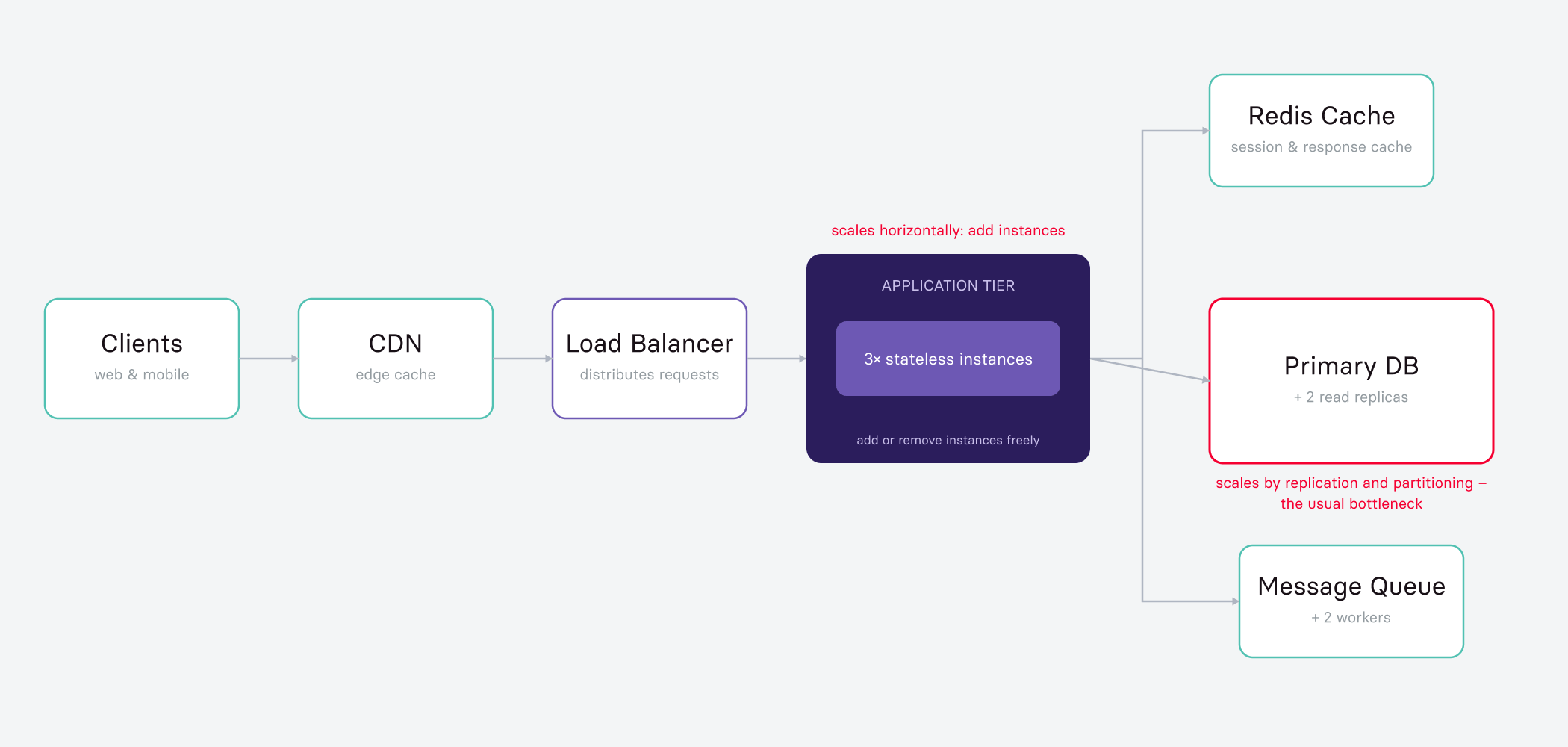
The discipline is fundamentally about identifying the component that will saturate first and designing so that it can be replicated or divided. Every system has such a component. Architecture determines whether it is a shared database that cannot be split, or a stateless service tier that can be duplicated at will.
Why Is Architecture Design Worth the Investment?
Architectural decisions have the longest half-life of any technical choice. Application code is rewritten continuously; architecture persists, and the cost of changing it rises with every customer added.
Strategic Advantage: Sound architectural design preserves optionality. A system with clear component boundaries can be scaled selectively or extracted into services as commercial circumstances change. A tightly coupled system forecloses those options, and the constraint eventually appears in the product roadmap as work that cannot be estimated.
The Problem It Solves: It prevents the rewrite. Reewrites consume 1 to 2 years of engineering capacity and deliver no new customer value during that period. Most rewrites trace back to a handful of structural assumptions that were reasonable at launch and unsupportable at scale.
How Does Scalable Architecture Design Work?
The process is to locate limits and design them out, guided by expected load.
Establishing load characteristics. Design begins with numbers: expected users, read-to-write ratio, data volume growth, peak-to-average traffic ratio, and acceptable latency. A read-heavy system with a hundred-to-one read ratio and a write-heavy system with the same total volume require different architectures.
Choosing a scaling dimension. Systems are commonly scaled by running more copies of the same service, or by splitting into functionally distinct services that scale on their own. Most mature architectures use all three, applying each where it fits.
Designing for statelessness. Services that hold no request-specific state can be replicated without coordination. State is deliberately pushed to components designed to manage it, which concentrates the hard problems in a small number of places.
Selecting a data distribution strategy. This is usually the decisive decision. Options include read replicas for read-heavy loads and horizontal sharding by a partition key, with vertical partitioning by domain as a lighter first step. Choosing a shard key that distributes load evenly and rarely requires cross-shard queries is among the highest-leverage design decisions available.
Placing asynchronous boundaries. Separate operations that don't need to be synchronous with queues or event streams. This lets components scale independently and absorb load spikes.
Deciding consistency requirements per operation. Financial transactions need strong consistency; a follower count does not. Applying strict consistency uniformly across a system limits scale unnecessarily, so requirements are specified operation by operation.
Defining failure behavior. The design specifies what happens when a dependency is slow or unavailable: timeouts, retries with backoff, circuit breakers, and fallbacks. In a distributed system, partial failure is normal.
Which Patterns and Tools Support Scalable Architecture?
Architectural patterns: layered monolith, modular monolith, service-oriented architecture, microservices, event-driven architecture, CQRS, event sourcing.
Communication: REST and gRPC for synchronous calls; Kafka, RabbitMQ, Amazon SQS, and Google Pub/Sub for asynchronous messaging.
Data layer: PostgreSQL with logical replication and declarative partitioning, Vitess for MySQL sharding, CockroachDB and Spanner for distributed SQL, DynamoDB and Cassandra for partitioned key-value and wide-column workloads.
Infrastructure: Kubernetes, Terraform, service meshes such as Istio or Linkerd for traffic management between services.
Design documentation: architecture decision records, C4 model diagrams, and capacity models that state expected load explicitly.
What Are the Key Characteristics of Scalable Architecture Design?
Explicit component boundaries. Each component has a defined responsibility and a documented interface. This allows it to be scaled or replaced without coordinated changes across the system.
Deliberate placement of state. State lives in components chosen to hold it, and nowhere else. Incidental state in application memory or on local disk is the most common obstacle to horizontal scaling.
Independent scalability of components. A reporting workload and a checkout workload can be given different amounts of capacity, because they are not bound into the same deployment unit.
Loose coupling through defined contracts. Components interact through stable interfaces or message schemas, so internal changes stay internal.
Failure isolation. A degraded component affects the functionality that depends on it and not the entire system, achieved through timeouts, bulkheads, and circuit breakers.
Documented decisions with stated assumptions. Architecture decision records capture what was chosen and the load assumptions behind it. This lets a future team know when a decision has expired.
What Are the Benefits of Scalable Architecture Design?
Growth handled by provisioning. When architecture anticipates scale, responding to a tenfold traffic increase is a capacity exercise measured in hours, not an engineering program measured in quarters.
Targeted infrastructure spend. Independently scalable components mean money goes to the parts of the system under pressure. Monolithic deployments force over-provisioning of everything to satisfy the requirements of one hot path.
Faster delivery as the team grows. Clear boundaries let multiple teams work in parallel without constant coordination. Architecture that lacks them causes engineering throughput to flatten as headcount rises.
Higher availability. Component isolation and redundancy, introduced for scale, also limit the blast radius of individual failures. One slow dependency degrades one feature instead of the whole product.
Credible technical due diligence. Investors and enterprise buyers examine architecture. A documented design with explicit scaling paths shortens diligence and removes a category of procurement objections.
What Are the Challenges and Trade-offs of Scalable Architecture Design?
Complexity has a permanent operational cost. Every service boundary adds deployment, monitoring, and debugging work. A distributed architecture adopted before it is needed slows a team down indefinitely.
Over-engineering is the common failure mode. Microservices adopted at ten thousand users impose coordination overhead far exceeding any benefit. Starting with a modular monolith and extracting services when boundaries prove themselves is usually the better sequence.
Design depends on load estimates that may be wrong. Architecture is chosen against assumptions about future traffic and data volume. Wrong assumptions produce a system optimized for a shape of load that never arrives.
Distributed systems make consistency and debugging harder. Reasoning about a request that crosses six services requires distributed tracing and a tolerance for eventual consistency that single-process systems never demand.
The skills are scarce. Architects who have operated systems at scale are difficult to hire, and the consequences of inexperienced design surface years later.
Should I Scale Vertically or Horizontally?
Factor | Vertical Scaling | Horizontal Scaling |
Method | Increase one machine's resources | Add more machines behind a balancer |
Ceiling | Largest instance available | No practical architectural limit |
Application requirements | None; works with any design | Stateless tier, distributable data layer |
Downtime to scale | Usually requires a restart | None; instances join and leave |
Cost profile | Rises steeply at the high end | Roughly linear |
Failure tolerance | Single point of failure | Redundancy is inherent |
FAQ About Scalable Architecture Design
Need expert help with Scalable Architecture Design?
Monterail builds custom software solutions that leverage the latest technologies. Let's discuss how we can help with your project.
GET IN TOUCHGET IN TOUCH