The New Default. Your hub for building smart, fast, and sustainable AI software
Software Development Outsourcing
Handing the build or upkeep of your software to an outside company, while you keep ownership of the product.
What Is Software Development Outsourcing?
Software development outsourcing is hiring an external company to build or maintain software that an organization would otherwise develop in-house. The vendor supplies engineers, and often design and project management. Work runs under a project-based, dedicated team or staff augmentation model. The client keeps ownership of the product and its code.
Monterail has delivered 900+ projects since 2010 from its base in Wrocław, Poland. For Flink, its team grew from two to eleven engineers as the grocery delivery startup scaled to 10 million customers.
What Does Software Development Outsourcing Include?
Software development outsourcing can cover any stage of the product lifecycle, from scoping a new product to maintaining one that is already live.
What it includes
Discovery and scoping, including estimates for the work
Product design: user research and UX/UI design
Web, mobile, backend, and AI development
QA and testing, from regression to smoke testing
Project and delivery management
Code review and audits of an existing codebase
Maintenance and new features after launch
Documentation and knowledge transfer when the engagement ends
What it doesn't include
Product ownership and business decisions, which stay with the client
Hosting fees and third-party licenses, which the client pays directly
Legal accountability for the product, which stays with the company that runs it
Permanent hiring: the vendor's engineers stay on the vendor's payroll
When Does Software Development Outsourcing Fit?
Software development outsourcing fits when you need delivery capacity or skills faster than you can hire them.
It fits when
A funded product has to launch on a deadline your current team can't meet
You need a skill set, such as AI or mobile, that isn't worth a permanent hire
A key engineer left, and a delivery gap has opened
Your team should stay focused on the core product while a partner builds a separate app or module
It doesn't fit when
The software is your core intellectual property, and you want every engineer on staff. Building an in-house team is the better long-term investment.
Nobody on your side can act as product owner. Without one, priorities drift, and the vendor fills the gap with guesses.
The need is a single, short fix that a freelancer or your own team can handle with lower overhead.
You expect cost savings alone to justify it. The cost-versus-risk case shows why access to expertise matters more.
What Are the Benefits of Software Development Outsourcing?
The main benefit is access to a working team and its experience without the time and cost of hiring one.
Faster start. A vendor's existing engineers can start within weeks, without a recruiting cycle.
Skills on demand. Specialists such as AI engineers or Go developers join for as long as the project needs them.
Capacity that flexes. Team size can grow or shrink with the roadmap.
Delivery experience. A partner that has shipped many similar products brings tested practices for estimation and QA.
Focus for your team. In-house engineers stay on the core product while the partner handles a separate stream.
How Does Software Development Outsourcing Work?
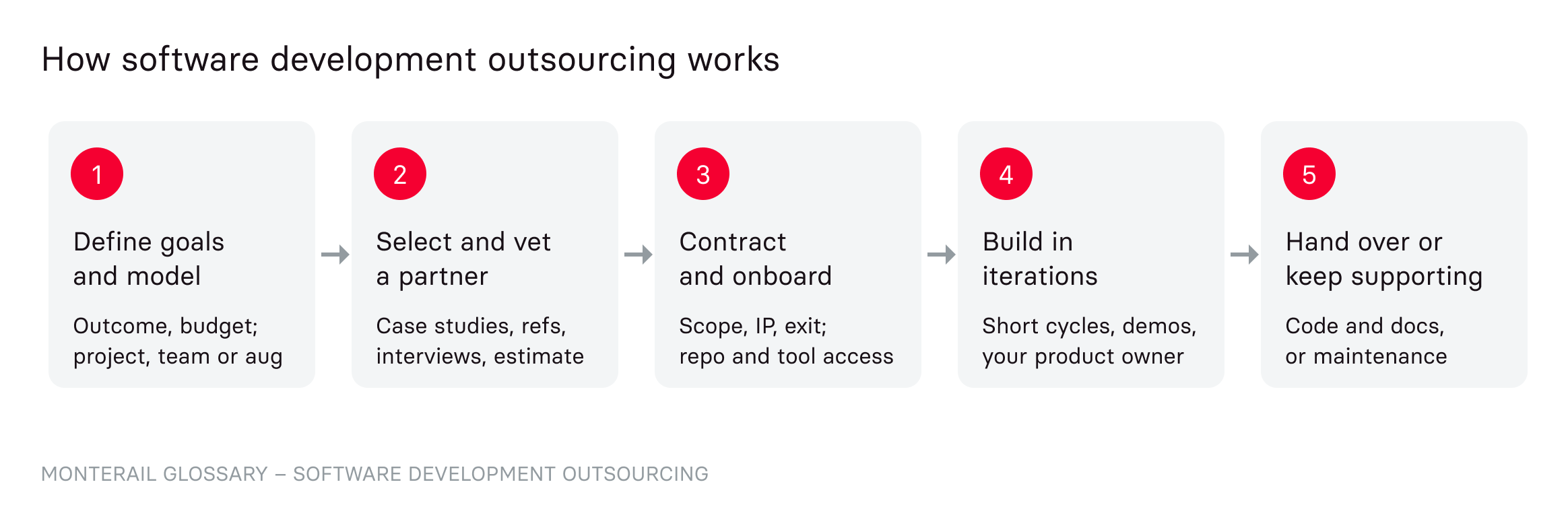
Software development outsourcing runs in five steps, from choosing an engagement model to handover or long-term support.
Define goals and the engagement model. The client sets the outcome and the budget. Then it picks a model: a project with a defined scope, a dedicated development team, or individual specialists through staff augmentation.
Select and vet a partner. Compare shortlisted vendors on case studies, references, technical interviews, and their scoping process. A detailed estimate is a good sign the vendor understood the brief.
Contract and onboard. The contract sets scope, pricing, IP assignment, and exit terms. Onboarding gives the team access to repositories and tools, plus the product context.
Build in iterations with reviews. Work ships in short cycles with regular demos. The client's product owner reprioritizes the backlog as feedback comes in.
Hand over or keep supporting. At the end, the vendor hands over code and documentation. Alternatively, the engagement continues as maintenance and new feature work.
Should You Outsource Software Development or Build an In-House Team?
Outsource when you need capacity or specific skills within weeks, and build in-house when the software is a long-term core asset you want fully staffed. A hybrid setup combines both: a core in-house team plus a partner for specific streams.
Factor | Outsourcing | In-house team |
Time to start | Weeks, with a vendor's existing engineers | A full recruiting cycle, then onboarding |
Access to skills | A vendor's whole bench, including niche specialists | Limited to the people you hire |
Control | Shared: you set priorities, the vendor runs delivery | Full control of people and process |
Cost structure | Vendor rates or project fees, with no hiring costs | Salaries, benefits and recruiting costs |
Knowledge retention | Depends on documentation and handover | Stays inside the company |
Scaling | Add or release people within weeks | Slow to grow and costly to shrink |
Challenges to plan for: Outsourced knowledge leaves with the vendor unless the contract requires documentation and a handover. Your product owner also needs time for every demo and backlog review.
How Does Monterail Approach Software Development Outsourcing?
Monterail sizes the team to the client's needs and changes it as the product grows.
Flink, a German quick-commerce startup, needed a production-ready backend fast. Monterail started with an expert code review in Go and then broke the checkout and cart monolith into microservices. Its team grew from two to eleven developers and QA engineers. Flink scaled to 10 million customers in 60 cities across four countries.
ZebPay, a cryptocurrency exchange with 5+ million users, needed its 2014 Angular web app rebuilt. A six-person Monterail team started within 15 days and rewrote it in React in six months.
GiveDirectly chose Monterail after "a rigorous vetting process" and rebuilt its donation flow in four months. The client credits Monterail's detailed scoping and estimation for completing the project under budget.
When Should You Bring In a Software Development Outsourcing Partner?
A partner helps when your roadmap needs more people or skills than your hiring plan can deliver in time. It also helps when you need a team that has built similar products before, so you skip the learning curve.
If you need individual engineers inside your own team, Monterail's IT staff augmentation services add them. For a full product team, see Monterail's software development services. For costs and talent in Poland, see outsourcing software development to Poland.
Talk to our team about what you want to build.
FAQ About Software Development Outsourcing
Need expert help with Software Development Outsourcing?
Monterail builds custom software solutions that leverage the latest technologies. Let's discuss how we can help with your project.
EXPLORE WEB DEVELOPMENT SERVICESEXPLORE WEB DEVELOPMENT SERVICES