The New Default. Your hub for building smart, fast, and sustainable AI software

Table of Contents
Data pipelines rarely fail with a bang. More often it is 2 a.m., a PagerDuty buzz, and the realization that the ingest job died again because a data provider quietly swapped commas for pipes overnight.
A self-healing data pipeline promises to change this. It detects the failure, reasons about the root cause, proposes a fix, and opens it for review, even before anyone has opened a laptop to see what's happening.
This is what agentic AI for data engineering makes possible: pipelines that repair their own common breakages while keeping engineers in charge of the outcome.
That 2 a.m. story is one data engineer, Benjamin Nweke, tells about his own pipeline. His fix took thirty seconds, but the real cost was the interrupted sleep and a brain that refuses to work at that hour.
Sometimes it's worse, because nothing visibly breaks at all. As data consultant Tony Ojeda puts it, "data pipelines break in quiet ways. A schema changes upstream. A connector drops a field. A dbt model references a table that no longer exists. The data keeps flowing, but the numbers are wrong, and nobody notices until a stakeholder asks why the dashboard looks off."
The software you ship is only as smart as the data behind it, and most pipelines are built on a false assumption that incoming data will keep its shape. Traditional ETL and ELT encode that assumption as static rules. The moment an upstream schema, format, or API changes, the rules stop matching reality, and something breaks.
Executive Summary
Traditional ETL and ELT pipelines are brittle because they assume data never changes shape; the moment a source renames a column or an API shifts, the rules break and engineers firefight. Agentic data engineering replaces those static rules with systems that observe, diagnose, and repair failures on their own, while routing every proposed change through human pull-request review.
Teams adopting the pattern report resolution times dropping from hours to minutes and engineers reclaiming days otherwise lost to maintenance. The approach is production-ready for common, well-scoped failures such as schema drift, bad type casts, and broken joins, but it demands real guardrails around cost, data privacy, and oversight.
What follows is how the pattern works, where it earns its keep, and where it still needs a human.
What Is the Cost of Pipeline Maintenance Debt in 2026?
The quiet failures add up to a loud bill, and data teams have been paying it for years, mostly in time. A Monte Carlo survey found data engineers spend around two days a week firefighting bad data rather than building anything new.
It is not getting better. Monte Carlo's 2023 follow-up reported organizations averaging 67 data incidents a month, each taking roughly 15 hours to resolve, a 166% jump in resolution time year over year. On average, 31% of revenue was exposed to data-quality issues. 74% of the time, business stakeholders spotted the problem before the data team did. The dashboard looked off, and someone downstream noticed first.
Put a currency figure on it and the picture sharpens. Some estimates show that poor data quality costs organizations an average of $12.9 million a year. Much of that is invisible: rework, wrong decisions, and eroded trust in the numbers.
None of this comes from catastrophic events. As Cloudera's Pamela Cárcamo notes in a talk on agentic data engineering, "most pipeline failures aren't actually caused by catastrophic events. They're caused by much smaller issues, schema drifts, missing fields, or downstream dependency changes."
Each one triggers the same reactive loop: stop what you are doing, dig through logs, patch the code, rerun the pipeline, repeat. Multiply that across a growing estate of pipelines and you get what Cloudera calls a "reactive culture," where expensive engineering talent stays stuck in firefighting mode while SLAs slip.
At many enterprises, a large share of data-engineering time now goes to maintaining existing pipelines rather than building new ones. That is the maintenance debt, and it compounds every time a source changes.
How to Go from Static Rules to Reasoning-driven Pipelines
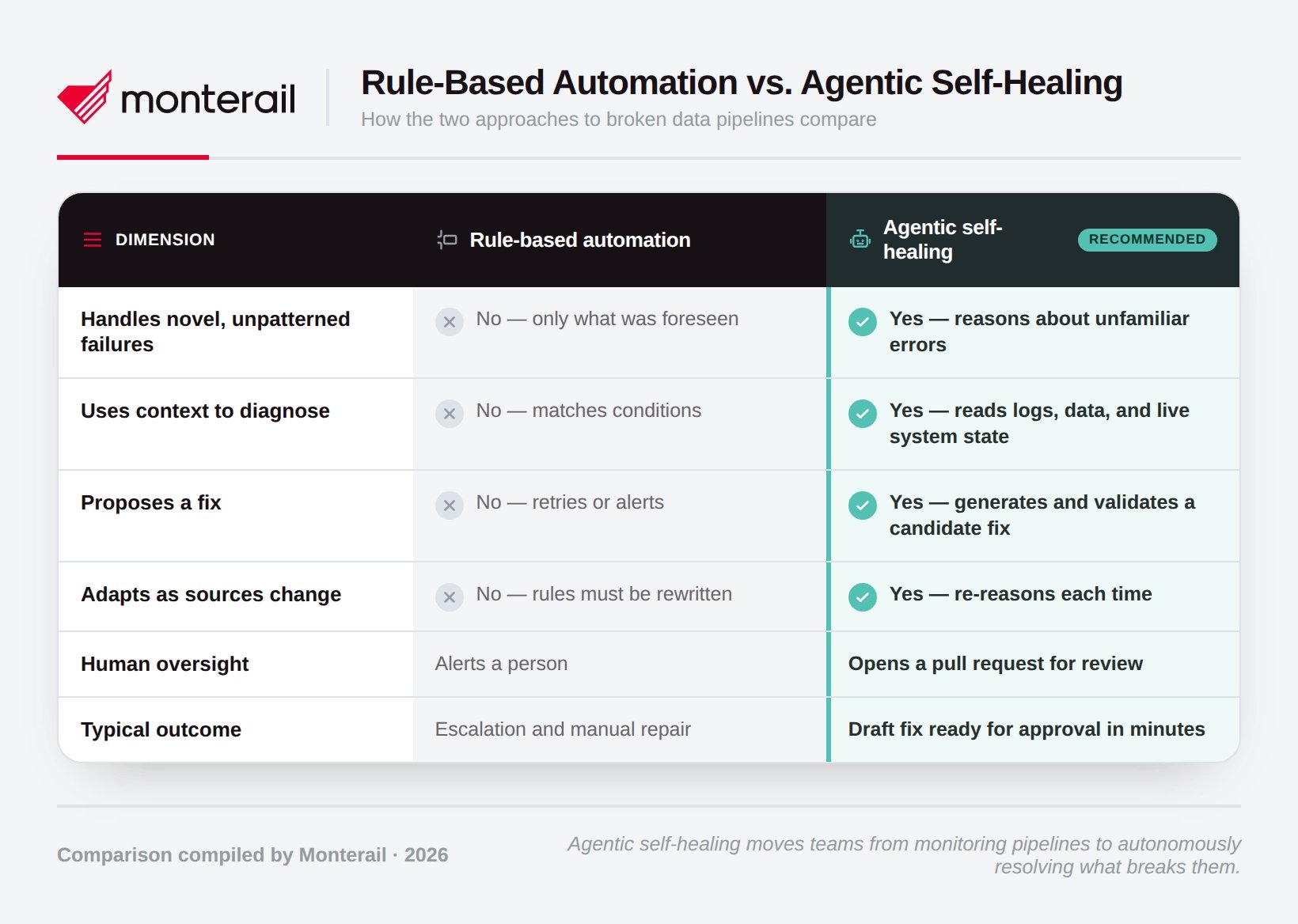
The instinct is to fix brittleness with more automation. But traditional automation is exactly what keeps breaking. Rule-based automation executes predefined steps on predefined conditions.
It is excellent at modularizing repetitive work and useless the moment a failure falls outside its rules. Many failures in data pipelines simply don't follow any patterns. Hardcoded or rule-based automations often end up requiring more human intervention. A rule can retry a job. It cannot read a stack trace, notice that customer_id should have been account_id, and rewrite the query accordingly.
An agent observes what is happening, works out what to do across multiple systems, takes action, and adapts when conditions change. It moves a team beyond monitoring pipelines to autonomously resolving what breaks them.
Here is how the two approaches compare.
What is striking is how consistently the same shape appears across otherwise unrelated implementations. Whether the stack is the Claude Agent SDK, LangGraph orchestrating a Spark repair, GitHub Agentic Workflows over dbt and Airflow, or a lightweight n8n and OpenAI loop for CI/CD, the repair loop is the same:
Detect the failure the moment it happens.
Gather evidence, not just an error string, but the logs, the offending data sample, and the live state of the system.
Diagnose the root cause and classify whether it is actually fixable in code.
Propose a minimal fix.
Validate that fix against hard checks before it goes anywhere.
Hand it to a human for review, usually as a pull request.
The interesting engineering is the discipline. Gathering good evidence, refusing to trust the model blindly, keeping a person in the loop - this is what turns a clever demo into something you would run in production.
What Happens When an AI Agent Catches an Upstream Change
Consider the failure mode at the heart of the brittle-pipeline problem, when something upstream changes without warning. A source column gets renamed, or an API starts returning a different structure.
The break looks familiar. A transformation job that expects order_status_v2 suddenly finds the column gone, because someone renamed it at the source, and in one expert's dbt-based pipeline everything downstream fails. In another example, a job crashes because it queried customer_id when the schema actually offers account_id.
The evidence is where good design separates itself from log-dumping. The pipeline collects structured "crime-scene evidence." dbt is particularly well suited here because it emits machine-readable artifacts by design: a results file naming the exact node that failed and why, a manifest describing the full dependency graph, and the compiled SQL showing the precise query the warehouse rejected. These are diagnostics designed for programmatic analysis.
An evidence collector can also query the warehouse live, checking which schemas exist, which tables are present, and which permissions are active, so the agent reasons from facts about the current state rather than guesses parsed from an error message.
Then comes the diagnosis. A read-only research agent investigates: it reads the failed node, traces the dependency graph to see whether the real cause is upstream, and produces a structured root-cause analysis. It also decides whether this is even the right kind of problem to fix in code. If the source database is simply down, there is nothing to patch, and a well-built agent stops at diagnosis rather than inventing a workaround.
For issues it can fix, a separate resolution agent takes over, cloning the repository into a disposable workspace, making a minimal change such as renaming the column reference or adjusting the mapping, and validating it against hard gates like dbt parse, compile, and SQL linting before anything is proposed. This requires judgment, and intelligent, context-aware reasoning rather than blind string replacement.
Finally, the handoff. The agent does not push to production. It opens a draft pull request, and a data engineer reviews and merges. If they request changes, a revision agent can incorporate the feedback and push an updated commit.
The payoff is resolution time falling from hours down to just minutes, with engineers freed from log-diving to do the work only they can do. The pipeline heals, and the humans stay in charge.
What Does It Take to Do It Responsibly: Guardrails, Cost, and Honest Limits
The gap between an impressive demo and a system you trust with production data is filled entirely with guardrails, and this is the part worth slowing down for.
Start with keeping a human in the loop. Every serious implementation here stops short of letting the agent change production on its own; it opens a draft pull request, and a person reviews and merges.
The agent might be confident about a fix, but that doesn't mean the fix is correct. Closely related is separating reading from writing. The architecture might need to enforce a clean split, where the research agent can query data and read code but cannot modify anything, while the resolution agent can write code but only inside a disposable workspace behind hard validation gates. That boundary limits how much damage an over-eager agent can do.
Cost is the next concern, because every failure that triggers an agent is an API call. A bad deploy breaking 100,000 files at once could produce a very nasty surprise on your bill. You need a circuit breaker or a local model. For example, $0.75 per investigation and $0.25 per fix, with a hard cap of $50 and ten issues per run before the rest wait for the next cycle.
Data privacy is just as important. If the agent samples raw data to diagnose a problem, that sample leaves your environment. You don't send patient data to Claude just to fix a comma error. For regulated industries, a locally hosted model is the responsible default. Finally, alert tuning matters more than it sounds. One expert's biggest source of false alarms disappeared once fixed staleness thresholds gave way to adaptive ones, so a table that updates daily is flagged after two days and a weekly table not until day fourteen.
Agents also have clear limits. They correctly stop at diagnosis when a source is simply offline, but they struggle when output is wrong yet no check fails, in situations with business logic ambiguity.
They can also misread cascading failures, patching a downstream symptom when a single upstream cause, such as a missing permission, is the real culprit. An agent should not hallucinate a way to load data that should have failed. Self-healing is an assistant that still answers to a human, not an autopilot.
Key Takeaways
Brittleness is a data problem, not a code problem. Rule-based ETL/ELT assumes incoming data keeps its shape, so schema drift and format changes break it by design.
The cost is mostly hidden. Data teams lose around two days a week to firefighting, incidents average 15 hours to resolve, and Gartner puts the average annual cost of poor data quality at $12.9 million.
The repair loop is consistent across stacks. Detect, gather structured evidence, diagnose, propose a minimal fix, validate, and hand to a human, whether the tooling is the Claude Agent SDK, LangGraph, or GitHub Agentic Workflows.
Guardrails are the real engineering. Read-only versus write-capable agent separation, hard validation gates, draft-PR-only handoffs, cost caps, and local models for sensitive data are what make it production-safe.
It is an assistant, not an autopilot. Agents excel at well-scoped fixes like column renames and bad casts, but stop short on source outages, ambiguous business logic, and cascading failures.
Is This the Era of Resilient Data Engineering?
It seems like we're entering a new era of data engineering, one that's less about building pipelines and more about managing intelligent systems that handle those pipelines.
The pipeline becomes something that watches itself, explains itself, and repairs the small, common breakages before they reach a dashboard, while the engineers who own it move up the value chain.
For teams building data-heavy products, that is the real opportunity in agentic data engineering. It retires the 2 a.m. wake-up call and the reactive culture it breeds, and it frees engineers to build.
At Monterail, we know that software is only ever as dependable as the data flowing beneath it. If you are weighing what these patterns could mean for your own pipelines, that is a conversation worth having.
Self-healing data pipelines FAQ

Maciej Korolik
Senior Frontend Developer and AI Expert at Monterail

Maciej is a Senior Frontend Developer and AI Expert at Monterail, specializing in React.js and Next.js. Passionate about AI-driven development, he leads AI initiatives by implementing advanced solutions, educating teams, and helping clients integrate AI technologies into their products. With hands-on experience in generative AI tools, Maciej bridges the gap between innovation and practical application in modern software development.