The New Default. Your hub for building smart, fast, and sustainable AI software
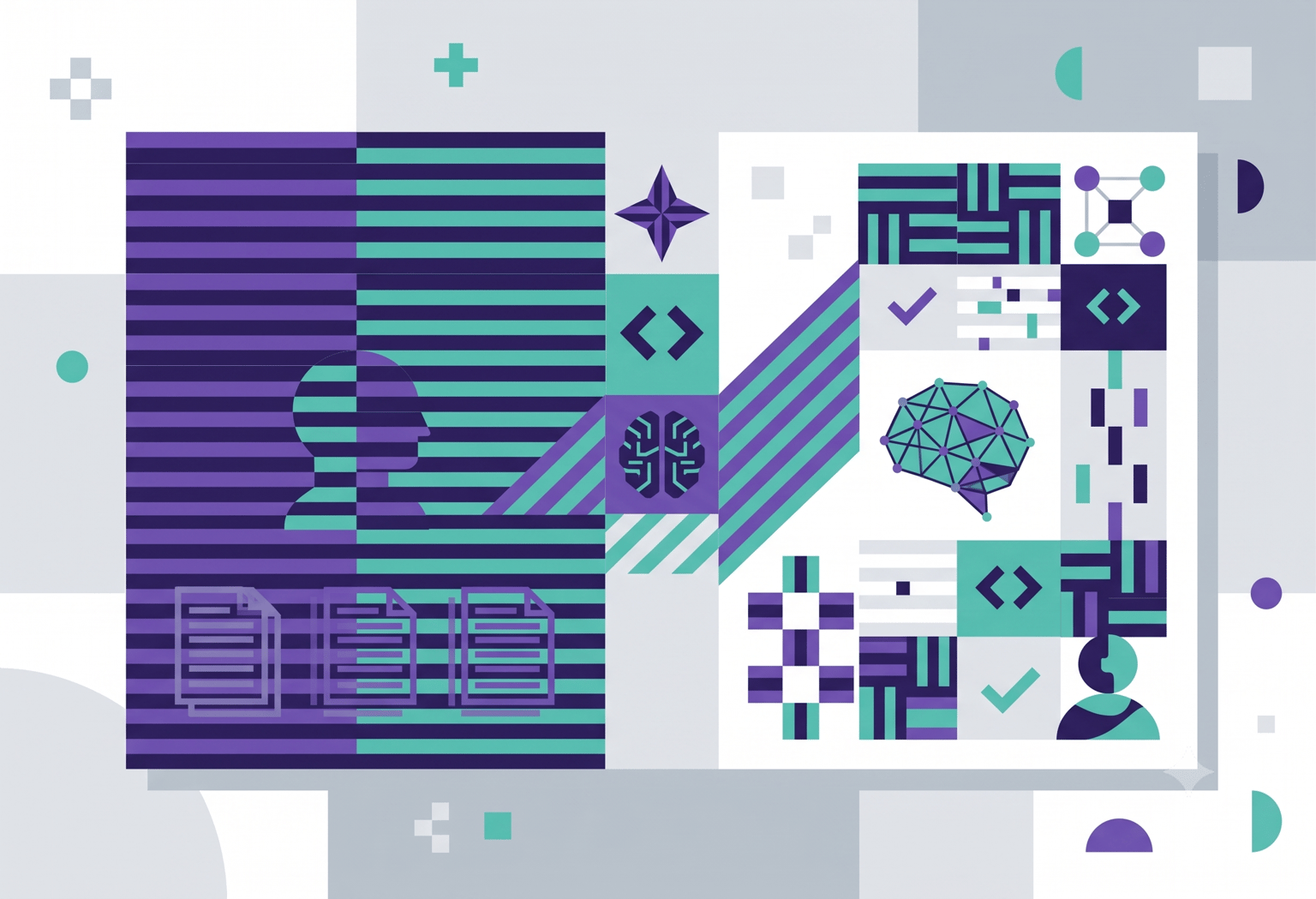
Table of Contents
Executive summary
Yes, AI can modernize legacy systems, but not the way the demos suggest. You cannot drop a mainframe into a model and collect a clean modern application on the other side.
What works is narrower and more useful: AI as an accelerator inside a disciplined, target-driven migration process.
From what we’ve seen in practice, that approach moves roughly three to four times faster than a hand-written rewrite, while keeping engineers in control of every change. This article lays out how that actually works, what it costs, and what has to be true before you start.
The systems most businesses depend on were written decades ago by engineers who are now retiring, and the bill for ignoring them is coming due in maintenance cost, security exposure, and regulatory pressure.
Generative AI changes the economics of fixing this, because it is unusually good at reading unfamiliar code, mapping dependencies, and translating from one language or framework to another.
The catch is that the gains come from engineering discipline, not from the model alone. Teams that treat AI as a translation engine inside a tested, slice-by-slice process get reliable speedups; teams that treat it as magic ship subtle bugs they cannot find. The strategic payoff is a modernization you can actually finish before your last COBOL expert leaves.
Why Is Legacy System Modernization Suddenly So Important?
Three forces now make this a board-level problem rather than a backlog item. The engineers who built these systems in the 1990s are retiring, taking undocumented knowledge with them. Regulators are pushing harder on operational resilience. And there is a lot of code to move, with the COBOL estate alone estimated at around 800 billion lines. The work was always going to be hard. AI is the first thing that has made the timeline plausible.
The cost of stale code shows up in strange and expensive ways. In April 2024, Citigroup briefly credited a customer's account with $81 trillion, because a rarely used backup screen pre-filled the amount field with 15 zeros and an operator did not delete them. A second reviewer missed it too.
That's what happens when critical work runs through interfaces nobody can safely change.
The pattern repeats across industries that matter. A 2024 GAO review of FAA air traffic control found that 51 of 138 systems (37 percent) were unsustainable and another 54 were potentially unsustainable, with fixes for the most critical ones still six to thirteen years out. Unpatched legacy also carries direct security risk: the 2017 WannaCry worm hit around 200,000 machines across 150 countries and forced UK hospitals to turn away patients.
Why Most Modernizations Fail
Modernization projects have a grim reputation, and a widely repeated figure puts the failure rate near 70 percent. Treat that number with some suspicion, as one of its likely originators was later acquired by a mainframe vendor with an interest in you staying put. Still, the reasons projects stall are real and consistent. Four of them show up again and again.
Legacy archaeology is the first wall. Teams map a codebase by hand, give up around 5 percent in, and find the system far more tangled than anyone believed. Standard static analysis often misses the worst of it, because frameworks with dynamic or "magical" wiring hide their real dependencies from the tools meant to trace them.
Then there is the switchover itself. A system nobody touches rarely explodes, so any big cutover trades a known quiet state for an unknown one. Running alongside that is the feature-freeze problem: the business will not accept a year of "no new features" while engineering rewrites plumbing. And underneath all of it sits the team that maintains the old system, who often like it, understand it, and have no wish to learn a stack they did not choose. AI takes real weight off the first three. That last one stays a human problem.
Using AI To Make Legacy Modernization Easier
The value of AI comes from a chain: a capable model, used in a specific behavior, producing a measurable outcome.
Understanding comes first. AI can run scripts across an entire codebase to build a dependency graph that follows the dynamic wiring static tools miss, which you can load into a graph database and explore visually. That graph is not documentation for its own sake; its job is to help you cut the system into migratable pieces. Avoid generating documentation until you know exactly what it is for, because undirected documentation just produces a pile nobody reads.
Next comes slicing. Break the system into vertical slices, with a single API route or screen, and identify the repeating constructs inside them, such as "every SQL query in this function moves to this class in the target." Once a slice's shape is clear, you can write a target-driven prompt that translates it, then refine that prompt until the translation is dependable.
This is deliberately not vibe coding. The prompts are precise, they encode your target architecture as explicit rules, and they run inside the IDE so an engineer reviews every output. When a translation is wrong, you fix the prompt rather than the code, which is how the team's intuition compounds over time. The named tools, whether Claude Code, AWS Transform, or something else, are interchangeable instruments. The method is the asset.
The last link is the safety net. AI helps generate the equivalence and end-to-end tests that prove the new slice behaves like the old one, ideally driven from the interface rather than the code, so a bug in the rewrite cannot reproduce itself unnoticed in the test.
Choosing a Legacy System Modernization Pattern
There is no single right move. The AWS modernization framing lays out a spectrum from light to heavy change, and most large estates need a different choice per application.
Pattern | What changes | Risk and effort | Where AI helps most |
|---|---|---|---|
Rehost ("lift and shift") | Infrastructure only; same code | Lowest | Little; this is mostly ops work |
Replatform | Runtime, database, managed services | Low to medium | Dependency and config upgrades, version bumps |
Refactor | Language and framework; same business functions | Medium to high | The sweet spot: translation, test generation, slice automation |
Re-architect | Business functions and structure change too | Highest | Helps, but every functional change adds slower human decisions |
AI pays off most in the refactor band, where behavior stays constant and the work is high-volume translation that a well-tuned prompt can repeat. The moment you also change what the software does, you reintroduce business decisions, and those, not the code, become the bottleneck.
When Should You Attempt Modernization With AI?
This approach has preconditions. Skip them and the speed turns into a faster way to ship defects.
Engineers review every change. The reason we cap slice size is so a human can read each pull request and understand what moved. That review is why our gains land near 3 to 4 times, not 20.
Target standards are written down. The rewrite quality depends on explicit rules for the new architecture, kept in living files the model reads on every run. A useful side effect is that the incumbent team can load the same rules into their own editor and learn the new stack faster.
You have a validation strategy. Equivalence testing is genuinely hard, and on most projects existing end-to-end tests carry the load. Decide early how you will prove behavior matches, because "it compiles" is not proof.
You control the context window. Long agentic sessions overflow their memory without warning and start producing nonsense. Scripting the prompts and the back-and-forth with the model keeps that in check.
You plan for the people. The team running the legacy system needs a reason to come along, or they become a slower kind of blocker than any technical one.
Legacy modernization has never really been a coding problem; it is a systems problem wearing a coding costume. The hard parts are understanding what you have, cutting it into pieces you can verify, proving the new behaves like the old, and bringing people along.
AI is a strong new tool for three of those four, which is why it changes the timeline from "someday" to "this year." Treat it as one component inside a tested, human-reviewed process and it compounds; treat it as the whole answer and it will hand you problems you cannot see until production finds them for you.
If you are weighing a modernization and want a second opinion on where AI fits in your specific estate, we are happy to talk it through.
Key takeaways
AI accelerates legacy modernization by a realistic three to four times when used inside a disciplined process; expect a faster mistake machine if you skip the discipline.
Start by understanding the system. An AI-built dependency graph that follows dynamic framework wiring beats hand-mapping and standard static analysis.
Migrate in small vertical slices and improve the prompt, not the output, each time a translation is wrong. That is how the work speeds up and the team learns.
Keep a human reviewing every change and build the test safety net from the interface, so a rewrite bug cannot hide inside a matching test.
The model is interchangeable; your slicing method, target standards, and validation strategy are the durable assets.
FAQ

Maciej Korolik
Senior Frontend Developer and AI Expert at Monterail

Maciej is a Senior Frontend Developer and AI Expert at Monterail, specializing in React.js and Next.js. Passionate about AI-driven development, he leads AI initiatives by implementing advanced solutions, educating teams, and helping clients integrate AI technologies into their products. With hands-on experience in generative AI tools, Maciej bridges the gap between innovation and practical application in modern software development.