The New Default. Your hub for building smart, fast, and sustainable AI software
Human-Centered Design
Human-centered design is an approach to building products and services that starts from the needs and context of the people who will use them, and keeps those people involved through repeated rounds of design and testing.
What Is Human-Centered Design?
Products often work as specified yet leave the people using them confused or shut out. Human-centered design is the design world's answer to that failure: it puts those people at the center of every design decision.
The approach has an international standard behind it. ISO 9241-210, last revised in 2019, sets out human-centred design principles and activities for interactive systems, from software and websites to consumer devices.
The term overlaps with user-centered design, which Don Norman helped popularize in the 1980s. Many practitioners use the two interchangeably. Where a difference is drawn, human-centered design looks beyond the direct user to everyone a product affects, such as patients whose clinicians use a hospital system.
IDEO.org's Field Guide to Human-Centered Design (2015) brought the approach to business and social-sector teams, framing good solutions as the overlap of three lenses: desirability, feasibility, and viability.
Why Does Human-Centered Design Matter?
Human-centered design matters because the people who build a product are rarely the people who use it, and the gap between the two shows up as support tickets and abandoned features.
It moves risk earlier. Testing with users during design catches problems while fixing them means changing a prototype, not rebuilding working code.
Regulated fields require it. In medical devices, the usability engineering standard IEC 62366-1 requires evaluation with representative users before release. Teams building software that qualifies as a medical device need human-centered methods to meet that bar.
It widens who can use a product. Designing around the full range of people's abilities and situations, such as low vision or a noisy workplace, produces products more people can use.
How Does Human-Centered Design Work?
Human-centered design works as an iterative cycle. ISO 9241-210 describes it as planning followed by four core activities that repeat until the design meets users' requirements.
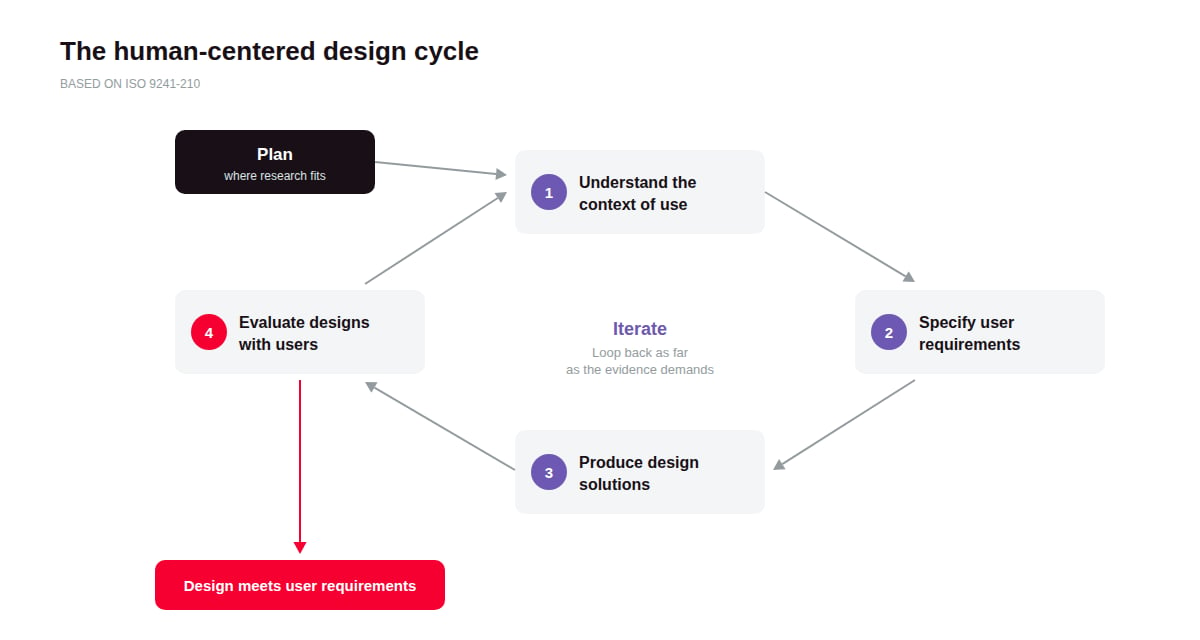
Plan human-centered activities. Decide at the start where research and evaluation fit into the project plan and who does them, so they are not squeezed out when deadlines tighten.
Understand and specify the context of use. Research who the users are and the conditions they work in, from the equipment they use to the interruptions they face.
Specify user requirements. Turn findings into requirements that can be tested, such as "a new nurse can record a patient's vital signs in under a minute without training."
Produce design solutions. Create sketches and prototypes that respond to the context and requirements, starting rough and adding detail as confidence grows.
Evaluate designs with users. Test each version with representative users against the requirements, and record where it falls short.
Iterate until requirements are met. Loop back as far as the evidence demands. Sometimes that means another design round; sometimes it means revisiting the context of use itself.
What Tools Do Teams Use for Human-Centered Design?
Teams practicing human-centered design mostly need tools for learning about users and for testing designs with them, plus a shared space for co-design sessions.
Which Tools Support User Research and Synthesis?
Dovetail and Condens store interview and observation recordings, then let researchers tag and cluster them into patterns the whole team can search.
Which Tools Support Co-Design Workshops?
Miro and Mural host remote workshops where users and stakeholders sketch and sort ideas together on a shared board.
Which Tools Test Designs With Users?
Maze and Lyssna run unmoderated tests on prototypes with recruited participants, so each design iteration can be checked against users within days.
What Are the Key Characteristics of Human-Centered Design?
Human-centered design is defined less by specific methods than by how decisions get made: with users involved and evidence in hand.
Users involved throughout. Users take part from research through evaluation, not only at the start and the end of a project.
Covers the whole experience. The design includes everything around the interface, such as onboarding and support, because users experience them as one product.
Multidisciplinary. ISO 9241-210 calls for a multidisciplinary team, so design decisions draw on engineering and domain knowledge, not design skill alone.
Open to changing the problem. Research sometimes shows the team is solving the wrong problem. Human-centered design treats reframing the brief as a legitimate outcome.
What Are the Benefits of Human-Centered Design?
The main benefit of human-centered design is products that people can use as intended, which reduces the cost of problems that would otherwise surface after launch.
Higher adoption. People keep using tools that fit how they already work, which matters most for internal and B2B software, where frustrated users fall back on spreadsheets and workarounds.
Lower support and training costs. Interfaces tested with users generate fewer help desk tickets and need shorter training.
Evidence for regulators. The research and evaluation records produced along the way double as the usability documentation regulated industries ask for.
Better decisions when stakeholders disagree. Observed user behavior gives the team a way to settle design debates that does not depend on who is most senior.
What Are the Challenges of Human-Centered Design?
The main challenge of human-centered design is that it asks for time and access to users up front, before the payoff is visible.
Users are hard to reach. Clinicians and other busy professionals are difficult to schedule. Remote sessions make access easier, but they lose the view of the environment people work in.
Iteration takes time. Several rounds of design and testing extend the early phases of a project. The investment pays off only if the problems it catches would have occurred, which is hard to prove in advance.
Users do not always know what they need. Asking people what they want is not enough; observing what they do takes longer and costs more.
User needs and business goals can conflict. A design that serves users best may not be viable for the business. IDEO's viability lens helps teams weigh this, but the tension does not disappear.
It can stay inside the design team. When only designers practice it, engineering and leadership decisions can ignore the findings. Training the wider team spreads the approach, at the cost of everyone's time.
What Is the Difference Between Human-Centered Design and Design Thinking?
Human-centered design is a design approach with an international standard behind it, while design thinking is a broader problem-solving method that applies human-centered principles to business and strategy questions.
Human-centered design | Design thinking | |
Scope | Products and services for the people who use them | Broad problems, including strategy and business models |
Structure | ISO 9241-210 activities: context of use, requirements, design solutions, evaluation | Stages such as empathize, define, ideate, prototype, and test in the Stanford d.school model |
Formality | Can be audited against a published standard | No widely adopted standard; practice varies by organization |
Typical practitioners | Designers, UX researchers, usability engineers, product teams | Cross-functional teams, often working in workshops |
Typical output | Tested designs that meet stated user requirements | New concepts and strategic directions to explore |
FAQ about Human-Centered Design
Related Terms
Need expert help with Human-Centered Design?
Monterail builds custom software solutions that leverage the latest technologies. Let's discuss how we can help with your project.
GET IN TOUCHGET IN TOUCH