The New Default. Your hub for building smart, fast, and sustainable AI software
Proof of Concept (PoC) as a Service
A short, fixed-length engagement in which an outside team tests whether a risky idea can work before the full build is funded.
What Is Proof of Concept (PoC) as a Service?
Proof of concept (PoC) as a service is a time-boxed engagement in which an external partner tests an idea's riskiest assumption. The partner agrees on a success threshold with the client and builds only what the test needs. The output is a feasibility report with a go or no-go recommendation for the full build.
Monterail has delivered 900+ projects since 2010. At Monterail, a time-boxed PoC runs four to six weeks from kickoff to demo.
What Does Proof of Concept as a Service Include?
PoC as a service covers the narrow build and measurement needed to answer one question, plus the evidence decision-makers need to act on it.
What it includes
A scoping workshop to pick the riskiest assumption and set the success threshold
Kill criteria agreed before kickoff, so a "no" is as clear as a "yes"
A narrow technical build, such as an integration, a novel algorithm, a hardware connection or a load test
Tests on the client's own data or systems, through sandbox and API access
Measurements against the threshold, such as accuracy, response time, throughput or running cost
A feasibility report with a go or no-go recommendation
The repository and documentation, including architecture notes, as named deliverables
A demo for the people who approve the budget
What it doesn't include
Production-ready code, since PoC code is built to answer a question and is usually discarded
A finished user interface, which a prototype or an MVP provides
Security certification and production hosting
The full build after a "go" decision, which runs as a separate engagement
When Does Proof of Concept as a Service Fit?
PoC as a service fits when one unproven technical assumption could sink the whole project, and your own team can't test it soon.
It fits when
The idea depends on technology nobody on the team has used in production, such as a new AI model
A new product has to run on top of a legacy system, and the integration is untested
Performance requirements are unusual, and nobody knows if the architecture can meet them
An enterprise budget holder wants evidence before funding, and the internal team is booked
It doesn't fit when
You are building a standard web platform on well-documented frameworks, where the technical risk is already low
The main risk is whether users want the product. Product discovery and user testing answer that faster.
You need something customers can use in production. In that case, an MVP is the right scope.
Nobody can grant access to the systems or data the test depends on. Sorting out access comes first.
What Are the Benefits of Proof of Concept as a Service?
The main benefit is a funding decision based on measured results instead of opinions about what might work.
Risk tested for a fraction of the budget. A few weeks of work rules out an approach before months of development go into it.
Evidence budget holders accept. A demo and a report against agreed thresholds make the business case concrete.
No drain on the roadmap. An external team runs the test while internal engineers keep their planned work.
A clear exit. Kill criteria agreed up front make stopping a valid, documented result.
A head start if the answer is yes. Architecture notes and lessons from the PoC feed straight into planning the build.
How Does Proof of Concept as a Service Work?
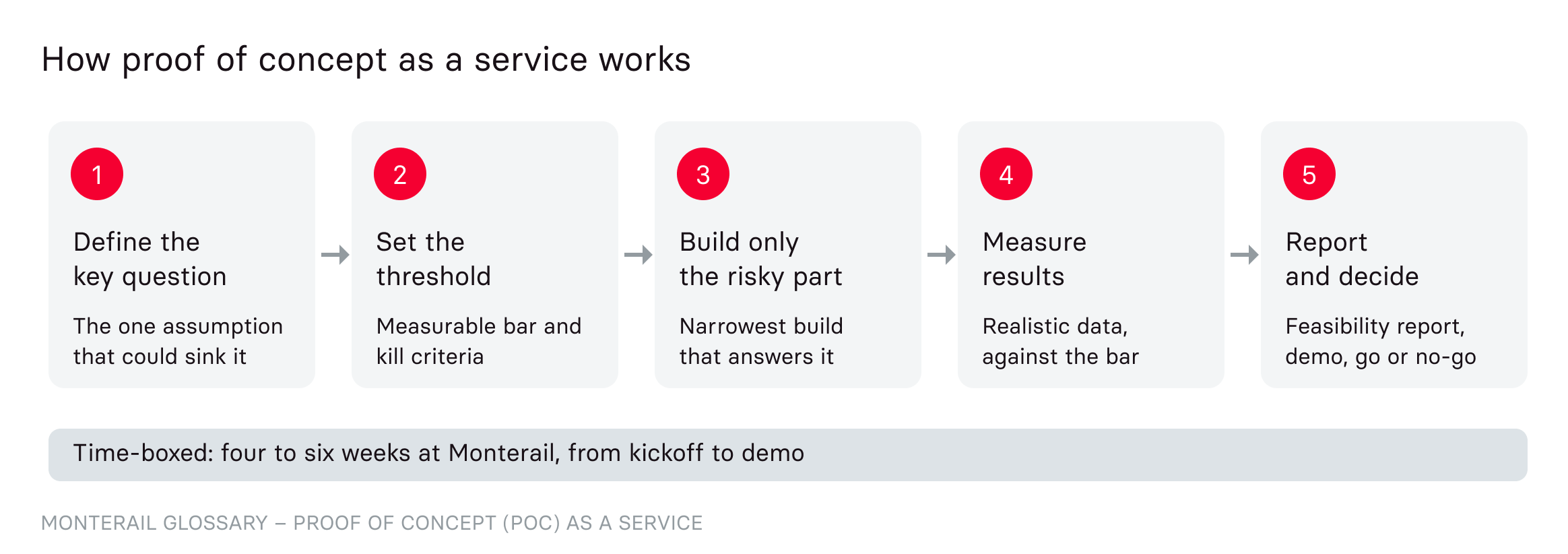
PoC as a Service runs in five steps, from naming the riskiest question to recommending whether to build.
Define the key question. Client and partner pick the riskiest assumption, the one that could invalidate the project, for example, whether a model reaches the needed accuracy on the client's data.
Set the success threshold. Before writing any code, both sides agree on a measurable bar and the kill criteria. Arrange access to data and sandbox APIs in parallel.
Build only the risky part. The team builds the narrowest version that can answer the question. Everything the test doesn't need stays out.
Measure against the threshold. The build runs on realistic data and load. Record results against the agreed bar.
Report and decide. The partner delivers a feasibility report and a demo. Decision-makers then fund the build or change course, and a stop comes with documented reasons.
Should You Use a PoC Partner or Build the Proof of Concept In-House?
Use a PoC partner when your team is booked or lacks the specific skill. Build in-house when the right people are free, and the question sits close to your core system. For a wider comparison that includes innovation labs and staff augmentation, see proof of concept as a service for enterprises.
Factor | PoC partner | Internal team |
Start time | After vendor onboarding, which can run in parallel with scoping | When engineers come free from roadmap work |
Skills | Specialists who have built similar tests before | Limited to the skills already on the team |
Objectivity | No stake in the outcome beyond a clear answer | Can lean toward the approach the team prefers |
Cost model | A fixed, time-boxed engagement | Hidden in delayed roadmap work |
Knowledge afterwards | Captured in the report and handover | Stays with the team that ran it |
Setup overhead | Procurement and security review | Little: access already exists |
Challenges to plan for: An external PoC needs procurement and system access before work starts, which can take longer than the PoC itself. A partner also needs an internal tech lead involved from week one, or the handover loses context.
How Does Monterail Approach Proof of Concept as a Service?
Monterail scopes every PoC around one decision and sets success measures before building.
Infinant Health wanted a mobile app that assesses an infant's gut health from inputs like stool photos and cry recordings, without lab tests. Monterail built two prototypes: a technical prototype that worked through challenges such as transferring audio from an Apple Watch to an iPhone, and a no-code prototype for the user experience. Infinant Health received a validated business model and development-ready documentation.
For Joii, Monterail proved that menstrual flow could be measured from photos. The functional prototype's scanner reached 99% accuracy in image processing.
For AI products, the "Prove" phase of Monterail's AI development services delivers a working prototype on the client's data, with performance benchmarks and a clear go/no-go.
When Should You Bring In a Proof of Concept Partner?
A partner helps when an idea has been stuck in the backlog because no internal team can take it on. It also helps when the test needs a skill your team doesn't have, such as computer vision or a complex integration. The guide to proofs of concept in software development explains when a PoC is worth running.
Monterail's rapid prototyping services turn a backlog idea into something stakeholders can test and fund. Talk to our team about the assumption you need to prove.
FAQ About Proof of Concept as a Service
Need expert help with Proof of Concept (PoC) as a Service?
Monterail builds custom software solutions that leverage the latest technologies. Let's discuss how we can help with your project.
EXPLORE WEB DEVELOPMENT SERVICESEXPLORE WEB DEVELOPMENT SERVICES