The New Default. Your hub for building smart, fast, and sustainable AI software
UI/UX Design Services
UI/UX design services are professional services in which an external team designs and tests how a digital product works and looks, covering any stage from early user research to developer-ready interface designs.
What Are UI/UX Design Services?
Companies hire UI/UX design services when they need product design expertise they do not have in-house, or more of it than their own team can supply. The engagement can cover a whole new product or a narrow problem, such as a checkout flow that loses users halfway through.
The two halves of the name do different jobs. UX (user experience) design decides how a product works: what users need and which steps a task should take. UI (user interface) design decides how it looks and responds on screen. Most providers deliver both, because splitting them across vendors creates gaps at the handoff between them.
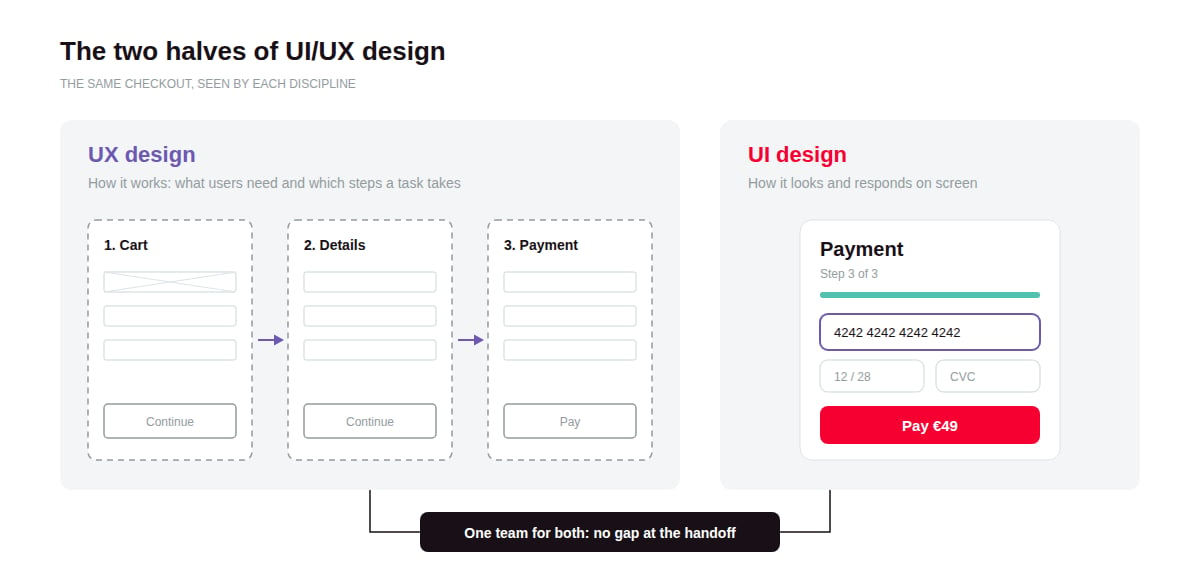
Engagements come in a few common shapes: a fixed-scope project, an ongoing retainer, designers embedded in the client's team through staff augmentation, and a dedicated product team that designs and builds the product together.
Why Do UI/UX Design Services Matter?
UI/UX design services matter because design decides whether users can get value from a product, and many companies lack the in-house design capacity to get it right on their timeline.
Design problems cost more to fix in code. A flow that confuses users is cheap to change in a prototype. The same flow, once built, costs engineering time to rework and users who gave up in the meantime.
User expectations are set by the best products. People judge a B2B tool against the consumer apps they use every day. A clumsy interface can lose a free trial to a competitor with weaker features but a clearer experience.
How Does a UI/UX Design Engagement Work?
A UI/UX design engagement usually moves from understanding the problem to validated, developer-ready designs, with users involved at several points along the way.
Discovery. The team interviews stakeholders and reviews analytics and the existing product to agree on goals and how success will be measured. This phase also surfaces technical and business constraints the designs must respect.
User research. Interviews or usability tests with target users show where the current experience fails and why. Findings are often captured as user personas or a customer journey map.
Information architecture and wireframes. Designers structure content and navigation, then sketch low-fidelity layouts. Wireframes are quick to revise, so most structural debates happen here.
Prototyping and testing. Clickable prototypes go in front of a handful of target users per round. Each round shows which parts of the flow work and which need another pass before anything is built.
Visual design. The approved structure gets brand styling and reusable components, often organized into a design system. Color contrast and text sizes are checked against accessibility requirements at this stage, before specs go to developers.
Handoff and design QA. Designers deliver specs developers can build from, then review built screens against the designs and fix gaps before release. This review catches missing states and layout drift that specs alone do not prevent.
What Tools Do UI/UX Design Teams Use?
Design service teams work mainly in shared design tools, with separate tools for testing ideas with users and for handing designs to developers.
Which Tools Do Teams Use to Design and Prototype?
Figma and ProtoPie cover most design and prototyping work. Figma lets designers and clients work and comment in the same file, including on clickable prototypes. ProtoPie builds high-fidelity interactive prototypes with complex logic and device sensors, for flows that Figma prototypes cannot simulate.
Which Tools Do Teams Use to Test Designs With Users?
Maze and Lyssna run unmoderated tests on prototypes with recruited participants, so a team can check a design with users in days instead of scheduling live sessions.
Which Tools Support Handoff to Developers?
Figma Dev Mode and Zeplin give developers measurements and code snippets for each screen. Figma Dev Mode also lets designers mark individual screens as ready for development.
What Are the Key Characteristics of Good UI/UX Design Services?
Good UI/UX design services are defined by decisions backed by user evidence and by designs that engineers can build as specified.
Scoped by outcome. Strong engagements define success as a user or business metric, such as task completion or trial conversion, instead of a number of screens delivered. Task-level metrics are the safer choice, because they are easier to trace back to a design change than revenue is.
Cross-functional from the start. Designers work with product managers and engineers from discovery onward, so designs fit technical constraints before they are polished.
Iterative. Designs go through several rounds of feedback and testing. The first version is expected to change, and the schedule allows for it.
Transparent. Clients see work in progress in shared files and can observe research sessions, so decisions do not arrive as a surprise at the final presentation.
What Are the Benefits of UI/UX Design Services?
The main benefit of UI/UX design services is access to a complete, experienced design team for as long as the product needs one.
Faster start. An external team can usually begin within weeks, while hiring a senior product designer can take months.
Specialist skills on demand. Engagements can include roles a company would rarely hire full-time, such as a UX researcher or an accessibility specialist.
Flexible capacity. The team can grow for a redesign and shrink to a small retainer afterward, instead of fixed headcount that sits underused between big projects.
Patterns from other products. A team that has designed for many clients brings solutions that already worked elsewhere, and an outside view of problems insiders have stopped noticing.
A reusable foundation. Research findings and a design system stay with the client and speed up every project that follows.
What Are the Challenges of UI/UX Design Services?
The main challenge of UI/UX design services is that an external team starts without the product knowledge an in-house team takes for granted.
Context takes time to build. Discovery costs weeks and budget before any polished screens appear. Skipping it produces faster visuals that miss constraints the client's team knew about.
Knowledge can leave with the vendor. When the engagement ends, the people who know why each design decision was made move on to other clients. Documentation and handover sessions keep that reasoning with the client, at the cost of billable time.
Designs can outrun engineering. A design team working apart from developers can produce screens that are hard to build. Involving engineers from discovery prevents this but costs their time early on, while hiring a provider that also builds the product narrows the choice of vendors.
Return is hard to measure. Design changes often ship alongside other changes, so their effect is hard to isolate. A/B tests can separate it, but they need enough traffic to reach a clear result.
Fixed scope fights discovery. A fixed-price contract gives budget certainty but penalizes changing course when research reveals something new. Time-and-materials contracts adapt, at the cost of a less predictable budget.
What Is the Difference Between UI/UX Design Services and an In-House Design Team?
UI/UX design services offer broad skills and flexible capacity on a contract, while an in-house design team offers deep product knowledge that builds up continuously.
UI/UX design services | In-house design team | |
Time to add capacity | Usually weeks, once a contract is signed | Depends on hiring, often months |
Product and domain knowledge | Built during the engagement | Accumulates continuously |
Range of specialist skills | Broad, drawn from the provider's whole team | Limited to the people on staff |
Cost structure | Fees tied to scope or time | Salaries and benefits, plus tools and hiring costs |
Flexibility | Scales up or down by project phase | Headcount changes slowly |
Best fit | New products, redesigns, capacity peaks, specialist needs | Continuous work on a mature core product |
FAQ about UI/UX Design Services
Need expert help with UI/UX Design Services?
Monterail builds custom software solutions that leverage the latest technologies. Let's discuss how we can help with your project.
GET IN TOUCHGET IN TOUCH