The New Default. Your hub for building smart, fast, and sustainable AI software
User Personas
A user persona is a fictional profile of a typical user, built from research, that sums up the goals and pain points a group of users shares.
What Are User Personas?
Personas give a product team one shared answer to the question "who exactly are we building this for?" Without that answer, designers and stakeholders each picture a different user, and that user tends to look a lot like the person picturing them.
Alan Cooper began using personas in software design in 1983 and popularized the method in his 1999 book The Inmates Are Running the Asylum. His first personas came from informal interviews with seven or eight users.
A persona is a composite. No single interviewee matches it, but each detail on the card traces back to something the research showed. That link to evidence is what separates a persona from a marketing avatar or a guess with a stock photo attached.
Why Do User Personas Matter in Product Development?
Teams design for themselves by default. Engineers and product managers are fluent with software in ways most users are not. A persona brings a specific person with a specific skill level into every design review, so "this seems obvious" gets tested against someone for whom it may not be.
Many products serve groups with opposing needs. A clinic scheduling tool serves a receptionist who wants speed and a patient who wants clarity. Personas make that tension visible early, while it is still cheap to design around.
Research findings fade after the readout. Interview insights tend to end up in a slide deck nobody reopens. A persona packages the same findings into a format the team keeps referring to during sprint planning.
How Are User Personas Built?
Most user personas are built by interviewing users and grouping them by shared behavior, with one profile written per group.
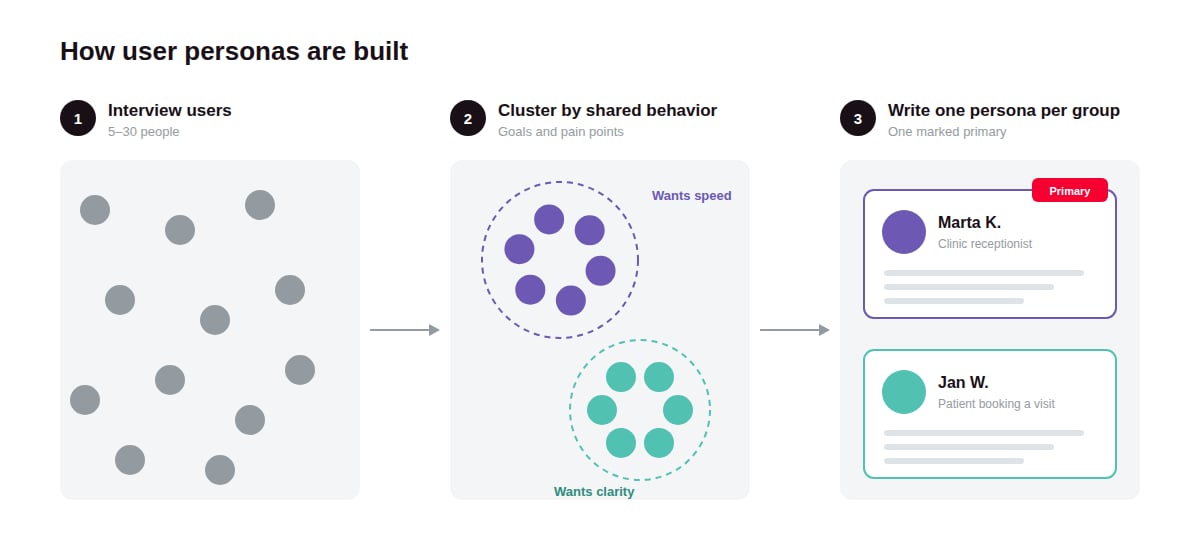
Interviews come first. Qualitative personas, which Nielsen Norman Group calls the best fit for most teams, draw on interviews with 5–30 users. Interviews run in rolling batches of five until new sessions stop surfacing new patterns.
Patterns decide the groups. Researchers code the transcripts and cluster participants by shared goals and pain points. A cluster that keeps reappearing across interviews becomes a candidate persona.
Each group becomes a profile. A persona card usually carries a name, a context of use, goals, frustrations, and the tasks the person brings to the product. The name and photo are memory aids; the rest is the research in summary form.
One persona is marked primary. When two personas need conflicting things, the primary persona is the default winner. Secondary personas still get served, though not at the primary's expense.
Statistical validation is optional. Statistical personas add a survey of at least 100 respondents, ideally 500 or more, then apply clustering methods such as k-means or latent class analysis. The payoff is an estimate of how much of the user base each persona represents.
Proto-personas are a hypothesis. A proto-persona comes out of a 2–4 hour team workshop with no new research. It is a fast way to make the team's assumptions explicit, provided everyone treats the result as something to test.
What Tools Do Teams Use for User Personas?
Persona work needs somewhere to keep the research and somewhere to turn it into profiles, with analytics as a check against usage data.
Which Tools Hold the Research Behind a Persona?
Dovetail and Condens are research repositories. They hold interview recordings and transcripts and let researchers tag findings, so the evidence behind each persona stays one click away.
What Do Teams Use to Synthesize Personas?
Miro and FigJam are online whiteboards where teams cluster interview notes into groups and lay out the finished persona cards.
How Do Teams Check Personas Against Usage Data?
Amplitude, Mixpanel, and PostHog are product analytics platforms. Their behavioral cohorts show whether the segments a persona describes exist in usage data at the size the team assumed.
What Are the Key Characteristics of a Good User Persona?
Behavior over demographics. Age and job title rarely change a design decision, while goals and daily workflow often do. Two users of different ages with the same workflow belong in one persona.
Traceable to evidence. Every claim on the card should map to interview notes or data. One unsourced detail invites the team to question the rest.
Specific enough to settle a debate. "Wants an easy experience" describes everyone. "Clears 40 referrals every Monday before 10:00" changes how a screen gets built.
Few enough to remember. A team cannot keep a dozen personas in mind, so in practice it designs for none of them.
Dated and owned. A persona describes users at the time of research. It needs an owner who revisits it when the market or the product shifts.
What Are the Benefits of User Personas?
User personas pay off mostly in decisions: who to build for first, and how to settle disagreements about it.
Clearer MVP scope. Designing for one primary persona gives a natural cut line between what ships first and what waits.
Shorter design debates. "Would the clinic receptionist use this?" is a question the research can answer. "I think users want this" is not.
Shared language across disciplines. Developers and stakeholders who never sat in an interview can still reason about users by name.
Faster onboarding for new team members. A new hire who reads the persona set gets a working picture of the user base before their first design review.
What Are the Challenges of User Personas?
Research costs time and money. Qualitative personas need participant recruitment plus interview analysis. Proto-personas skip that cost, but they can only reflect what the team already believes, so they miss whatever the team has wrong.
Personas go stale. Users change as the product and its market change. Keeping personas current means repeat research, which competes for the same budget as delivery work.
Detail trades off against accuracy. Research by Chapman and colleagues found that personas with many attributes are likely to describe very few people, if any. Each added detail makes a persona more vivid and less representative, so teams have to decide where to stop.
Stereotypes creep in. Stock photos and invented personal details can bring in bias the research never showed. Stripping them out makes personas safer but less memorable, and memorability is a large part of why teams use them.
Unused personas waste the research. A persona deck nobody consults costs the full research budget and returns nothing. Keeping personas in tickets and design reviews prevents that, but it needs ongoing effort from a product owner or researcher.
What Is the Difference Between User Personas and Jobs-to-Be-Done?
User personas describe who the user is, while jobs-to-be-done (JTBD) describe the outcome a user is trying to achieve, whoever that user is. Nielsen Norman Group treats the two as complementary.
Aspect | User Personas | Jobs-to-Be-Done |
Central question | Who is the user? | What outcome is the user trying to reach? |
Unit of analysis | A group of users with shared goals and behavior | A task or outcome, regardless of who performs it |
Typical output | A profile card with a name, context, goals and pain points | Job statements or job stories ("When I…, I want to…, so I can…") |
Strongest use | Prioritizing between user groups with competing needs | Spotting what users would switch products to get done |
Main risk | Drifting into stereotype or fiction | Losing context that differs between user groups |
Fit with the other | A persona can list the jobs it hires the product for | A job can be mapped to the personas that perform it |
FAQ about user personas
Related Terms
Need expert help with User Personas?
Monterail builds custom software solutions that leverage the latest technologies. Let's discuss how we can help with your project.
GET IN TOUCHGET IN TOUCH