The New Default. Your hub for building smart, fast, and sustainable AI software

Table of Contents
Choosing a Ruby on Rails development company in 2026 comes down to fit: the right team for your problem, budget, and stage. The nine companies profiled below span boutique specialists to enterprise partners, and the guide that follows covers how to pick one and what it costs. This is a curated showcase, not a ranking. Rails still runs a large share of the products people use every day, with GitHub, Shopify, and Intercom all deploying it at scale and more than 600,000 companies shipping on the framework worldwide, so the hard question is rarely whether Rails works. It is who should build it with you.
That fit is harder to judge than it looks. The companies that write Rails span solo freelancers charging $25 an hour and Chicago consultancies charging $300, small women-owned shops in Brooklyn and 400-person engineering groups across Central Europe. The label "Ruby on Rails development company" covers all of them, and the wrong choice costs you months. The list below shows that spread; the buyer's guide after it explains how to read it.
Executive Summary
The Ruby on Rails services market in 2026 rewards buyers who match the engagement to the problem rather than chasing the lowest rate. Senior Rails talent bills roughly $100 to $150 an hour in North America, $70 to $110 in Western Europe, and $50 to $70 in Eastern Europe, and a blended agency team sits above those numbers because it folds in product, design, and QA.
A well-scoped MVP lands between $25,000 and $60,000 regardless of who builds it, so the variable that moves your outcome is fit: domain experience, seniority of the people actually on your project, and whether the team can operate in your time zone.
The nine companies below are chosen to show that range, not to rank it. Read the buyer's guide after the list before you shortlist anyone.
Nine Ruby on Rails Development Companies to Know in 2026
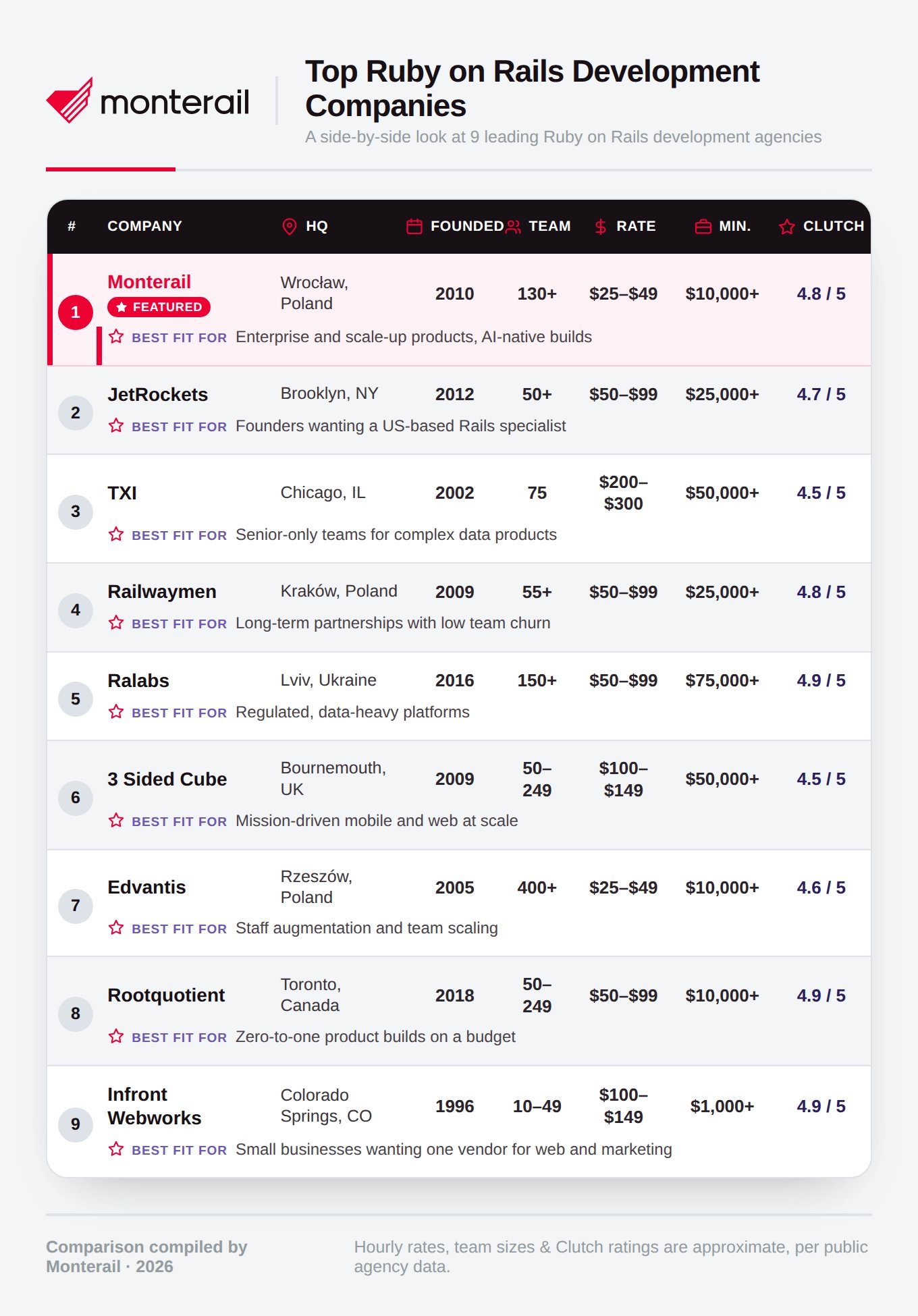
This list is not ranked. The companies below were picked to show the spread of what a Rails partner can be: different sizes, regions, price points, and specialties, from a two-person-founder boutique to a 400-strong engineering group. Monterail appears first because we wrote this guide, not because the list is ordered by quality. Use the comparison table for a fast scan, then read the profiles for the detail that matters to your decision.
Monterail
Monterail is an agentic development company founded in 2010 in Wrocław, Poland, with a team of 130+ engineers, designers, and product experts. Over 16 years it has delivered 900+ projects for clients that include Bosch, EY, Merck, DocPlanner, and SharkNinja, and it holds an official partnership with Vue.js and Nuxt alongside deep Ruby on Rails and React Native practices. The company works across healthtech, fintech, proptech, and retail, and recent acquisitions of Untitled Kingdom, EL Passion, and Lakeview Labs added MedTech, product design, and mobile depth. Its current NPS of 71 points to a client base that tends to stay.
Example project by Monterail
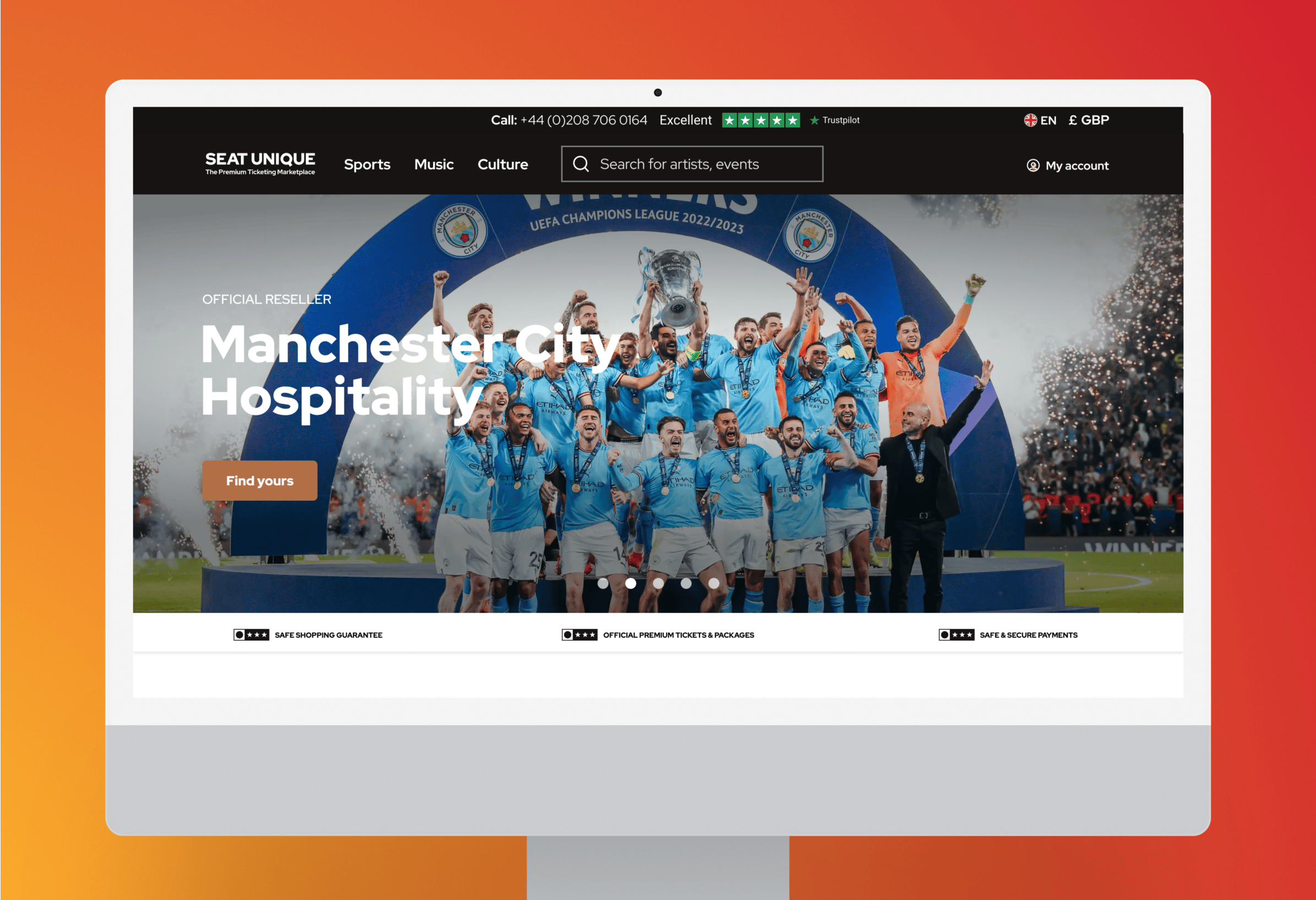
Seat Unique came to Monterail in 2018 needing an MVP fast enough to claim a first-mover advantage in premium live-event ticketing. What began as that MVP grew, over an eight-year partnership, into the platform behind some of the UK's biggest clubs and venues. Monterail built the core on Ruby on Rails, React, and PostgreSQL, added an Elixir-powered ticket-selling engine and a B2B seller tool, then rewrote the frontend to Next.js and built a virtual waiting room to survive peak-demand releases. The platform now sells 193,000+ premium tickets a year, draws 1M+ monthly visitors, and helped Seat Unique raise £48 million. You can read the full Seat Unique case study for the technical detail.
How Much Does Monterail Ruby on Rails Development Cost?
Monterail lists an hourly rate of $25–$49 and a minimum project size of $10,000, with a Clutch cost rating of 4.4 out of 5. Most engagements fall in the $50,000 to $199,999 band, though verified reviews describe projects from $30,000 to over $1 million depending on complexity. That places Monterail toward the lower end of the European agency range in this guide while offering enterprise-scale delivery, which is where its value-for-cost reputation comes from.
What Do Clients Say About Working With Monterail?
Client feedback centers on speed, technical depth, and the ability to grasp a complicated domain quickly.
"We moved from reactive scheduling to proactive, data-driven decisions. The ability to see a prototype in one day and scale it to an enterprise-ready solution so quickly was a game-changer for our resource management." - Bram Verstraeten, Senior Project Manager, SPIE Belgium
"I was impressed with the speed at which Monterail was able to grasp a complex and niche industry and translate that into a clear and practical system structure." - Amelia Christie, Director, Christie Constructive
"If you want to outsource your coding to the lowest hourly rate, then Monterail aren't for you. If you want to build winning products at pace, then Monterail need to be on your shortlist." - Alan Buxton, CTO, Simfoni
A few clients have noted that design was historically a step behind engineering and occasionally needed an outside hand, though the EL Passion acquisition was aimed squarely at closing that gap.
Why Do Businesses Choose Monterail?
Enterprise track record with regulated clients like Merck and EY, backed by Deloitte and Financial Times 1000 recognition
An AI-native delivery approach that took SPIE from concept to production prototype in 24 hours
Full-cycle coverage from product discovery and UX through web, mobile, and AI implementation
US-friendly working hours from a European base, which suits North American clients wanting a reliable offshore partner
Strong fit for healthtech and fintech teams that need domain literacy, not just Rails syntax
JetRockets
JetRockets is a women-owned Ruby on Rails specialist founded in 2012 and based in Brooklyn, New York. With 50+ developers and more than 100 completed projects, it has built a reputation as a Rails-first shop rather than a generalist agency that happens to know the framework. Clutch named it a top women-owned software developer, ranked #2 in the US, and its co-founders lead engagements directly rather than handing them to a junior bench. CTO Igor Aleksandrov has worked in Rails since 2008 and is a recognized Docker Captain, which tells you where the technical center of gravity sits.
Example project by JetRockets
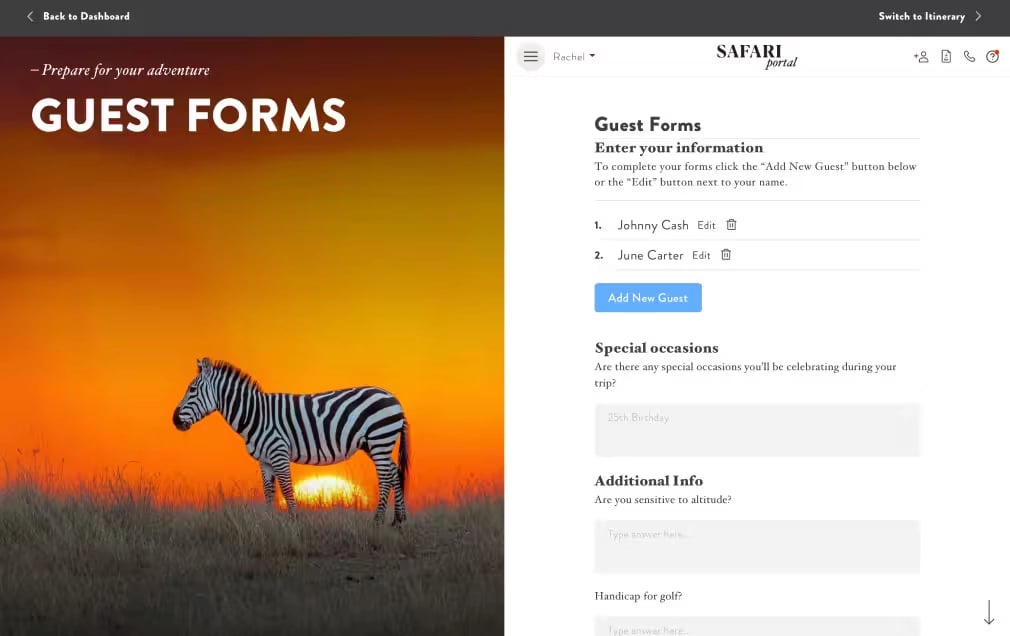
Safari Portal came to JetRockets as a loose idea from a team of travel professionals: a way for agents and tour operators to build interactive digital itineraries and print-ready proposals in minutes instead of wrestling with spreadsheets. JetRockets built the B2B2C platform on Ruby on Rails, React, and Elasticsearch, adding a personalized guest portal, offline access, a global flight tracker integration, and custom-branded templates. The product now serves 1,000+ travel agents worldwide and has generated more than 10,000 custom itineraries, and the relationship has grown from a single build into an ongoing partnership.
 Source: jetrockets.com
How Much Does JetRockets Ruby on Rails Development Cost?
JetRockets bills $50–$99 per hour with a $25,000 minimum project size and a Clutch cost rating of 4.7 out of 5. Reported projects run from $10,000 to over $500,000, and most web development work lands in the $50,000 to $199,999 range. Clients repeatedly note flexibility on payment structure and a genuine effort to work within a stated budget, which makes JetRockets an accessible option for a US-based team without US-agency blended rates.
What Do Clients Say About Working With JetRockets?
Reviews emphasize partnership, ownership, and comfort working with non-technical founders.
"JetRockets helped me start from a loose idea to a tangible product with very specific functionality that also differentiated the platform from existing competitors. From the design to data, they have been essential to every part of this process." - Stephanie Kaiser, Founder, Saymore
"JetRockets is so much more than a dev team. They are a core part of Safari Portal and of our family. They truly care about the product and its success and it shows in everything that they do." - Rachel West, Founder and CEO, Safari Portal
"Their team delivers on time and is very communicative. They've taken ownership of the project when necessary; they are very responsible." - Nir Badichi, Product Manager, eBay
One client did report friction around team turnover and NDA compliance, so it is worth confirming continuity terms up front on a longer build.
Why Do Businesses Choose JetRockets?
A true Rails specialty rather than a framework offered on the side, with modern Hotwire and Turbo experience
Co-founder-led engagements, so senior people stay involved past the sales call
A strong record guiding non-technical founders from idea to shipped product
US East Coast base and time zone for teams that want overlap with domestic hours
Award-recognized as a top women-owned agency, which matters to buyers with supplier-diversity goals
TXI
TXI is a 100% employee-owned digital product consultancy founded in 2002 and headquartered in Chicago. Its 75 consultants average 17 years of experience, and the firm deliberately staffs senior practitioners rather than the junior-team-with-oversight model common elsewhere. TXI has delivered 150+ products for Fortune 500 and mid-market clients including Tyson Foods and Keiser, and it built LandscapeHub, one of the better-known Rails marketplaces, on Rails and React. It leans toward strategy-led, data-heavy work where the problem is fuzzy at the start.
Example project by TXI
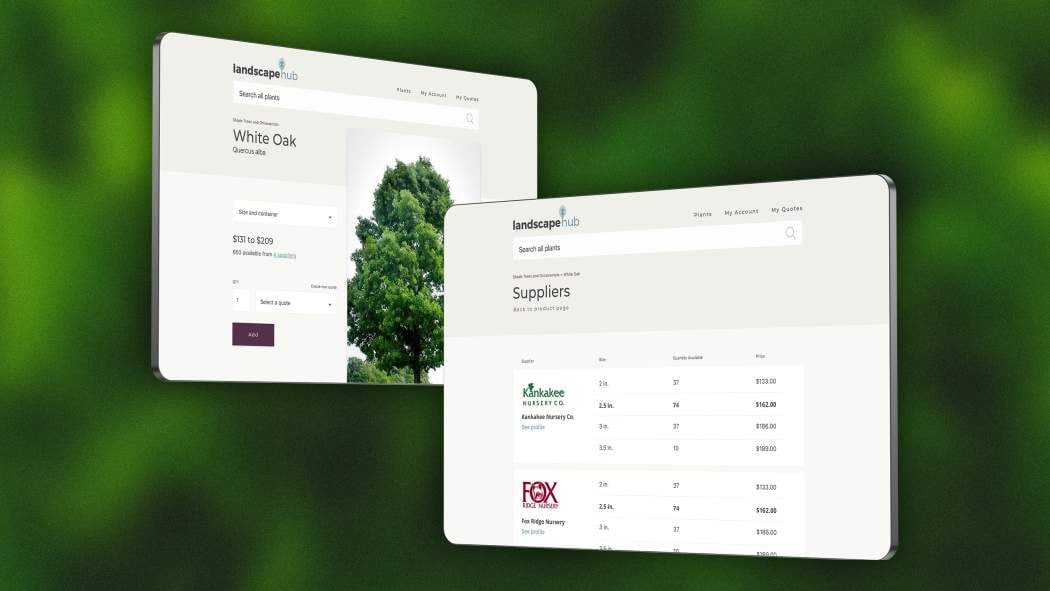
Lisa Fiore, fourth-generation owner of a century-old plant-supply business, wanted to disrupt her own family company before someone else did. She came to TXI to build LandscapeHub, a two-sided online marketplace giving landscapers transparent, searchable access to every available plant, size, and price for the first time. TXI started with a Google Design Sprint and user research to validate the idea, then built the marketplace on Rails and React atop a large relational plant database. The MVP proved the concept well enough to raise a seed round and recruit a former Grubhub CTO, and TXI paired with the new in-house team to hand off everything it had built.
 Source: txidigital.com
How Much Does TXI Ruby on Rails Development Cost?
TXI is the premium option in this guide, billing $200–$300 per hour with a $50,000 minimum project size and a Clutch cost rating of 4.5 out of 5. Projects range from $10,000 to over $800,000. Clients are candid that the price is high, and equally candid that the senior-only staffing and strategic input justify it for the right problem. If your project is mostly execution of a known spec, this is more firepower than you need; if it is ambiguous and high-stakes, the rate buys judgment.
What Do Clients Say About Working With TXI?
Feedback highlights culture, speed of understanding a niche business, and a partnership that outlasts a single project.
"Our business is difficult to understand from an outside perspective. TXI worked actively to understand what we do. I was impressed with how quickly they got up to speed on the jargon." - Adam Wilhelm, Vice President, Campbell and Company
"They're more than just a vendor. It's become commonplace to refer to vendors as 'partners,' but TXI really earned the title. They've truly embraced us in a way that's uncommon." Larry Schor, CEO, Push for Wellness
"The culture is amazing. Every person was a delight to work with and obviously felt comfortable. The collaborative and positive nature was fantastic." - Zach Mellender, Business Systems and Analytics Manager, Omaha Zoological Society
Why Do Businesses Choose TXI?
Senior-only teams averaging 17 years of experience, working as peers with your experts
Strong at the fuzzy front end: design sprints, discovery, and validating an idea before heavy build
Employee ownership that clients tie to a long-term, accountable mindset
Deep cross-industry range across manufacturing, healthcare, logistics, and nonprofits
A clean track record of transferring knowledge so your in-house team can take over
Railwaymen
Railwaymen is a Kraków-based software house founded in 2009, with a team of around 55 developers, designers, and project managers and 17 years in the market. It has shipped 150+ web and mobile apps across five continents and collected 10+ international awards, with particular depth in fintech, construction, and foodtech. The company's calling card is stability: CEO Łukasz Młynek points to a team rotation "close to zero," which underpins the long-term partnerships it favors over one-off builds.
Example project by Railwaymen
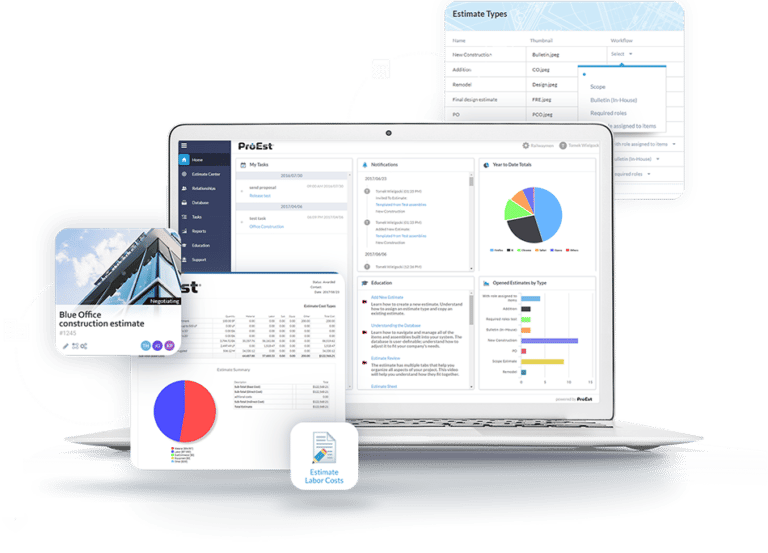
ProEst, a construction-estimating software company serving clients since 1976, needed a cloud platform that could handle enormous volumes of interwoven data. Railwaymen built ProEst Cloud on Ruby on Rails, growing the dedicated team from three developers to six as the product matured through daily client collaboration. The system handles real-time cost estimation across a large construction-elements database, PDF takeoff with on-screen measurement, and bid leveling, plus C++ image-processing algorithms and native code execution in the browser for performance. The result is one of the more technically demanding Rails products on this list, still evolving years into the relationship.
 Source: railwaymen.org
How Much Does Railwaymen Ruby on Rails Development Cost?
Railwaymen bills $50–$99 per hour with a $25,000 minimum project size and one of the higher Clutch cost ratings here at 4.8 out of 5. Reported project costs span $10,000 to over $800,000, and its most common web development band is $10,000 to $49,999, which makes it approachable for smaller builds. Clients consistently say costs track budget expectations, a reflection of the transparent communication the firm is known for.
What Do Clients Say About Working With Railwaymen?
Reviews stress the caliber of the people, the executive access, and genuine investment in the client's outcome.
"Our search for the right development team lasted for a month, interviewing over 30 companies. We are confident that our decision to go with Railwaymen was the perfect choice. Not only do you have direct access to the executive team but have a development staff with knowledge and creativity that is unmatched." - Jeff Gerardi, President and CEO, ProEst
"They didn't just execute our ideas; they brought fresh, innovative suggestions to the table. Their ability to introduce new concepts enhanced our project significantly." - Senior Security Analyst, Cybersecurity Company
"The way the team really invested in my project to ensure the most success and satisfaction. I think that's hard to find these days with B2B or even just in general." - Jacob Dombrowski, Founder, Education Firm
Some clients have flagged occasional slips in time estimates, so build a little schedule buffer into fixed deadlines.
Why Do Businesses Choose Railwaymen?
Near-zero team rotation, so the developers who learn your business stay on it for years
Direct access to the executive team, not a layer of account managers
Proven on data-intensive, technically hard products like ProEst
Business consulting and a structured discovery program that shapes scope before code
Budget predictability that clients single out in review after review
Ralabs
Ralabs is a distributed engineering partner founded in 2016, headquartered in Lviv, Ukraine, with a US entity in Delaware and staff across Poland, Portugal, Spain, Estonia, and beyond. The team grew from 113 to 150+ people in 2025 alone. Ralabs builds products, data pipelines, cloud infrastructure, and AI systems, and its work adheres to GDPR, HIPAA, PCI, and DSS, which makes it a fit for regulated fintech and healthcare. Every engagement is led by senior engineers who stay accountable past handoff, and the firm carries a 4.9 out of 5 Clutch cost rating across 45+ reviews.
Example project by Ralabs
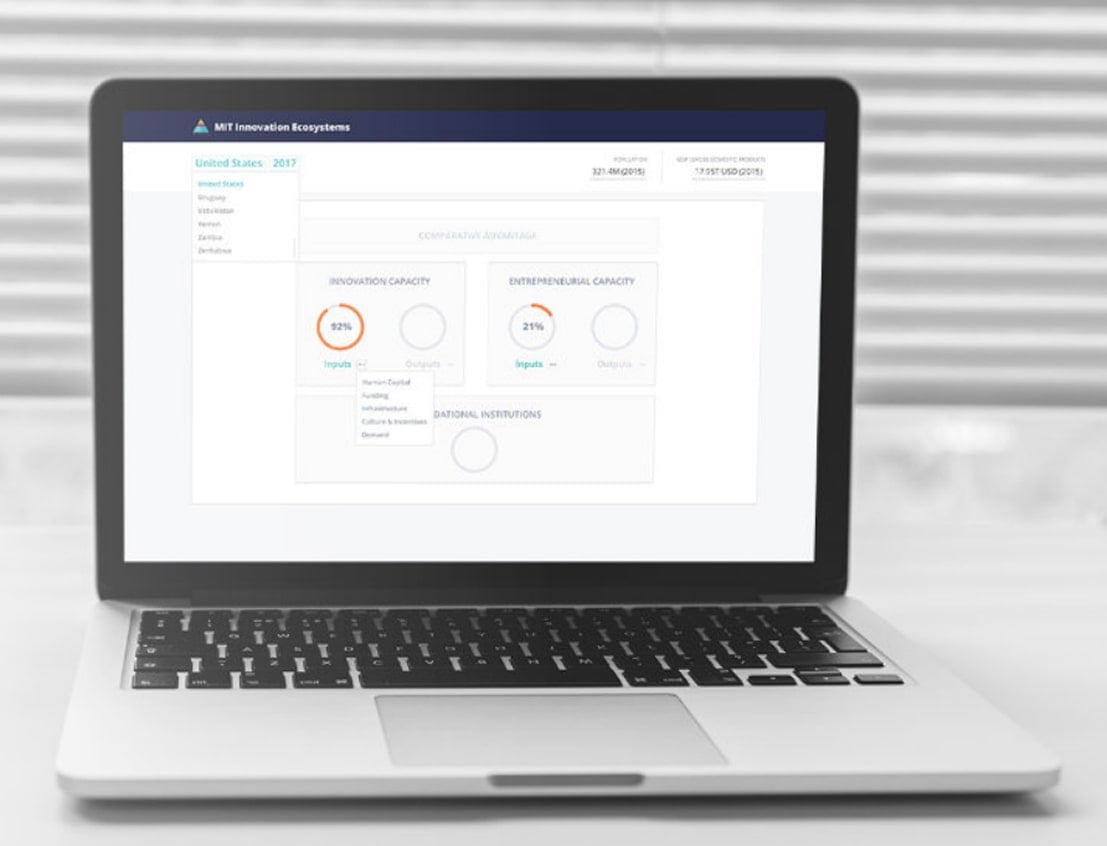
MIT's Lab for Innovation Science needed a stronger analytics platform to measure and visualize the dynamics of its innovation ecosystem, tracking metrics like country GDP and population against innovation outcomes over time. The existing system had accessibility, data-input, and performance problems that were getting in the way of research and classes. Ralabs rebuilt the platform on Ruby on Rails, Angular, and PostgreSQL, refining SQL queries for faster response, adding an admin panel for data management, and improving the interface with better sorting and filtering. Researchers got a reliable tool for drawing insight from innovation trends, and load times dropped enough to make the platform usable in live coursework.
 Source: ralabs.org
How Much Does Ralabs Ruby on Rails Development Cost?
Ralabs sets the highest entry point in this guide, with a $75,000 minimum project size, billing $50–$99 per hour at a Clutch cost rating of 4.9 out of 5. Reported investments range from $14,000 to $200,000. The higher floor signals that Ralabs targets substantial, senior-led engagements rather than small fixes, so it fits companies with a real budget and a complex, compliance-sensitive build, not a quick MVP.
What Do Clients Say About Working With Ralabs?
Clients rate the engineering talent highly and describe a team that treats the product as its own.
"Honestly, the engineers that I'm working with are some of the best engineers I've worked with in my career. The fact that we can learn from each other's strengths is what makes the relationship so incredible." - Andrew Rondeau, Principal Engineer, OptiRTC
"One of the most impressive aspects of Ralabs was their attention to detail and their commitment to quality. They took the time to understand our requirements fully and worked closely with us." - Eugen Shevchenko, Founder, UAMASTER
"They are dedicated to what they do and it can be seen. And yes, they take your projects seriously as if it was their own product." - Yevheniia Motorevska, Editor-in-Chief, Hromadske
One client noted an early hiccup where an engineer had oversold their experience, which Ralabs resolved by swapping in a better-matched developer. Worth a pointed question during vetting, and a sign the firm corrects course when flagged.
Why Do Businesses Choose Ralabs?
Senior-led teams with accountability that continues after the handoff
Compliance built in for fintech and healthcare, covering GDPR, HIPAA, PCI, and DSS
Real strength in data engineering, cloud infrastructure, and AI on top of Rails
A genuinely distributed European footprint that eases time-zone and hiring flexibility
Consistently top-rated on cost value despite the higher project floor
3 Sided Cube
3 Sided Cube is an AI-first, "tech for good" technology partner founded in 2009, based in Bournemouth, England, with offices in Washington DC, Florida, and London. Its software has passed 100 million downloads across 87+ countries, and its client roster reads like a mission statement: the American Red Cross, Vodafone, IFRC, UNHCR, and Glastonbury Festival. The company builds everything in-house with no offshoring, holds ISO and Cyber Essentials accreditation, and carries a 4.9 Clutch rating from 47 reviews. It works where reliability is non-negotiable, from emergency response to climate action.
Example project by 3 Sided Cube
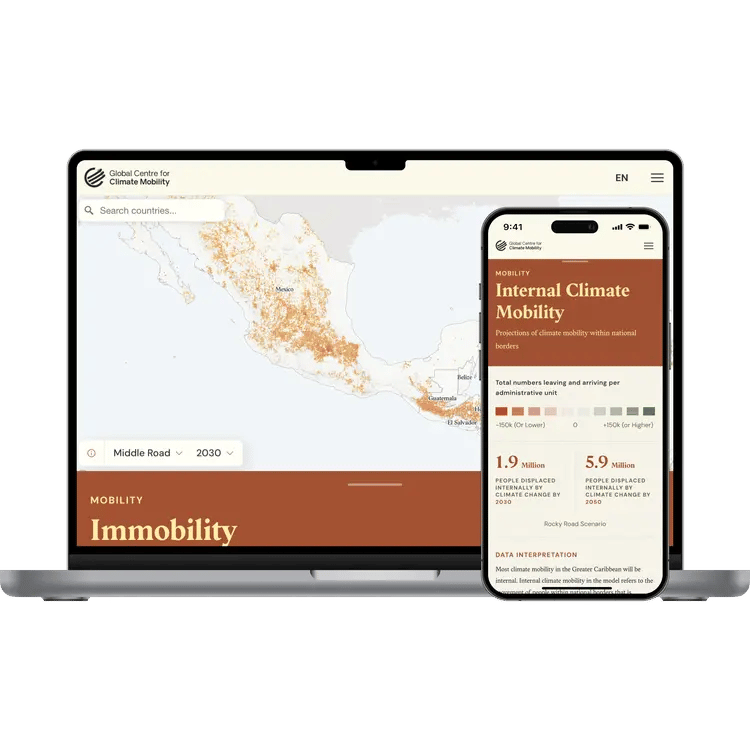
The Global Centre for Climate Mobility needed a digital platform to turn dense climate-migration data into stories that policymakers, researchers, and the public could act on across the Greater Caribbean. 3 Sided Cube took a design-first approach, building an immersive platform that pairs interactive 3D hotspot maps and a data explorer portal with multimedia storytelling from affected communities, fully bilingual in English and Spanish. Early projections put it at 15,000 unique visitors in the first three months and 1,000+ report downloads supporting academic and policy research. The platform is built to expand to other regions as the initiative grows.
 Source: 3sidedcube.com
How Much Does 3 Sided Cube Ruby on Rails Development Cost?
3 Sided Cube bills $100–$149 per hour with a $50,000 minimum project size and a Clutch cost rating of 4.5 out of 5. Its most common web development band is a substantial $200,000 to $999,999, and reported projects run from $10,000 to $500,000. This is a partner for funded organizations and enterprises with meaningful builds, and clients note that ongoing maintenance costs deserve a clear agreement early, since scope on long-running platforms can drift.
What Do Clients Say About Working With 3 Sided Cube?
Clients describe a team that buys into the mission and moves fast without losing quality.
"They took the time to get to know us, and it was clear how much they care about working with companies that care about impact." - Tilly Brooke, CEO, now>press>pay
"3SC grasped the importance of the work, was enthusiastic and proactive, contributed good ideas, worked quickly and on budget." - Tim Kelly, Executive Director, Earth HQ
"3 Sided Cube only works with organizations with strong mission statements. This inspires their people to work with passion. As a result, the whole team buys into the project." - Shubhi Rao, Founder and CEO, Uplevyl
Why Do Businesses Choose 3 Sided Cube?
Deep experience building for high-stakes, mission-driven organizations where failure is not an option
Everything built in-house, so there is no mystery offshore team behind the work
Mobile and AI depth alongside web, with a design-led process
ISO and Cyber Essentials accreditation for security-conscious buyers
A values-aligned model that draws motivated teams to impact-focused work
Edvantis
Edvantis is a data, AI, and software engineering partner founded in 2005, with 400+ professionals across Central and Eastern Europe and the USA and a hub in Rzeszów, Poland. Over 20 years it has delivered 450+ projects and earned a 96% customer satisfaction rate, working with names like Indeed, BigCommerce, Kardex, and TrustRadius. Its model centers on flexible, stackable service arrangements: staff augmentation, dedicated teams, and fixed-price projects, which makes it a natural pick for companies that need to scale an existing engineering group quickly rather than outsource a whole build.
Example project by Edvantis
A property-management platform, Safety Media, hired Edvantis to fix a compliance system that had grown slow and hard to maintain. Edvantis assembled a dedicated team of engineers, a test engineer, a technical lead, and a UI/UX designer, and traced the performance problems to memory leaks. Working across Ruby, Vue.js, PostgreSQL, and Heroku, the team cut key report generation from 15 minutes to 10–15 seconds and resolved 400+ issues, then expanded the engagement into a full customer self-management interface. What began as a targeted fix turned into a long-term maintenance and development relationship.
How Much Does Edvantis Ruby on Rails Development Cost?
Edvantis sits at the accessible end, billing $25–$49 per hour with a $10,000 minimum project size and a Clutch cost rating of 4.6 out of 5. Client investments range from $35,000 to over $1 million, spanning small firms to enterprises listed in the Fortune 500 and Inc. 5000. For teams focused on affordable capacity, especially staff augmentation to fill a specific skills gap, the combination of a low rate and a large bench is the draw.
What Do Clients Say About Working With Edvantis?
Feedback centers on reliability, budget discipline, and fast access to the right specialists.
"We particularly appreciated the agency's reliability, both in delivering the project as planned and in staying within the agreed budget." - Carsten Gastes, CEO, Duschenmarkt GmbH
"Edvantis was able to provide developers with specific skills and experiences that aligned well with the project and minimized the time required to onboard team members." - Brian Baker, CTO, Tapigo
"Their ability to bring top-level development talent, testers, and project managers was very impressive and unique." - Martin Day, CEO, Safety Media Inc.
A handful of clients mentioned that English proficiency varied across the team, so ask to meet the specific people who will be on your account.
Why Do Businesses Choose Edvantis?
A 400-person bench that can staff or scale a dedicated team fast
Stackable engagement models, from staff augmentation to full fixed-price delivery
Two decades of enterprise experience with a documented 96% satisfaction rate
A trial period on the dedicated-team model that lowers the risk of committing
Security certifications spanning ISO/IEC 27001, PCI DSS, and HIPAA
Rootquotient
Rootquotient is a product engineering company founded in 2018, with offices in Toronto, the UK, and India. It calls itself a "zero-to-one" company, building custom software from scratch for healthcare, education, fintech, retail, and energy clients that include Akamai, TD Bank, and Deloitte. Certified as a Great Place to Work and recognized by Clutch as a top software developer for three straight years, Rootquotient pairs a strong discovery process with a 4.9 out of 5 cost rating, the joint-highest in this guide. It is the youngest company on the list, which shows in its modern, product-minded framing.
Example project by Rootquotient
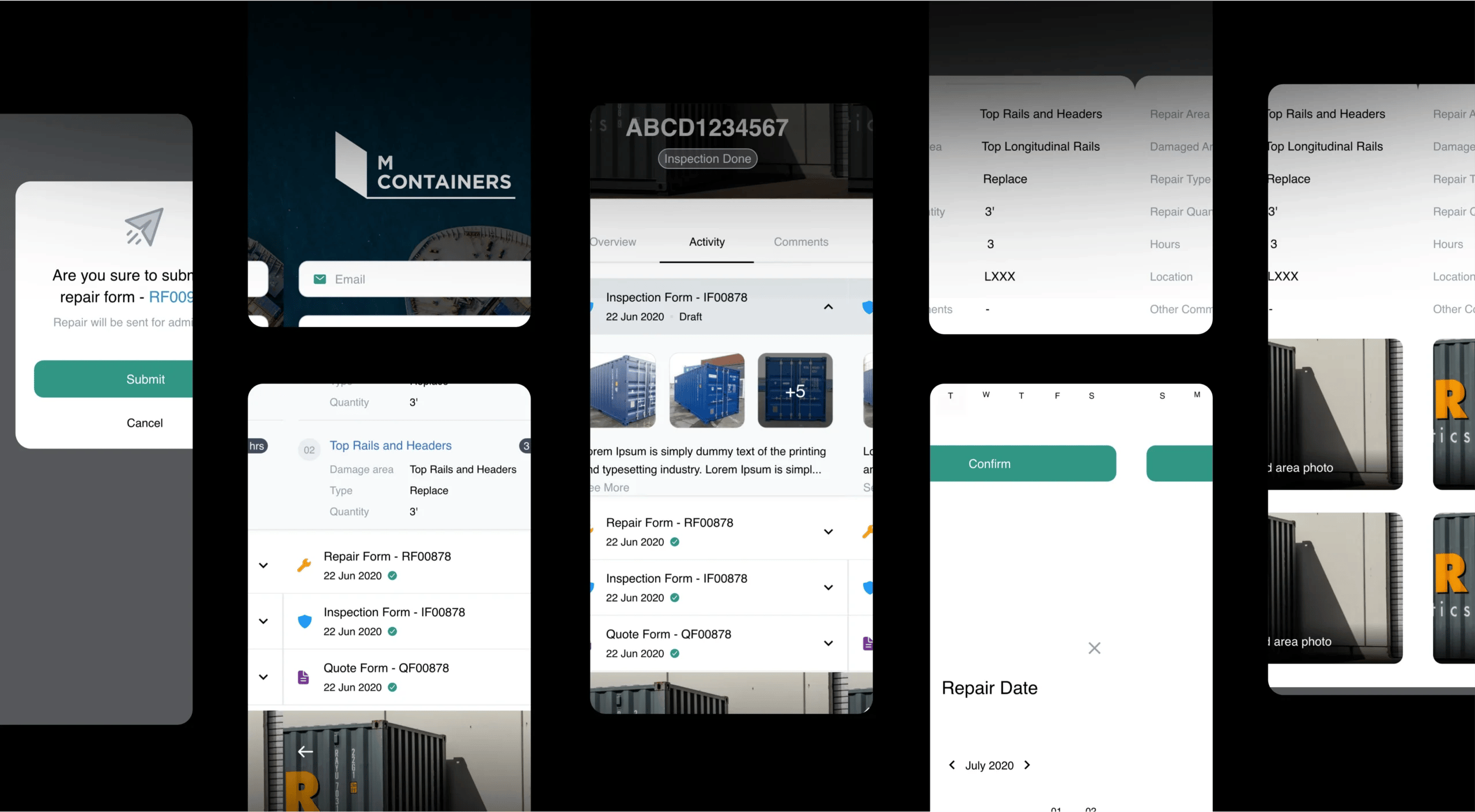
Mcan set out to digitize container-service operations that were bogged down by manual inspections and poor visibility. Rootquotient ran a discovery phase with user research, then used rapid prototyping to validate requirements before building an integrated platform with container-number validation, structured activity life cycles, integrated invoicing, and offline usage for low-network ports. The results were concrete: 95% improvement in data accuracy, container inspections 3x faster, and a 30% reduction in turnaround times. Mcan is now moving the product toward a SaaS model to scale across the logistics industry.
 Source: www.rootquotient.com
How Much Does Rootquotient Ruby on Rails Development Cost?
Rootquotient bills $50–$99 per hour with a low $10,000 minimum project size and a Clutch cost rating of 4.9 out of 5. Projects range from $30,000 to over $1 million, with the most common web development band at $10,000 to $49,999. Clients consistently tie the pricing to strong value, which, combined with the low floor, makes Rootquotient a practical choice for a well-defined MVP or a first product build without a large budget.
What Do Clients Say About Working With Rootquotient?
Reviews point to technical depth, dependable delivery, and developers who ramp fast.
"They know what they are doing and do what they said they would do. They've come in on budget, and I'm happy with how everything has gone." - Bruce Bernard, President, CMJ Sheet Metal Limited
"The onboarding process with Rootquotient didn't take very long because the developer they put forward was really good. He hit the ground running really quickly and didn't need much guidance." - Luke Harbord, CTO, Azzera
"I'm mostly impressed with Rootquotient's technical knowledge and experience with writing the code and third-party integrations. The team's problem-solving skills are impressive." - Brett Wills, Founder and CEO, CarbonOne
Because the team spans Canada, the UK, and India, a few clients noted time-zone friction, so agree on overlap hours before you start.
Why Do Businesses Choose Rootquotient?
A product-first, zero-to-one approach that starts by co-owning the problem
A rigorous discovery phase that de-risks the rest of the build
Enterprise clients like TD Bank and Akamai despite being a younger firm
Broad technical range across Rails, Node.js, React, Flutter, and AWS
Top-rated value for cost with a low minimum project size
Infront Webworks
Infront Webworks is a full-service digital agency operating since 1996 in Colorado Springs, Colorado, with a team of 10 to 49 specialists. It is the outlier on this list: its documented work is website design, development, hosting, SEO, and digital marketing rather than Ruby on Rails specifically, so treat it as the small-business, single-vendor option rather than a Rails specialist. The agency is a Google-certified partner, holds LSA certification, and carries a strong reputation for SEO results and responsive service, with a 4.9 out of 5 cost rating and the lowest entry point here.
Example project by Infront Webworks
The YMCAs of Boulder Valley, Pikes Peak Region, and Pueblo were preparing a brand-awareness campaign, but their local associations were held back by websites that were not mobile-responsive, scattered across different vendors, and hard for staff to update. Infront built multiple mobile-responsive, brand-compliant sites and centralized them in a single content management system with drag-and-drop editing, approval workflows, and granular permissions. Marketing teams across Colorado can now create and manage content without an internal web team, and the associations share consistent experiences across web, email, mobile, and social.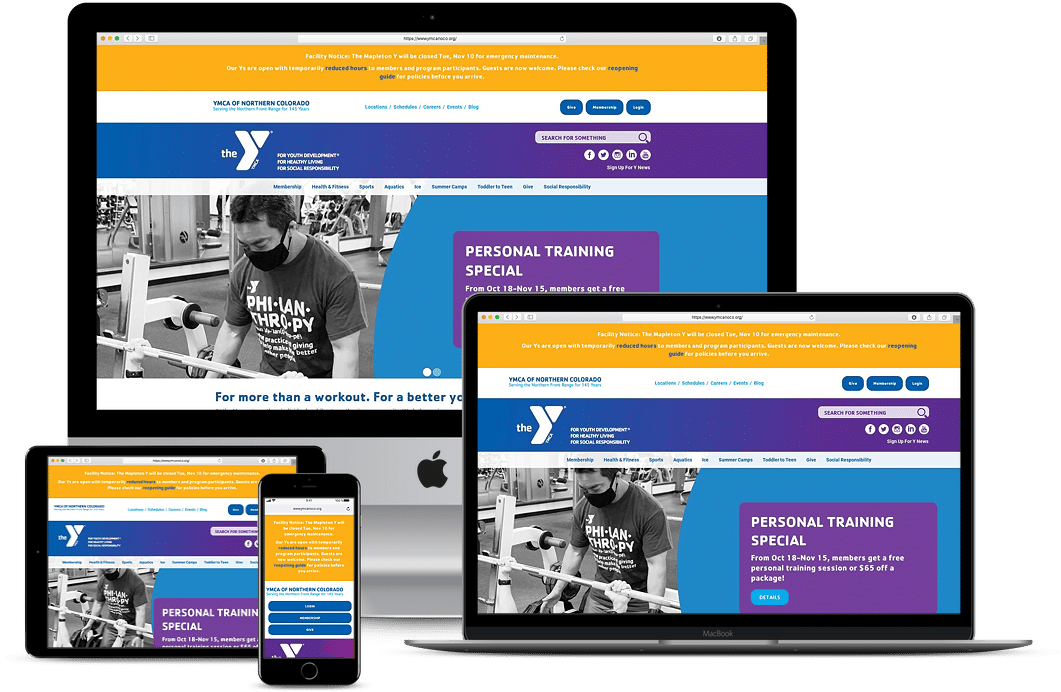 Source: www.infront.com
How Much Does Infront Webworks Ruby on Rails Development Cost?
Infront has the most accessible entry point in this guide, with a $1,000 minimum project size and an hourly rate of $100–$149, at a Clutch cost rating of 4.9 out of 5. Real engagements range from around $700 a month for SEO to roughly $20,000 for a full web design and marketing package, with most web projects landing at $10,000 to $49,999. Because Rails is not its stated specialty, treat these numbers as a benchmark for small-business web and marketing work rather than for a custom Rails application.
What Do Clients Say About Working With Infront Webworks?
Clients highlight marketing expertise, attentive listening, and quick, clear communication.
"I was really impressed with their offering in the Marketing/SEO space. Very knowledgeable and great recommendations. I looked at 2 other firms, but settled with them because of this." - Janine Davis, Owner and President, Talent Search Company
"Infront Webworks gives me the time needed to explain what I want. As a result, the website is exactly what I asked for." - Jody Smith, Founder, Plumb-EZ
"Their attention to detail was excellent. The replies to questions were quick and speedy." - Jeremiah Polacek, Advertising Rep, Wolfe Publishing Company
Why Do Businesses Choose Infront Webworks?
One vendor for the whole digital footprint: web, hosting, SEO, PPC, and content
Award-winning SEO and digital-marketing results over more than 25 years
A low minimum that suits small businesses and local organizations
Personal, responsive service with a single point of contact
Best when the priority is web presence and lead generation rather than a custom Rails platform
What Makes a Great Ruby on Rails Development Company?
A strong Rails partner is defined less by knowing the framework than by the discipline around it. Rails is convention-driven, which means a good team writes code that the next developer can read: thin controllers, clear naming, and tests around the parts of the app that carry real risk. When you evaluate a company, ask for a representative repository or code sample and look for exactly that. Sloppy, clever, or untested code is a warning regardless of how polished the portfolio looks.
Seniority on your specific project matters more than the size of the company. Several firms in this guide, including TXI, JetRockets, and Ralabs, make a point of keeping senior people on the work instead of using a junior bench under light supervision. Ask which engineers will actually write your code, and confirm their seniority before you sign. Domain experience is the other multiplier: a team that already understands healthcare compliance, fintech regulation, or marketplace dynamics will map your requirements far faster than one learning your industry on your budget, as SPIE found when Monterail paired with a manufacturing consultancy to nail construction scheduling logic.
Finally, look for a partner that plans to hand the keys back. The best engagements leave you with documentation, a team that can maintain the product, and a clear architecture, rather than a dependency you cannot escape.
How Much Does It Cost to Hire a Ruby on Rails Company in 2026?
Rails pricing in 2026 splits along two axes: where the team sits and how you engage them. Senior Rails developers bill roughly $100 to $150 an hour in North America, $70 to $110 in Western Europe, and $50 to $70 in Eastern Europe, with Latin America and South Asia lower still. Eastern European and Asian teams typically offer comparable seniority at 35% to 60% less than a North American equivalent, which is why so much Rails work is built in Poland, Ukraine, and India. The table below sets the current benchmarks.
Region | Junior / mid freelancer | Senior freelancer | Agency (blended team) |
|---|---|---|---|
North America (US, Canada) | $40–$90 / hr | $100–$150 / hr | $150–$300 / hr |
Western Europe (UK, DACH, Nordics) | $40–$70 / hr | $70–$110 / hr | $100–$180 / hr |
Eastern Europe (Poland, Ukraine) | $30–$55 / hr | $50–$70 / hr | $50–$120 / hr |
Latin America | $30–$55 / hr | $45–$70 / hr | $50–$110 / hr |
South & Southeast Asia (India) | $20–$45 / hr | $30–$55 / hr | $40–$90 / hr |
The engagement model shifts the total as much as the region does. A senior freelancer is often 30% to 60% cheaper than an agency for a small, well-defined job, because an agency rate folds in project management, design, and QA that a solo contractor does not provide. An agency earns that premium on anything with real complexity or a team-sized scope. A dedicated team, where the agency staffs full-time engineers you direct, sits between the two and suits ongoing work, while a fixed-price contract shifts risk to the vendor, who typically adds a 20% to 30% premium to absorb the uncertainty.
For project totals, a well-scoped MVP with authentication, a core data model, and essential features runs $25,000 to $60,000 across most credible teams. Budget another 10% to 25% on top of any contract for in-scope adjustments, and plan for 5% to 15% of the build cost per year for maintenance. For most MVPs, time-and-materials with a budget cap beats a rigid fixed price, since it lets you steer based on what users actually do without paying the fixed-price risk premium.
How Do You Choose the Right Ruby on Rails Partner?
Start by matching the engagement to the problem rather than the price to the budget. A fuzzy, high-stakes product with an unclear spec is worth a senior consultancy like TXI; a well-defined MVP is a fit for a value-oriented shop like Rootquotient or JetRockets; scaling an existing team points to staff augmentation from Edvantis or Ralabs. Naming that fit first narrows the field before you talk to anyone.
Then vet the shortlist on evidence, not decks. A few checks separate the real from the rehearsed:
Run a small paid trial task, four to eight hours against a real ticket in your backlog. It tells you more than any interview.
Ask to see live products and real code, not just screenshots and a case-study PDF.
Read both the positive and the critical reviews on Clutch or G2, and ask each firm directly about the weaknesses those reviews name.
Confirm who will be on your team and their seniority, then hold the company to keeping those people on it.
Pin down time-zone overlap and communication cadence, especially with a distributed or offshore partner.
Watch for the red flags too. A rate far below the regional benchmark usually means corners will be cut somewhere you will discover later. Vague answers wrapped in jargon, reluctance to share real work, and a refusal to touch legacy code all signal a team that will struggle when your project stops being greenfield. A partner that gives clear answers to hard questions early tends to keep doing so when something goes wrong mid-build.
Is Ruby on Rails Still the Right Choice in 2026?
For a large class of products, yes. Rails holds around 4.6% of the web-framework market and powers GitHub's 2-million-line monolith, Shopify's checkout, and Intercom's messaging at scale, so the "Rails is dead" claim does not survive contact with production data. Ruby 4.0 shipped in December 2025 with a new JIT compiler, and Rails 8.1 continues to sharpen the developer experience, including tooling aimed at AI-assisted workflows. The ecosystem is mature exactly where SaaS products need it: billing, multi-tenancy, background jobs, and admin tooling are largely solved problems.
Where Rails wins is speed to a working product. If your backend is mostly CRUD, integrations, and business logic, which describes most SaaS platforms, marketplaces, and internal tools, Rails will usually get you there faster and with less accidental complexity than a JavaScript-first stack assembled from parts. That is why it remains a strong default for startups validating an idea and enterprises modernizing an internal system alike.
The honest caveat: the active Rails talent pool is smaller than the Python or Node.js pool, which nudges rates and can make senior hiring slower. That is an argument for choosing an established Rails partner rather than against the framework. If your product is a real-time system with extreme concurrency demands or a heavily compute-bound workload, weigh alternatives. For the products most companies are actually building, Rails in 2026 is a safe, productive bet.
Which Ruby on Rails Partner Fits Your 2026 Roadmap?
The most useful conclusion from comparing these nine companies is that the best Rails partner is simply the one that fits your specific problem, budget, and stage. The rate you pay matters far less than whether the team has built something like your product before, staffs senior people on your work, and can operate in your time zone. Once you have named the type of engagement you need, the shortlist writes itself, and a short paid trial will confirm it faster than any sales call.
Key Takeaways
Rails is still a strong 2026 choice for SaaS, marketplaces, and internal platforms, backed by GitHub, Shopify, and Intercom in production and refreshed by Ruby 4.0 and Rails 8.1.
Senior Rails rates run about $100–$150/hr in North America, $70–$110 in Western Europe, and $50–$70 in Eastern Europe; a comparable Eastern European or Asian team costs 35% to 60% less.
A well-scoped MVP costs $25,000 to $60,000 almost regardless of vendor, so fit and seniority drive the outcome far more than the headline rate.
Match the engagement to the problem: premium consultancy for ambiguous high-stakes work, value shops for defined MVPs, staff augmentation for scaling an existing team.
Vet with a paid trial task, real code, and both positive and critical reviews; treat a far-below-market rate as a warning sign, since corners get cut somewhere you find later.
Ruby on Rails Development Companies FAQ

Grzegorz Hajdukiewicz
Chief Delivery Officer

With over a decade of experience in the IT industry, Grzegorz has a proven track record of delivering complex projects on time and on budget. At Monterail, he leads a team of dozens of developers, designers, project managers, and business analysts, ensuring the successful delivery of software solutions for clients worldwide. Passionate about agile methodologies and continuous improvement, he constantly seeks new ways to optimize the delivery process.