The New Default. Your hub for building smart, fast, and sustainable AI software

Table of Contents
IT staff augmentation means hiring developers or small teams to work with your team temporarily. People often use the phrase interchangeably with hiring a contractor or outsourcing a project, though each involves a different level of day-to-day direction.
Whether it works depends on a handful of details. Some of them end up mattering more than you may initially think.
Executive Summary
IT staff augmentation closes a specific skills or capacity gap by adding an external developer or a small team of specialists directly to an existing team.
Augmentation sits between two more permanent choices: the commitment of a full-time hire and the reduced oversight of handing an entire project to an outsourcing agency.
Companies use augmentation when a roadmap lacks a skill or when workload outpaces what the core team can handle alone.
Why and When Do Companies Use IT Staff Augmentation?
Companies reach for staff augmentation because hiring full-time is slow and expensive, while outsourcing a project means giving up control over how the work gets done.
SHRM's latest recruiting benchmark shows that the median time to fill a role is 39 days, before a new hire's notice period or ramp-up even begins. Workable's hiring benchmarks, on the other hand, put the average time to fill a senior data scientist role at 70.5 days, nearly double the general figure.
That's the exact trade-off many teams weigh when comparing nearshore and offshore outsourcing models with keeping a specialist within their own process.
The trigger is usually a skills shortage or a sudden jump in workload. A roadmap calls for a skill no one on the team has, or a launch date compresses the runway to build it. When a specific skill is missing for too long, feature work stalls, deadlines slip, and the business loses ground or delays revenue. That difficulty is compounding as AI reshapes product development, layering new specialized roles atop existing shortages.
Model | Speed to Onboard | Cost Structure | Control Over Process | Team Integration |
In-House Hiring | Weeks to months (sourcing, interviews, onboarding) | Salary, benefits, and recruiting overhead | Full control, held internally | Native from day one |
IT Staff Augmentation | Days to a few weeks | Hourly or monthly rate, no overhead costs | Client keeps process and priorities | Works inside existing tools and workflows |
Full Outsourcing / Agency | Weeks (scoping plus vendor onboarding) | Fixed project fee or retainer | Vendor manages delivery and process | Vendor's own team, limited day-to-day overlap |
Staff augmentation lands in the middle on every measure, faster than a full-time hire and easier to manage than an outsourcing deal.
But what does that middle ground look like once the contract is signed?
How Does IT Staff Augmentation Work?
The mechanics stay consistent even when vendors label it differently, whether the term is IT staff augmentation, software staff augmentation, or simply team extension.
The client defines the specific skill or role that's missing. It can be anything from a senior Vue.js developer to someone who has built HIPAA-compliant systems before. From there, whoever joins works inside the client's own tools and sprint rhythm from day one.
The client's project manager retains ownership of the backlog and priorities throughout. The staffing partner's role is limited to finding and vetting the right person.
When the skill match is right, the new developer contributes inside the team's board and chat channels from day one. That alignment is what keeps team velocity high and the roadmap on schedule.
A few terms are worth confirming before signing anything:
Vetting rigor. Respectable offshore software companies can demonstrate how thoroughly they verify technical skills upon request.
Contractual flexibility. Whether the engagement can scale up or down as the scope changes, and there’s no need for lengthy renegotiation each time.
IP and confidentiality terms. Who owns the code the augmented developer writes, and how client data is handled after the engagement ends.
The model adjusts its size based on the shortfall. Some engagements need a single engineer for a few months; others require a small, dedicated pod that scales as the project grows. It’s that flexibility that lets one company bring in a single backend developer for a short, well-defined task, while another builds a several-person pod for a platform migration.
When Do Companies Use IT Staff Augmentation?
Staff augmentation can solve problems like a missing specific skill, a temporary spike in scope, or a steady mismatch between team size and workload. Each one points to a different way of sizing the engagement.
Closing a Niche Skill Deficit
A product team faces an unexpected obstacle: a single feature requires deep expertise in a specific stack. But nobody on staff has used it before. Posting a full-time role would take weeks. The need itself might not outlast this one release, making a permanent hire hard to justify.
Bringing in a specialist for the duration of the sprint unblocks the feature without creating a permanent role that outlasts the need.
For example, a mid-size fintech company needed a payment specialist for one quarter to launch a new checkout flow, then closed the contract once it went live. It was launched on time, and the specialist's contract closed the same week, with no lingering headcount to justify afterward.
Scaling a Team Through a Project Peak
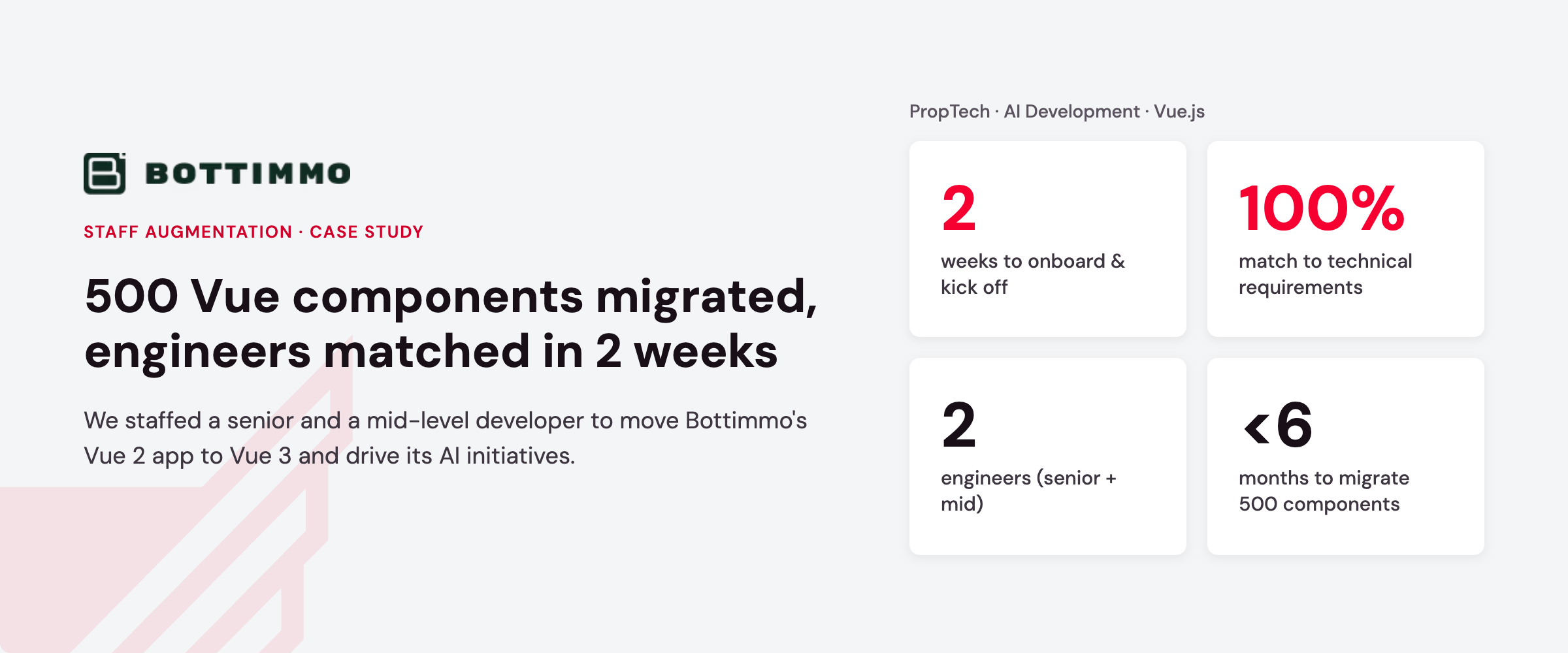
Some projects have a defined peak: a major migration, a compliance deadline, or a big feature push ahead of a fundraising round, etc. A company facing that kind of spike can add a dedicated pod for the duration, while not increasing permanent headcount for work that won't last.
This is the dedicated-team side of the model. The same partner who supplies one specialist for a small shortage can supply several people for a defined period, then scale back down once the peak passes. The transition between the two occurs within the same contract, with the same point of contact throughout.
Extending Capacity Without Long-Term Headcount Commitment
Some companies maintain a standing shortfall between what their core team can deliver and what the business needs, regardless of any single project or peak. For example, a retail company heading into its busiest season might add a backend developer on a contract through the run-up, then close the contract once volumes settle.
The arrangement can end with no severance costs or the morale impact of a layoff. That’s because billing is based on an hourly or monthly basis. That makes it easier to plan around a software development budget that shifts by project type and phase than a permanent hire's fixed cost would.
Across all three cases, the underlying decision is the same: define the shortfall precisely enough for a specialist or small pod to close it cleanly. However, one category of skill deficiency has recently grown large enough to warrant its own review.
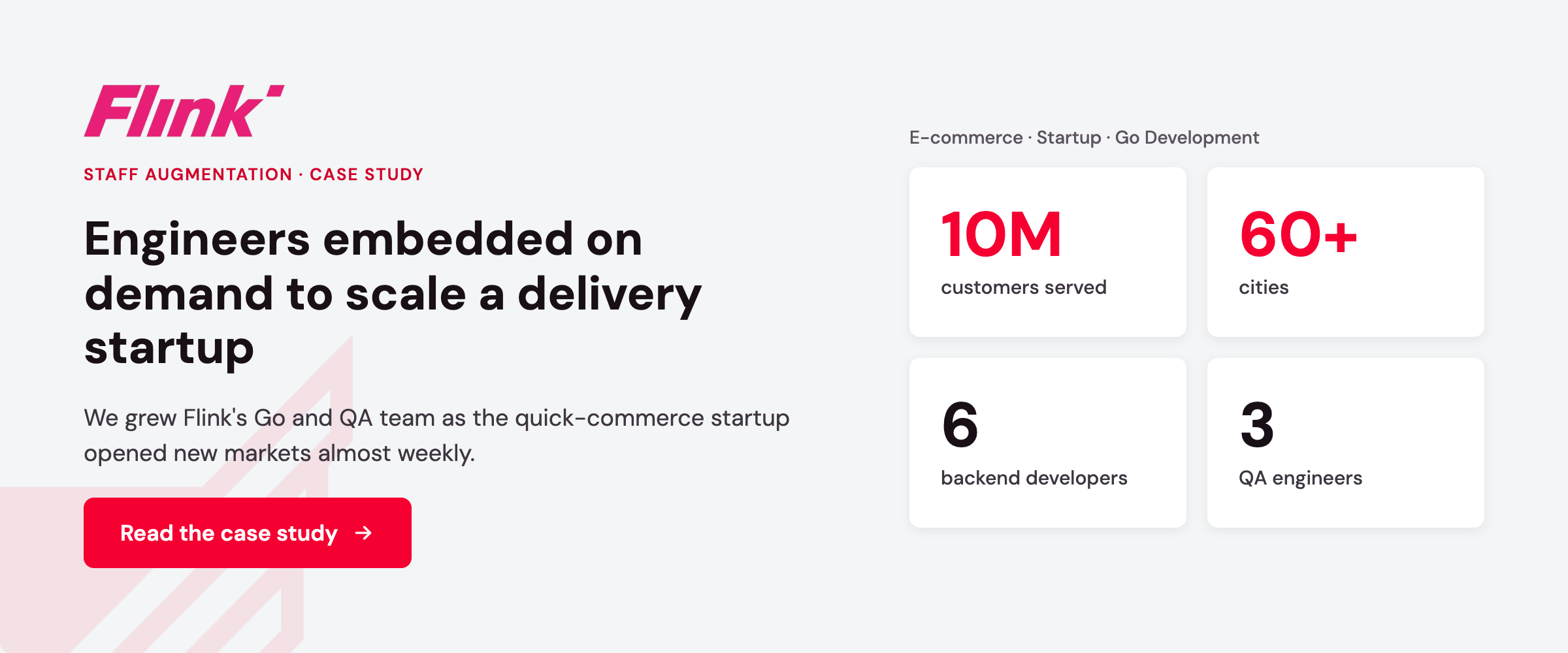
That was the story of Flink. The client needed a production-ready backend to support rapid growth as a German grocery delivery startup. Nine Monterail developers joined Flink's team as the startup opened new markets almost weekly. Adding a warehouse went from an engineering project to a routine operations task, and the backend kept pace as Flink reached 10 million customers across 60+ cities.
IT Staff Augmentation for AI and ML Projects
AI and ML have created one of the fastest-growing skill deficits in software right now. AI model and application development recently overtook traditional IT skills as the hardest capability to find, according to ManpowerGroup's 2026 survey of 39,000 employers.
Specialized roles such as ML engineers and MLOps practitioners remain scarce and costly to hire full-time, making augmentation a common way to access that talent with no long-term commitment. AI-focused engagements typically require tighter vetting and closer data scrutiny than a general developer search, since the work often involves proprietary data or training pipelines.
Companies often need just one or two specialists here, the individual-scale pattern behind Monterail's forward-deployed engineer model, such as a single ML engineer prototyping a new feature.
What Should You Know Before Choosing a Staff Augmentation Partner?
A handful of practical questions are easy to skip when comparing staff augmentation companies during a pitch. However, they are the ones that shape the first few weeks of the engagement.
Onboarding and integration time. Even a strong specialist needs a few days to learn a codebase and its conventions before delivering at full speed.
Time zone and communication overhead. Limited overlap in working hours delays standups and code review, turning same-day questions into next-day answers.
Data security and vetting quality. External staff accessing production systems raises IP and data concerns, with third-party breaches doubling to 30% in 2025. Weak vetting vendors often introduce this risk.
Confirm ramp-up expectations before signing so the specialist can start contributing on schedule. Set clear overlap hours up front, and keep daily standups quick and clear despite the distance. Ask for the vetting process in writing, and the door that usually lets a breach in stays closed.
Key Takeaways
Software staff augmentation places vetted external developers inside a company's own team and process, unlike outsourcing an entire project to an agency.
It fits a narrow need well, covering a specific missing skill or extra capacity for a limited period while the product itself remains fully within the company's hands.
Cost and control sit between full outsourcing (least control, typically cheaper per hour) and full-time hiring (most control, slowest to start).
The model scales in both directions, from one specialist to a several-person pod. That range lets a growing team size the engagement to what's genuinely missing.
Vetting quality and integration process end up mattering more than headcount when picking a partner.
Staff Augmentation as a Capacity Lever
The most useful way to think about staff augmentation is as an ongoing lever, one a company can turn up or down as the work itself changes. A team facing a six-week skill deficit can bring in one specialist and close the engagement when the work does. A team scaling toward a launch can add a pod for the stretch and step it back down after the busiest weeks end. What makes the model useful is how closely the team's shape can track the actual need.
Getting the shape right starts with naming the specific skill or capacity that's missing, before reaching out to a partner. That might be one skill for a few weeks, or a couple of extra hands for a quarter.
Monterail's dedicated development team page breaks down how the full-pod side works, if that's the shape you need. For a single specific role instead, get in touch to talk it through directly.
IT Staff Augmentation FAQ

Grzegorz Hajdukiewicz
Chief Delivery Officer

With over a decade of experience in the IT industry, Grzegorz has a proven track record of delivering complex projects on time and on budget. At Monterail, he leads a team of dozens of developers, designers, project managers, and business analysts, ensuring the successful delivery of software solutions for clients worldwide. Passionate about agile methodologies and continuous improvement, he constantly seeks new ways to optimize the delivery process.