The New Default. Your hub for building smart, fast, and sustainable AI software
)
Table of Contents
AI and the Cost of Building: Why Speed Is the Wrong Metric
The cheapest time to build software is right now. The second cheapest will be tomorrow. That single shift, in the cost of creation, is quietly dismantling assumptions that have governed how teams discover, validate, and commit to ideas for decades. This fourth article in The New Default speaker series examines what fills the space that opens up when building stops being the bottleneck.
Drawing on the insights of Maciej Korolik, Łukasz Pawłowski, and Michał Nowakowski, a unifying theme emerges: AI does not simply accelerate existing processes - it exposes which ones were never worth keeping. What follows is an exploration of how developers, product managers, and strategists are rethinking control, validation, and the very definition of software in an era when building has become dramatically cheaper and failing has become far less costly.
Key takeaways:
AI changes the economics of building, not just the speed. When development costs drop, internal tooling becomes a viable default rather than a luxury.
Human oversight is not optional — it is the architecture. Reliable AI requires structured review, planning, and agent separation built in from the start.
Discovery should precede development. AI makes thorough ideation cheap enough that skipping it is no longer a reasonable trade-off.
Synthetic research is a starting point, not a shortcut. Proto personas and scraped signals accelerate hypothesis formation but must be grounded in real user engagement.
Disposable software is a strategic mindset. Treating software as replaceable encourages bolder experimentation and more honest validation.
Three Practitioners on What AI Actually Changes About How Teams Work
The most useful thinking on AI rarely comes from theorists. It comes from people who have to make it work on Monday morning. Maciej Korolik, Łukasz Pawłowski, and Michał Nowakowski are three such practitioners: a frontend engineer, a delivery manager, and a solution architect, each approaching AI from a different angle, each arriving at the same place: that AI creates durable value not when it replaces human judgment, but when it extends the reach of teams deliberate enough to design around it.

Maciej Korolik, Senior Frontend Developer and AI Engineering Manager at Monterail
Maciej Korolik is a Senior Frontend Developer and AI Expert at Monterail, specializing in React.js and Next.js. Passionate about AI-driven development, he leads AI initiatives by implementing advanced solutions, educating teams, and helping clients integrate AI technologies into their products. With deep hands-on experience in generative AI tools, Maciej bridges the gap between innovation and practical application in modern software development. He has represented Monterail at international events, including the AI Engineer Summit in New York, and his writing on AI-powered coding practices has become a reference point for engineering teams navigating the shift to AI-assisted workflows.
In The New Default, Maciej addresses four interconnected dimensions of AI-augmented development:
How to keep code reviews rigorous at AI speed,
How to collapse the design-to-code pipeline,
When to build bespoke internal tools rather than buying SaaS,
Why the human-in-the-loop approach consistently outperforms unconstrained AI generation in production environments.
Across these topics, Maciej makes a consistent case that AI amplifies engineering outcomes only when deliberate structure, agent separation, living documentation, human validation gates, are built into the workflow from the start.
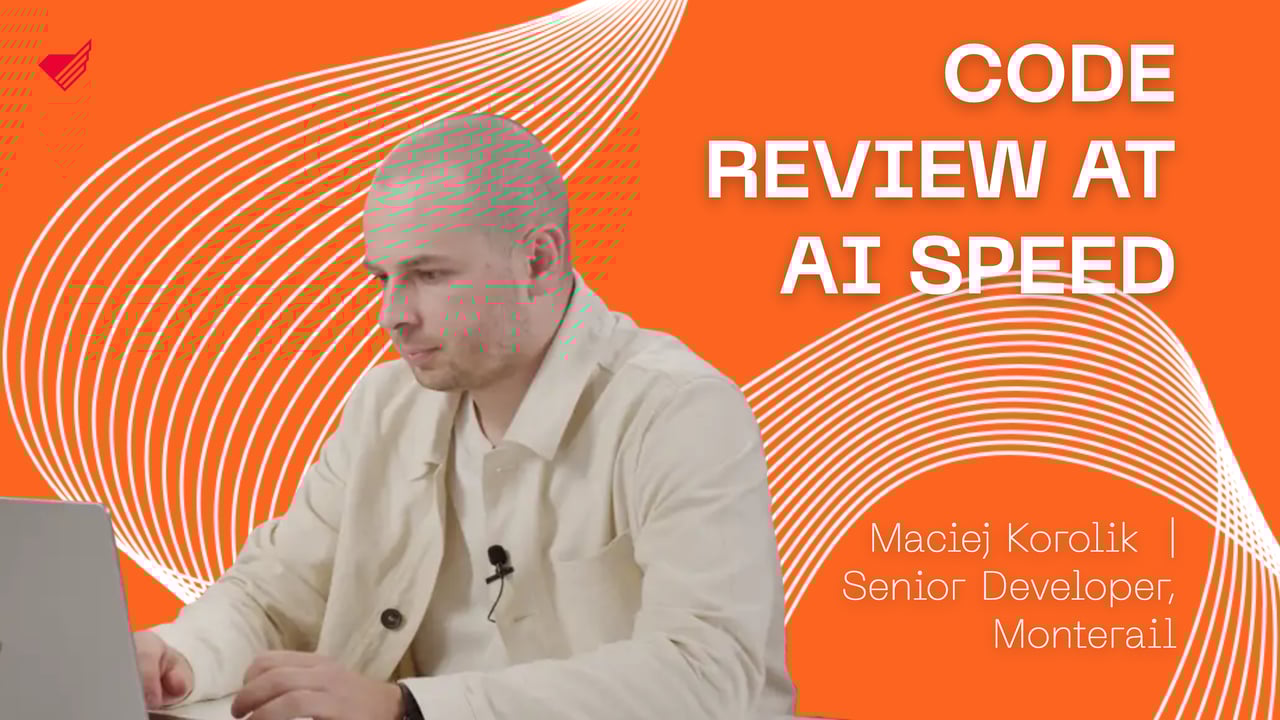
"I do vibe coding sometimes when I'm doing things for myself, but when I'm working on production, I care about quality, and I also want to understand the code. So I have the full plan divided into steps — this is where the human is in the loop. I can read everything. I can check if it makes sense."
Maciej presents a coherent engineering philosophy: AI is most powerful when it is given clear boundaries, separated responsibilities, and a human reviewer who understands what it has been asked to do.
AI as a critical third reviewer, not a rubber stamp
Maciej argues that AI code review tools like CodeRabbit function best when treated as a genuinely independent voice rather than a confirmatory assistant. The key insight is architectural: using a separate agent for review — one without the context of the agent that wrote the code — is what produces meaningful critique. When the same model that builds is asked to evaluate, it tends to affirm rather than interrogate.
Figma-to-code pipelines depend on design discipline upstream
His view on AI-assisted design translation is unsentimental: the quality of what AI produces from a Figma file is directly determined by the quality of the file itself. Well-structured layers, clear naming conventions, and responsive design thinking are not just good habits; they are the upstream inputs that determine whether AI conversion is a time-saver or a source of rework.
Internal tools are now the rational default
Maciej makes a compelling case that the economics of software development have shifted. With AI dramatically reducing build time, the traditional case for purchasing SaaS, avoiding the cost and complexity of building, weakens. For many team-specific use cases, a bespoke internal tool now offers more control, faster iteration, and no vendor lock-in, and can be assembled in hours rather than months.
Planning mode over vibe coding in production
His most pointed argument is about discipline under pressure. The "vibe coding" approach — accepting whatever the AI generates and moving on — may be fine for personal projects, but in production, Maciej treats AI-generated plans as drafts to be read, challenged, and confirmed. The developer's role shifts from writing code to auditing intent: verifying that the plan makes sense before execution begins.
Łukasz Pawłowski, Delivery Manager and Senior Project Manager at Monterail
Łukasz Pawłowski is a Delivery Manager at Monterail, where he brings together project management expertise and a sharp eye for how AI can accelerate the earliest stages of product development. With a background in business process management and years of experience guiding cross-functional teams through complex software projects, Łukasz has developed a practice-first perspective on AI-assisted ideation, focused not on what AI can theoretically do, but on what it can reliably deliver when integrated into real product discovery workflows.
In The New Default, Łukasz explores two underused dimensions of AI in product work: its capacity to surface authentic market demand signals from public platforms like Reddit, and its potential to simulate user perspectives through proto personas when direct user research is unavailable or insufficient. Together, his contributions make the case that AI is reshaping the front end of product development just as decisively as it is reshaping the back end, and that teams which invest in AI-assisted discovery will arrive at better-grounded hypotheses before a single line of code is written.
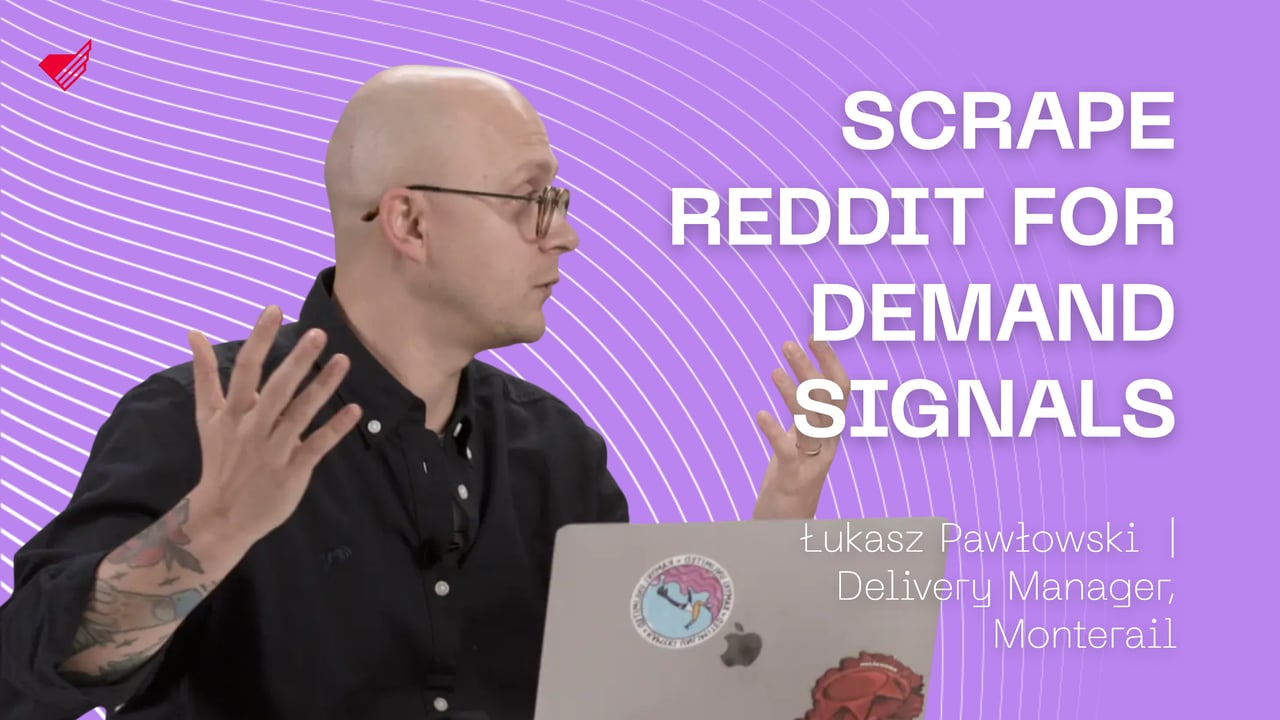
"I just ran it for two minutes, and I have input from 1,270 rows. One cool source of this knowledge is Reddit. It is open. They are okay with scraping. And a lot of people use it — for us, it's low-hanging fruit."
Across his contributions, Łukasz argues that AI does not replace the discipline of research; it removes the excuse for skipping it. Discovery is now fast enough and cheap enough that there is little justification for building on assumptions alone.
Reddit as a structured demand signal, not just noise
Łukasz presents a practical, reproducible methodology for using AI to extract and categorize user pain points from Reddit at scale. What once required days of manual research can now be completed in minutes, yielding structured insight into what real users complain about, what products they have tried, and where unmet needs are concentrated. The approach combines language model analysis of the competitive landscape with targeted scraping to produce data that is both broad and specific.
Proto personas as hypothesis engines, not substitutes for users
His treatment of proto-personas is notably careful. He presents them not as a replacement for real user research, but as a structured way to work through data when direct access to users is limited. A proto persona is a simulated user built from research findings, designed to spark hypotheses and surface questions that teams might otherwise overlook. Crucially, Łukasz emphasizes the methodological responsibility this requires: understanding the data sources, acknowledging embedded biases, and treating outputs as starting points for validation rather than validated conclusions.
A more rigorous, repeatable discovery cycle
What distinguishes Łukasz's approach is its emphasis on process. He describes a disciplined loop that generates data with proto personas, extracts insights, validates assumptions, documents learnings, and iterates, bringing the rigor of the scientific method to a phase of product development that is often the least structured. AI does not make this loop automatic; it makes it tractable.
Michał Nowakowski, AI Solution Director and AI Expert at Monterail
Michał Nowakowski is a Solution Director and AI Expert at Monterail. His strong foundation in data and automation, combined with a background in operational business units, gives him a grounded, real-world perspective on the challenges organizations face when adopting AI. Michał leads feature discovery and business process design to surface hidden value and identify new verticals. He advocates for AI-assisted development, integrating conditional logic with machine learning capabilities to build systems that reduce manual effort and unlock overlooked opportunities. He has spoken at international events, including the AI Engineer Summit, and contributed extensively to Monterail's published thinking on AI strategy and product discovery.
In The New Default, Michał introduces two closely related ideas that together constitute a new paradigm for software strategy: the concept of disposable software and the shift toward data as the primary strategic asset. Where others focus on what AI can build, Michał focuses on what AI changes about how teams should think before building, and how the falling cost of being wrong should translate into greater organizational courage to test, discard, and learn.
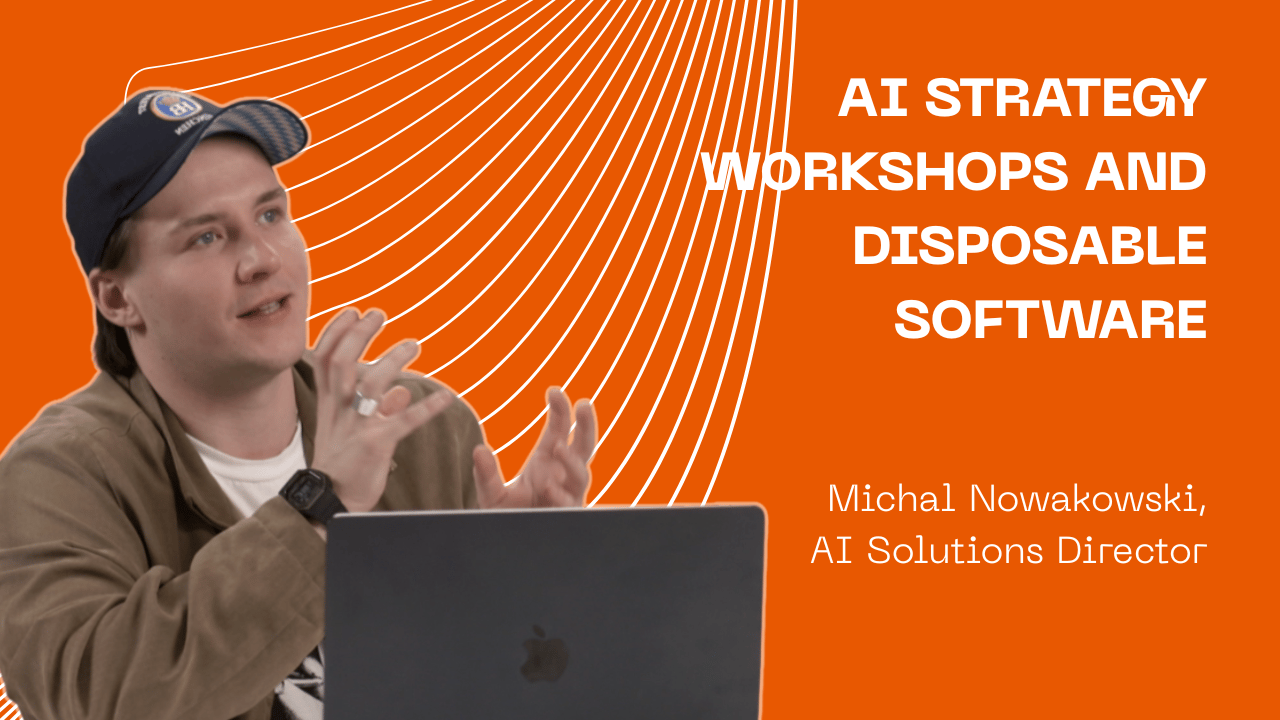
"It's not just to create an AI feature to get a quick fix for the AI hunger. It's more of changing the perspective on how you can actually develop your software in a way that you can utilize your data."
Michał makes the case that AI's deepest impact on product development is not in the features it enables, but in the strategic posture it makes possible, one defined by hypothesis-driven experimentation, lower tolerance for untested assumptions, and a fundamentally different relationship with the software teams build.
Disposable software as a risk management strategy
Michał's central provocation is that software should be treated as a disposable asset rather than a permanent investment — especially in the early stages of validating a new idea. When AI dramatically reduces the cost of building, holding on to code that has not proven its value becomes the higher-risk choice. Disposable software is not a statement about quality; it is a statement about commitment: teams should be willing to throw away what has not been validated and build something better.
AI lowers the cost of being wrong — so be wrong faster
A recurring theme in Michał's thinking is that AI does not just make building cheaper; it makes experimentation more rational. When validation is slow and expensive, organizations naturally become conservative. When it is fast and cheap, the bias should shift toward running more tests, challenging more assumptions, and treating each initiative as a hypothesis to be confirmed or refuted rather than a plan to be executed.
AI strategy belongs to the whole team, not to a feature roadmap
Michał pushes back against the tendency to treat AI adoption as the delivery of a specific AI-powered feature. The more durable opportunity, he argues, is for teams to redesign their development approach so that the data generated by user interactions becomes a continuously growing strategic asset. This requires a workshop mindset, one that begins by imagining what would be possible with unlimited resources, then works backwards to what is achievable, rather than starting from the constraints and never escaping them.
Data is the enduring product of software development
Underlying all of Michał's contributions is a reframing of what software is actually for. Features are transient; data is cumulative. Teams that design their systems with data utilization in mind from the outset, not as an afterthought, will be positioned to compound their AI advantage over time, while those that ship features without capturing learning will find themselves perpetually starting from zero.
Why the AI Advantage Belongs to Intentional Teams, Not the Fastest Shippers
Maciej, Łukasz, and Michał approach AI from different disciplines, but their conclusions point in the same direction. Reliable development requires deliberate architecture. Thorough discovery is now faster than skipping it. And the teams that compound their advantage will be those who treat software as disposable, data as strategic, and every initiative as a hypothesis rather than a plan.
Together, they make a quiet but pointed argument: the new default is not the team that ships the fastest. It is the team that has thought hardest about what shipping is actually for.
)
Barbara Kujawa
Content Manager and Tech Writer at Monterail

Barbara Kujawa is a seasoned tech content writer and content manager at Monterail, with a focus on software development for business and AI solutions. As a digital content strategist, she has authored numerous in-depth articles on emerging technologies. Barbara holds a degree in English and has built her expertise in B2B content marketing through years of collaboration with leading Polish software agencies.