The New Default. Your hub for building smart, fast, and sustainable AI software

Table of Contents
Poland is the most balanced location in Europe for engineering operations that need to grow. It’s the only large European market where senior talent, grid capacity, buildable land, and public capital are all still available at the same time.
Germany has the engineers but not the cost base. Ireland and the Netherlands have the capital but not the power. The Nordics have clean, cheap electricity but a fraction of the workforce.
That does not make Poland the answer to every question, and this piece is specific about where it comes up short. But if you are planning a five-to-ten year buildout, the list of countries that can absorb that growth is short, and Poland is on it.
Executive Summary
Poland's position in 2026 rests on four things holding at once: A workforce of 778,800 ICT specialists, fifth largest in the EU; whole-economy labor costs at 42% of Germany's; a transmission plan that explicitly provisions for data center load through 2040; an R&D tax regime that still pays for itself for companies below the global minimum tax threshold.
EU-funded infrastructure lowered the cost of operating there, which drew hyperscalers, which raised the ceiling on the work Polish engineers get to do.
What has changed since this article first ran is that the talent market has tightened at the senior end and softened at the junior end, while the cost gap with Western Europe closes by roughly six points a year. Poland remains a good answer for European buildouts.
What Are The Options For European Engineering Leaders?
The FLAP-D markets are not closed, but they are expensive and slow. Colocation vacancy across Frankfurt, London, Amsterdam, Paris and Dublin hit 6.4% in Q2 2026 and is forecast to reach an all-time low by year end, with pricing up about 12% in 2026 to roughly €145/kW. Grid connection queues in those cities are routinely quoted at seven to ten years.
There are two caveats. One, Ireland lifted the Dublin connection moratorium in December 2025. It’s on demanding terms: new data centers must supply on-site generation covering full demand, export to the grid when called, and meet 80% of annual demand from new Irish renewables. Hyperscale self-build across Europe also grew 22% in 2026. The core markets are not full so much as costly, conditional and slow.
Poland fills that gap. Colliers' H1 2026 EMEA report names energy constraints in the core metros as a reason capital is moving east, and Poland is the largest destination on that path.
What Are The Advantages of Engineering in Poland?
Two decades of EU structural funds rebuilt Polish roads, rail and industrial zones, which lowered the cost of operating there. That cost base attracted hyperscalers and shared-service operations, which raised the local ceiling on salaries and on the complexity of work available. Higher-ceiling work attracted higher-value R&D, which justified more capital, which deepened the talent pool again.
Samsung's R&D Institute Poland is a good illustration of the end state. Polish engineers ship AI, cybersecurity and language-processing code into products sold worldwide. They don’t just maintain someone else's legacy stack.
This is what separates Poland from its regional peers.
Does Poland Lead European High-Scale Engineering in 2026? 7 Things To Consider
1. The Largest Senior Engineering Bench in Central Europe
Poland had 778,800 ICT specialists in 2025 per Eurostat, the fifth largest such workforce in the EU, ahead of the Netherlands and roughly three times any other country in the region. About 76,000 students graduate each year from STEM, ICT and engineering programs.
31.4% of Polish 25-to-34-year-olds hold a master's degree or equivalent against an OECD average of 16%, second highest of 36 countries. For work that needs architects rather than headcount, that density is the number that matters. Poland also ranks 15th of 123 countries on the EF English Proficiency Index 2025 edition, scoring 600 against a global average of 488.
Workforce growth has flattened, from 15.4% in 2022-23 to 1.1% in 2024-25. And the market has split: senior-targeted postings rose from 50% to 55% of the total while junior postings fell to around 5%, a shift Polish recruiters attribute partly to AI absorbing routine tasks. Poland in 2026 is a buyer's market for junior talent and a seller's market for senior engineers, which is the useful half of that trade if you are staffing high-scale work.
2. Stellar Cloud and AI Infrastructure
Be precise about what is on the ground, because the providers are not equivalent. Microsoft Azure runs a full region, Poland Central, with three availability zones. Google Cloud runs a full region, europe-central2 in Warsaw, opened in 2021 as the first in Central and Eastern Europe. AWS operates a Warsaw Local Zone rather than a region, an edge deployment for latency-sensitive workloads without full multi-AZ resilience.
Microsoft committed PLN 2.8 billion, about USD 700 million, to Polish data center expansion in February 2025. Google's agreement with the Polish Development Fund targets AI in energy and cybersecurity, and Google employs over 2,000 people in Poland.
Publicly, the PIAST-AI Factory at Poznań began bringing services online in Q3 2026, with a second facility planned for Kraków. Kraków's Helios supercomputer ranked 96th in the June 2026 TOP500 and eighth in the Green500. Poland also leads a consortium bidding to host an EU AI Gigafactory, though that competition does not close until November 2026.
3. Grid and Power Capacity
Power is the binding constraint on European data center growth. Without a connection, nothing else matters.
Transmission operator PSE's Network Development Plan for 2027-2036 models data center demand explicitly for the first time, anticipating 500MW of connected capacity by 2030, 1.2GW by 2034 and more than 5GW by 2040, with sector demand climbing from 1.7 TWh today to over 29 TWh. PSE has committed PLN 64 billion in transmission capital expenditure to support it.
Live capacity is roughly 200MW of colocation and 291MW of total IT capacity, placing Poland in Europe's top ten. The Polish Data Center Association projects over 600MW by 2030 and, with PwC, put the sector's gross value added at PLN 10.6 billion in June 2026.
The renewable picture moved this summer. Baltic Power delivered Poland's first offshore wind electricity to the grid on 10 July 2026, a 1.14GW project expected to generate around 4 TWh annually, with the 1.5GW Baltica 2 following in 2027. Poland also runs the EU's second-largest district heating system by heat delivered, about 22,000 km serving 15 million people, which makes waste-heat recovery commercially viable.
Factor | Poland | FLAP-D markets |
|---|---|---|
Grid capacity for new builds | Provisioned in PSE's 2027-2036 plan; 1.2GW modeled by 2034 | Constrained; 7-10 year connection queues |
Land availability | Available outside Warsaw | Severely limited |
Colocation vacancy | Market still building out | 6.4% (Q2 2026), heading for a record low |
Pricing trend | Below FLAP-D | Up ~12% in 2026, to ~€145/kW |
Renewable backbone | First offshore wind online July 2026 | Mixed by country |
Heat-reuse infrastructure | EU's 2nd-largest district heating system | Limited |
Permitting | Simplification committed June 2026; no dedicated law yet | Slow |
4. R&D Economics That Work
Poland's IP Box regime taxes qualifying IP income at 5%, and R&D relief allows deductions of up to 200% of eligible costs. Both hold through 2026.
Poland implemented the EU global minimum tax in January 2025. If your group's consolidated revenue exceeds €750 million, a Polish effective rate below 15% is topped back up to 15%. The 5% headline is real for SMEs and scale-ups and largely theoretical for a multinational. A draft amendment would further restrict IP Box access from January 2027 by requiring at least three unrelated full-time employees.
The surrounding ecosystem stands regardless. Innovate Poland launched with a PLN 4 billion first-phase budget, and the business services sector employs 500,500 people across 2,179 centers, contributing 6.1% of Polish GDP and USD 48.4 billion in service exports.
5. Geography and Political Alignment
Poland borders seven countries, putting most of the continent within same-day logistics reach, and sits on Central European Time alongside Germany and France.
Security has become an economic input. Defense spending rose from 2.19% of GDP in 2021 to 3.75% in 2024, an estimated 4.25% in 2025 and a budgeted 4.68% for 2026 on NATO's accounting. Poland was NATO's largest relative spender in 2025, though Lithuania, Estonia and Latvia are all ahead on 2026 estimates. Poland also secured €43.7 billion under the EU's SAFE defense loan instrument, the largest allocation of any member state, with 89% directed into Polish industry.
US defense technology is arriving, more narrowly than commonly reported. Anduril agreed in July 2026 to produce Barracuda-500M cruise missiles with state-owned PGZ in Bydgoszcz, the first such line in Europe, and Palantir signed a letter of intent with the defense ministry in October 2025. Neither has disclosed a Polish office or headcount, and both are defense-industrial rather than commercial software arrangements. FORT KRAKÓW opened in January 2026 as Poland's first NATO DIANA accelerator.
6. Operational Track Record
Pioneers absorb risk that followers do not repeat, and the playbook for running serious engineering out of Poland already exists. Samsung maintains one of its largest European footprints there, combining R&D, manufacturing and sales, with around 4,239 employees at the end of 2024. Danone's Katowice planning center coordinates forecasting and distribution for 26 factories across nine European countries.
The resilience evidence has improved. Poland grew GDP 3.6% in 2025 and 3.8% year-on-year in Q2 2026, the fastest of any large EU economy. FDI into Europe fell 7% in 2025 while Poland's rose 10%, per EY's May 2026 survey, in the same year Poland became the first NATO member to fire on Russian assets.
7. Services Layer That You Can Enter Through
Most European companies do not enter Poland by buying land and hiring two hundred people directly. They enter through a software services partner, scale to the point of comfort, then commit to a permanent footprint.
Polish IT services exports reached PLN 80 billion in 2024, about 17% of all Polish services exports, and outsourcing software development to Poland usually follows the above sequence.
Notable Polish Software Development Companies
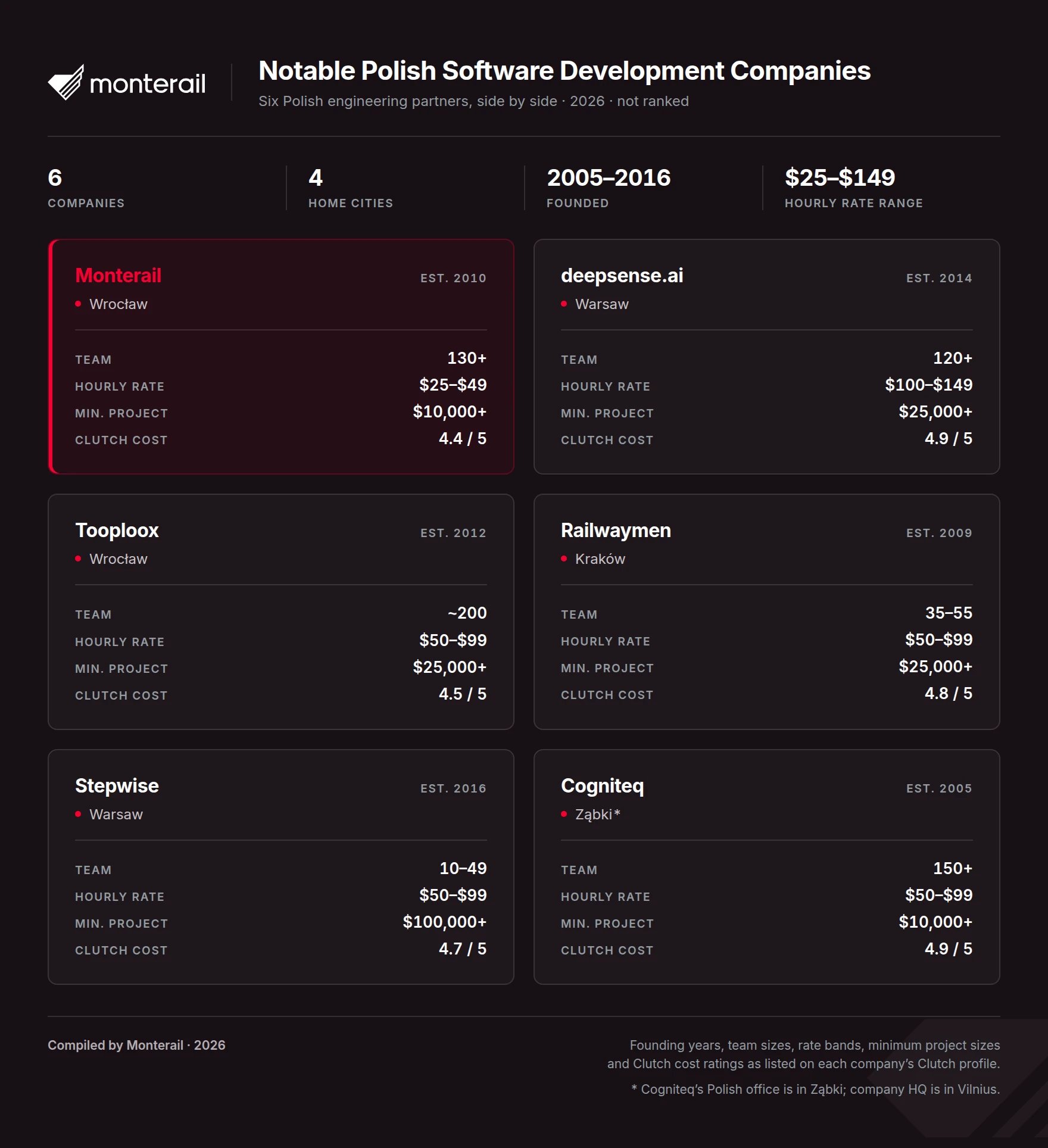
This list is not ranked. These six were chosen to show the range of the Polish market, from a two-hundred-person research organization to a senior-only consultancy, at price points from $25 to $149 an hour. The right one depends on whether you need product velocity, research depth, regulatory rigor, or a team that will still be there in five years.
If your search is specifically about AI capability, our roundup of the best AI software development companies in Poland goes deeper on that dimension.
Monterail
Monterail is a Wrocław product engineering company founded in 2010, with 130+ in-house engineers, designers and product specialists and 900+ projects delivered for clients including Bosch, Merck, EY, DocPlanner and SharkNinja. Acquisitions of Untitled Kingdom, EL Passion and Lakeview Labs since 2024 added MedTech, design and mobile depth, alongside dedicated AI development services. Current NPS is 71.
Example Project by Monterail
SPIE Belgium, a 1,550-person division of the European multi-technical services group, was scheduling 600 field workers across disconnected databases, attendance trackers and spreadsheets with no single source of truth. Monterail replaced it in a 7-week fixed-price engagement, starting from a working prototype built in 24 hours and following with 13 releases over four months. The platform reclaims 100 hours per week previously lost to manual reconciliation. Read the full SPIE case study.

How Much Does Monterail Cost?
Monterail's Clutch rate is $25 to $49 per hour, the lowest band here, with a $10,000 minimum and a 4.4/5 cost rating. Most engagements land between $50,000 and $199,999, though reviewed projects run from $30,000 to over $1 million.
What Do Clients Say About Working With Monterail?
"We moved from reactive scheduling to proactive, data-driven decisions. The ability to see a prototype in one day and scale it to an enterprise-ready solution so quickly was a game-changer for our resource management."
Bram Verstraeten, Senior Project Manager, SPIE Belgium
"If you want to outsource your coding to the lowest hourly rate, then Monterail aren't for you. If you want to build winning products at pace, then Monterail need to be on your shortlist."
Alan Buxton, CTO, Simfoni
Reviewers rate the engineering above the design work, and some have brought in external designers for specific needs.
Why Do Businesses Choose Monterail?
Fixed-price delivery for scoped work, which removes the open-ended budget risk that makes procurement nervous
Regulated-industry experience that transfers, with 75+ healthcare applications shipped
Onboarding fast enough that reviewers describe the team as an extension of their own
Official Vue.js and Nuxt partner, with Ruby on Rails, React Native and Node.js in the core stack
deepsense.ai
deepsense.ai is a Warsaw applied-AI firm founded in 2014, reporting 120+ AI specialists and 200+ commercial AI projects for clients including Johnson & Johnson, Google, Volkswagen, Hexagon, Sky and DocPlanner. It became an OpenAI Advanced Partner in July 2026 and publishes ragbits, an open-source framework for LLM and agent systems.
Example Project by deepsense.ai
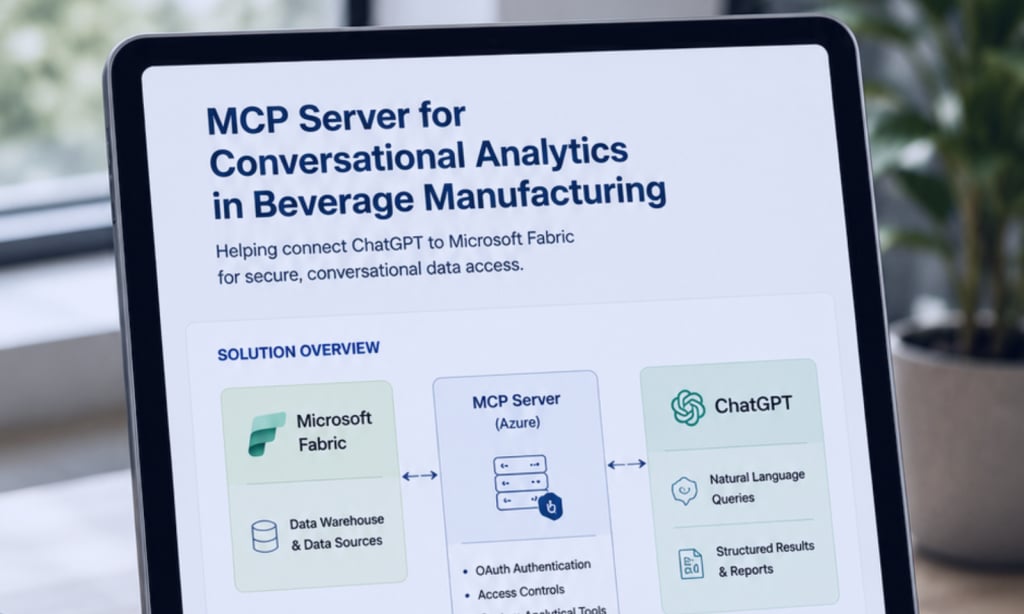
A US spirits producer needed business users to query warehouse data in Microsoft Fabric without routing every question through an analyst. deepsense.ai deployed an enterprise-grade MCP server on Azure linking ChatGPT to the client's Fabric environment, using OAuth and controlled access so the model could query only approved datasets and return structured tables and reports. It removed a standing dependency on manual reporting across operational, commercial and financial questions.
How Much Does deepsense.ai Cost?
At $100 to $149 per hour deepsense.ai is the most expensive company here, with a $25,000 minimum and a 4.9/5 cost rating. Its published project-size distribution rests on a small number of Clutch reviews, so treat the banding as indicative. 67% of revenue comes from relationships longer than two years, and its NPS is 82.
What Do Clients Say About Working With deepsense.ai?
"The team demonstrates strong ownership, with a notable ability to onboard very quickly."
Kostis Manolitzas, Group Head of Data Science & AI, Sky
"Overall, the collaboration was very smooth."
Lech Sawoń, Engineering Manager, DocPlanner
Substantive complaints are rare, though some reviewers note that initial alignment on business context could be sharper.
Why Do Businesses Choose deepsense.ai?
The deepest formal AI research credentials on this list, with Kaggle winners and PhDs on staff
Structured entry points, from discovery to proof of concept to advisory, so you can validate before committing
Production experience rather than pilots, including enterprise ChatGPT rollouts to 1,500+ users
A referral-heavy client base, with 55% of relationships originating that way
Tooploox
Tooploox, a Solvd Inc. company since June 2025, is a Wrocław firm founded in 2012 with close to 200 people, including a 40+ person R&D group where many hold or are pursuing PhDs. Its researchers have published 30+ peer-reviewed papers at NeurIPS, ICML and ECCV, with collaborations at Stanford, Carnegie Mellon and ETH Zurich. Clients include eBay, Ro and Statespace.
Example Project by Tooploox
Ashoka, the social entrepreneurship network supporting around 4,000 fellows, had built AI-powered semantic search over its internal database, but only one person could operate it. Its AI team ended up running hundreds of searches by hand and emailing results back. Tooploox interviewed every user group, from partnerships to PR to selection, then designed an interface usable by any Ashoka staffer after brief instructions rather than supervision.

How Much Does Tooploox Cost?
Tooploox bills $50 to $99 per hour with a $25,000 minimum and a 4.5/5 cost rating. Most projects fall between $50,000 and $199,999, with reviewed budgets from $30,000 to over $1 million.
What Do Clients Say About Working With Tooploox?
"They are careful with quality, set a high bar for themselves, and execute with satisfactory speed."
Manoj Kintali, Head of Engineering, Salvo Health
"Tooploox's team had an amazing can-do spirit."
Odin Mühlenbein, Co-Lead AI Lab, Ashoka
One recurring criticism is worth knowing before signing: several clients report Tooploox could not always supply additional people during periods of high demand.
Why Do Businesses Choose Tooploox?
Research capability most agencies cannot staff, evidenced by publications and patents rather than claims
Solvd's global scale and enterprise governance behind a team that still runs a flat structure
A strong track record in healthcare, life sciences and e-commerce specifically
Product design for AI interfaces, a scarcer skill than model engineering
Railwaymen
Railwaymen is a Kraków company founded in 2009, with 35 to 55 people and 150+ web and mobile products delivered across five continents. It has collected 10+ international awards and concentrates on fintech, construction and foodtech. Its distinguishing claim is staff turnover close to zero, which matters more than it sounds on a multi-year build.
Example Project by Railwaymen
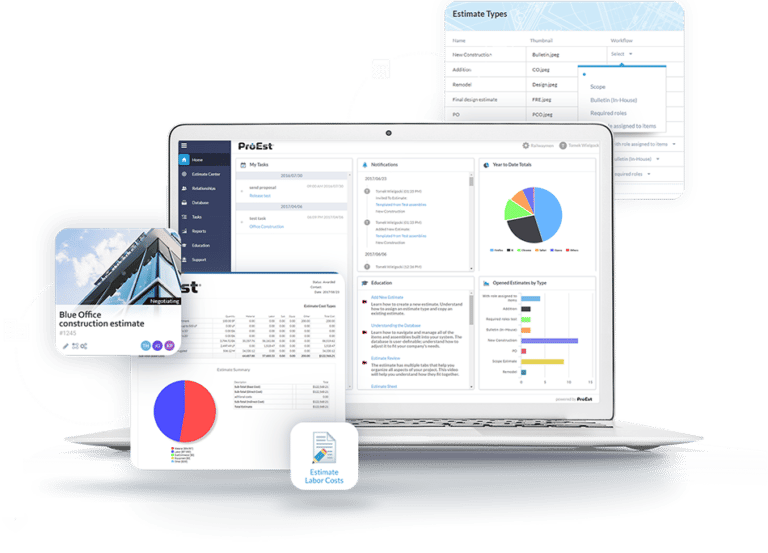
ProEst has served construction estimators since 1976 and needed its cloud platform built and continuously developed. Railwaymen started with three developers and grew to six, building an estimating engine that computes project costs in real time over large datasets, a takeoff module that lets users measure lengths and areas directly on uploaded PDF construction drawings, and a bid-leveling tool that normalizes subcontractor bids into comparable packages.
How Much Does Railwaymen Cost?
Railwaymen charges $50 to $99 per hour with a $25,000 minimum and a 4.8/5 cost rating, among the highest here. Most web development projects fall between $10,000 and $49,999, though engagements range up to $800,000.
What Do Clients Say About Working With Railwaymen?
"Our search for the right development team lasted for a month, interviewing over 30 companies. We are confident that our decision to go with Railwaymen was the perfect choice. Not only do you have direct access to the executive team but have a development staff with knowledge and creativity that is unmatched."
Jeff Gerardi, President and CEO, ProEst
"They didn't just execute our ideas; they brought fresh, innovative suggestions to the table. Their ability to introduce new concepts enhanced our project significantly."
Senior Security Analyst, cybersecurity company
Some clients have found time estimates optimistic, which is worth probing during scoping.
Why Do Businesses Choose Railwaymen?
Near-zero rotation, so the people who learn your domain in year one are still there in year four
Direct access to the executive team rather than an account management layer
Real depth in construction and fintech, where domain logic takes months to absorb
Structured discovery programs, from a free initial session to a 150-hour engagement, before code starts
Stepwise
Stepwise is a Warsaw AI and cloud consultancy founded in 2016 and named to Deloitte's Fast 50 Central Europe. Its data science practice is led by a PhD with large-scale machine learning experience, and its stack centers on Google Cloud, BigQuery, Vertex AI, OpenAI, Python and Terraform. Projects are staffed with senior engineers supervised by a CTO and solution architect rather than large mixed-seniority groups.
Example Project by Stepwise
International flights require overflight and landing permits, and PERMITS to Fly was processing roughly 3,000 a year by hand, around three documents each, consuming about 11,000 working hours. Errors meant delays and cancellations. Stepwise ran discovery workshops, mapped the user journey, then built and usability-tested the interface before any production code was written. Projected savings ran to 90% on cost and 80% on time.
)
How Much Does Stepwise Cost?
Stepwise bills $50 to $99 per hour and carries a $100,000 minimum project size, the highest on this list, with a 4.7/5 cost rating. Reviewed projects span $5,000 to over $589,000, with most between $10,000 and $49,999.
What Do Clients Say About Working With Stepwise?
"Stepwise delivered the project with professionalism, efficiency, and exceptional quality."
Wojciech Liszka, Co-Founder and Managing Partner, Seerio
"Working with Stepwise has been a positive experience for our business's growth and development."
Keith Price, Co-Founder and Managing Partner, Ackwest Group
As with several firms here, a few reviewers have raised English proficiency for individual team members.
Why Do Businesses Choose Stepwise?
Senior-only staffing, which suits complex AI work where junior throughput adds little
C-level executives involved in delivery rather than only in the sales process
Success metrics agreed at the outset, which makes the engagement auditable
Deep Google Cloud specialization, useful if your data platform already lives there
Cogniteq
Cogniteq is the oldest company here, founded in 2005, and needs one geographic footnote: it is headquartered in Vilnius and runs its Polish operation from Ząbki near Warsaw, which is the location its Clutch profile lists. The team runs to 150+ specialists with 300+ projects delivered for clients in 30+ countries. Mobile is 75% of the service mix, alongside IoT, AR/VR and video streaming.
Example Project by Cogniteq
A league of German football clubs needed two things at once: a better experience in its fan-facing app, and a way for PR managers across member clubs to coordinate. Cogniteq enhanced the public application and built new iOS and Android tools for internal use, giving club communications teams a shared channel for coordinating announcements and holding a consistent message across the league. The company has not published quantified outcomes for this engagement.

How Much Does Cogniteq Cost?
Cogniteq charges $50 to $99 per hour with a $10,000 minimum and a 4.9/5 cost rating, the joint-highest here. Most projects come in under $49,999.
What Do Clients Say About Working With Cogniteq?
"The team was always in touch addressing all the questions from our side and providing options of possible solutions with detailed descriptions of pros and cons so that we could choose the one that fits our needs and budget."
Alexander Ehm, CEO, Visions 101 GmbH
"We were impressed by Cogniteq's work culture and continuous availability."
Steven Braun, CEO, Directional GmbH
English proficiency for some team members comes up in reviews, as it does for several firms in this market.
Why Do Businesses Choose Cogniteq?
The strongest formal compliance position here: SOC 2 Type 2, ISO/IEC 27001 and ISO 9001:2015, which shortens security review for regulated buyers
Twenty years of continuous operation, a meaningful signal in a market with high churn
Mobile depth specifically, rather than mobile as an adjunct to web work
Clear scope definition, which reviewers cite repeatedly as the reason expectations stayed aligned
How Much Does Software Development in Poland Cost in 2026?
Polish agencies bill roughly $45 to $99 per hour, depending on seniority and specialism. The more useful context is that rates are falling almost everywhere. Accelerance, which surveys more than a hundred outsourcing firms annually, found Central and Eastern European rates down 4.4% year on year, Latin America down 7.1%, and Asia down about 8%, with AI-augmented delivery cited as the cause.
Region | Junior to mid | Senior | Year-on-year |
|---|---|---|---|
Central & Eastern Europe | $31-39/hr | $64-76/hr | -4.4% |
Latin America | $33-45/hr | $60-75/hr | -7.1% |
Asia | $24-31/hr | $31-41/hr | ~-8% |
Western Europe / US | Not published | $95-150/hr | Not published |
Accelerance 2026 Global Software Outsourcing Rates Guide. Currency conversions below use NBP mid-rates of 17 September 2026: USD 1 = PLN 3.80, EUR 1 = PLN 4.36.
The contractor rate is not the agency rate. A Polish senior engineer contracting directly takes home roughly $33 to $58 an hour. The same seniority billed through an agency costs $45 to $99. That gap covers project management, QA, bench capacity, recruitment, and the risk that someone leaves mid-project. Whether it is worth paying depends on whether you want to carry those functions yourself.
In-house is not automatically cheaper. A senior Polish developer costs roughly €5,800 to €6,300 per month on a B2B contract, or €6,800 to €8,000 through an employer of record. The equivalent in Germany runs €110,000 to €115,000 fully loaded annually. In the US, $161,000 to $260,000.
For budgeting a first engagement, a simple MVP runs $8,000 to $25,000 over four to six weeks, a medium one $25,000 to $55,000 over six to ten weeks, and a complex build $55,000 to $150,000 over ten to eighteen weeks.
Anything in a regulated domain starts around $75,000. Clutch's platform-wide average project is $132,480 across 13 months, and our notes on estimating cost and time explain why early numbers move. Our cost breakdown by project type goes further into what drives the variance.
How Do You Choose the Right Polish Engineering Partner?
Our broader checklist for picking a software development partner applies anywhere, these points are specific to Poland:
Ask what happens when your project is not their priority. Resource constraints during peak demand may happen. Ask how the partner handles contention.
Check turnover, not just headcount. Rotation can be a real differentiator, and it is a fair question to ask anyone.
Be clear about what actually needs AI. The question of when to use AI versus conventional software is worth settling before you brief anyone, because it changes which of these partners is even relevant.
Match the compliance posture to your industry. If you are in health or finance, a partner’s SOC 2 Type 2 and ISO 27001 certification will shorten your security review by weeks. If you are building a consumer product, you do not need that.
Try a small paid engagement first. A fixed-price discovery or prototype, like Monterail ran for SPIE, tells you a lot about a partner.
Read the negative reviews specifically. Every company on this list has a recurring criticism. A partner with no visible weaknesses has either done very few projects or curated their references carefully.
Get the contract right before the kickoff. Scope change, IP assignment, and exit terms are cheap to negotiate in month zero and expensive in month fourteen.
Should You Outsource Engineering To Poland?
Poland's advantage is not that everything is cheaper. Junior work is cheaper almost everywhere, and rates are falling globally as AI absorbs routine implementation.
What Poland has is a deep senior bench, a functioning R&D ecosystem, and enough power and land to put infrastructure next to the people who run it. Those are the ingredients for architecture, platform engineering, regulated product work, and applied AI, the categories where a wrong hire costs more than a high hourly rate.
The companies that will get the most from Poland over the next ten years are the ones that establish the relationship now, while the senior bench is deep and the cost gap is still wide, rather than the ones that wait for the case to become completely obvious.
Key Takeaways
Poland has the largest senior engineering workforce in Central Europe, 778,800 ICT specialists, with master's-level education at double the OECD rate.
The cost advantage is real but closing. Polish labor costs sit at 42% of Germany's and are rising 10.4% a year in euro terms against the EU's 4.1%.
Power and grid capacity are the genuine differentiator, with PSE provisioning for 5GW of data center load by 2040, though connection refusals hit a record 107GW in 2025.
The 5% IP Box only works below €750 million in group revenue. Above that, Poland's domestic top-up tax restores a 15% effective rate.
Entering through a services partner remains the lowest-risk path, and a small fixed-price engagement will tell you more than any procurement process.
Engineering in Poland: FAQ

Grzegorz Hajdukiewicz
Chief Delivery Officer

With over a decade of experience in the IT industry, Grzegorz has a proven track record of delivering complex projects on time and on budget. At Monterail, he leads a team of dozens of developers, designers, project managers, and business analysts, ensuring the successful delivery of software solutions for clients worldwide. Passionate about agile methodologies and continuous improvement, he constantly seeks new ways to optimize the delivery process.