The New Default. Your hub for building smart, fast, and sustainable AI software

Table of Contents
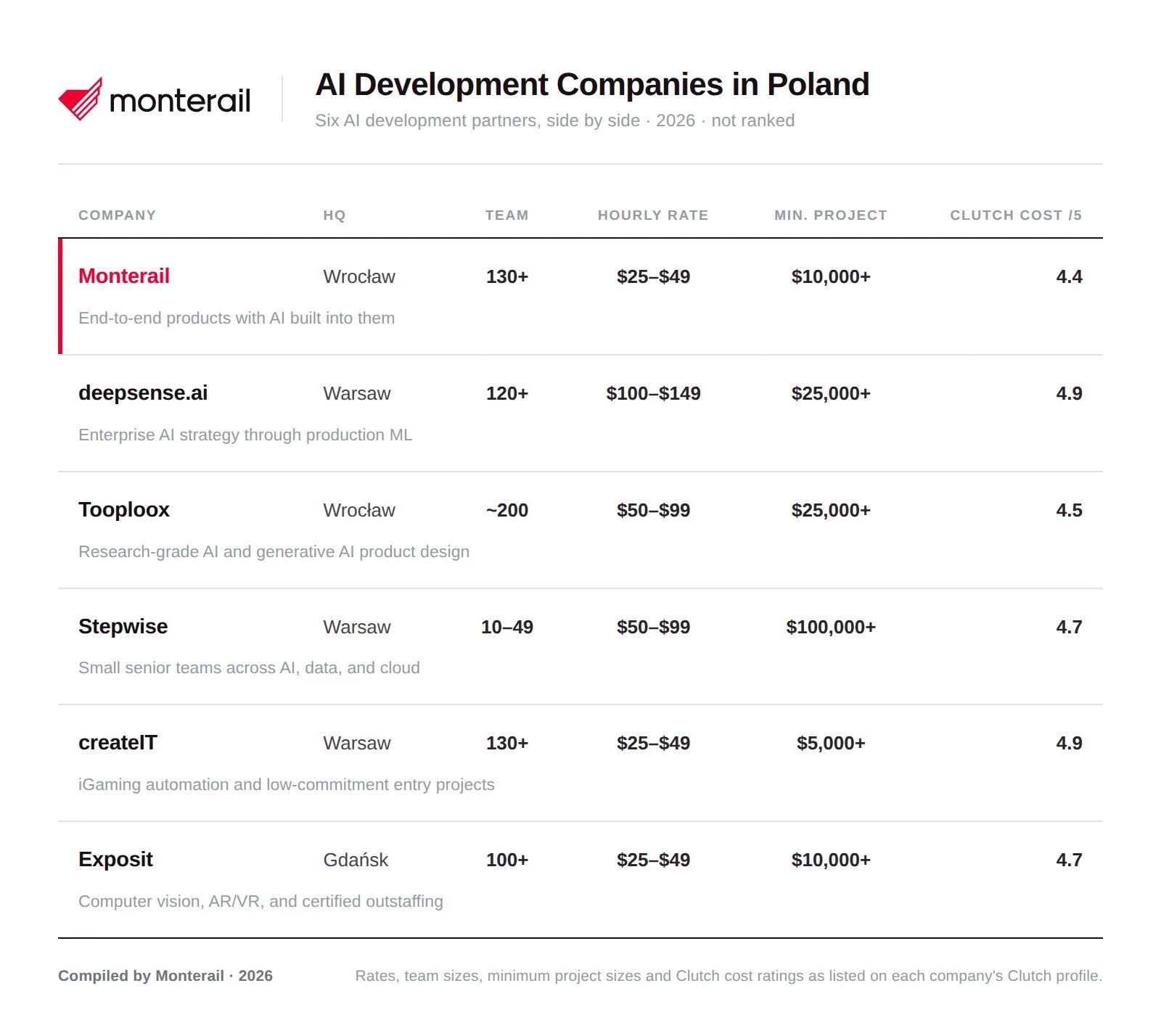
Six AI development companies operating in Poland are profiled below: Monterail, deepsense.ai, Tooploox, Stepwise, createIT, and Exposit. They span $25 to $149 per hour and $5,000 to $100,000 in minimum project size, and the guide that follows explains which price point buys what.
Poland ranks first in the EU and fourth globally for the share of its workforce doing advanced AI work: building deep learning models, computer vision systems, and generative architectures, rather than wiring up someone else's API. That finding comes from interface's Technical Tiers classification of the global AI workforce, published in April 2025, and it explains why so many US and Western European buyers put Polish vendors on the shortlist in the first place.
Getting from shortlist to signature is the harder part. MIT's GenAI Divide: State of AI in Business 2025 study reviewed 300 public deployments and found that 95% of enterprise generative AI pilots produced no measurable P&L impact. The models were rarely the problem. What separated the 5% was the engineering and organizational work around the model.
Executive Summary
Poland's AI vendor market has split into distinct categories, and that split matters more than any ranking. Pure-play AI consultancies charge two to four times what full-stack product studios charge, and they earn it on a narrow set of problems: model research, evaluation frameworks, and MLOps at enterprise scale.
For most companies the binding constraint sits in the work around the model: integration, data plumbing, security review, and the discipline to actually ship.
The six companies below span roughly $25 to $149 per hour and $5,000 to $100,000 in minimum project size, and the right choice depends on which of those two problems you have.
AI Development Companies in Poland Worth Knowing in 2026
This list is not ranked. The six companies here were chosen to show the range of what "AI development company in Poland" can mean: a 130-person full-stack product studio, a 120-expert pure-play AI consultancy, a research lab with 30-plus peer-reviewed papers, a 10-person senior-only boutique, a vertical specialist that only serves iGaming, and an ISO-certified outstaffing team on the Baltic coast. They differ by an order of magnitude in price, size, and the kind of problem they are built to absorb.
Monterail publishes this blog and goes first for that reason. Every figure in our own entry comes from the same public sources used for the other five: Clutch profiles, company sites, and published case studies.
Monterail
Founded in Wrocław in 2010, Monterail is an agentic development company with 130+ in-house engineers, designers, and product specialists and 900+ delivered projects, including 75 or more healthcare applications. Clients include Bosch, Merck, EY, DocPlanner, and SharkNinja. The company was named one of Central Europe's fastest-growing tech companies by Deloitte in 2016 and 2017, listed in the Financial Times 1000 in 2018, and became an official Vue.js partner in 2019 and a Nuxt partner in 2024. Three acquisitions since 2024 (Untitled Kingdom, EL Passion, and Lakeview Labs) added MedTech, product design, and mobile depth. Current NPS is 71.
Example project by Monterail
SPIE Belgium, a 1,550-person subsidiary of the European multi-technical services group, was scheduling 600 field workers across 13 business units using a disconnected mix of databases, attendance trackers, time-billing software, and spreadsheets. Nothing talked to anything else, leave requests lived in email chains, and scheduling clashes surfaced only after they caused problems.
Monterail built an AI-first resource management platform that replaced the whole arrangement. The engagement opened with a one-day prototype to prove the Supabase architecture could carry SPIE's resource logic, then moved straight to a 7-week fixed-price MVP, followed by 13 releases over four months adding Microsoft SSO, a training planner, multi-tenant business unit separation, and Gantt views. Because SPIE operates in sectors including nuclear energy, the system was built so SPIE owns its own data rather than spreading it across vendor platforms. The platform now gives real-time visibility over 600+ workers and has reclaimed 100 hours per week previously spent on manual data reconciliation, a full working week of effort recovered every week.

How Much Does Monterail AI Development Cost?
Monterail's published Clutch rate is $25–$49 per hour with a $10,000 minimum project size and a cost rating of 4.4/5. Across 45 reviews the most common engagement lands in the $50,000–$199,999 band, with individual projects running from $30,000 to over $1 million. That places Monterail at the accessible end of the Polish market on rate, while the fixed-price MVP model shown in the SPIE engagement gives budget certainty on the first phase before anyone commits to open-ended development.
What Do Clients Say About Working With Monterail?
"We moved from reactive scheduling to proactive, data-driven decisions. The ability to see a prototype in one day and scale it to an enterprise-ready solution so quickly was a game-changer for our resource management."
Bram Verstraeten, Senior Project Manager, SPIE Belgium
"I was impressed with the speed at which Monterail was able to grasp a complex and niche industry and translate that into a clear and practical system structure. I have confidence in their understanding of both the product vision and commercial context."
Amelia Christie, Limited Director, Christie Constructive
"If you want to outsource your coding to the lowest hourly rate, then Monterail aren't for you. If you want to build winning products at pace, then Monterail need to be on your shortlist."
Alan Buxton, CTO, Simfoni
The recurring criticism in Monterail's Clutch reviews concerns design: while clients rate the engineering highly, some have brought in external designers for specific needs.
Why Do Businesses Choose Monterail?
Sixteen years of continuous operation and 900+ shipped projects give it the longest verifiable track record on this list.
The one-day prototype to fixed-price MVP sequence lets a buyer validate an idea against real operational data before scoping phase two.
Deep regulated-industry experience across healthtech, MedTech, FemTech, and fintech, reinforced by the Untitled Kingdom acquisition.
Reviewers repeatedly describe the team integrating into their own organization rather than operating as an external vendor.
Working hours overlap comfortably with US and UK clients, which is a large part of why the client base skews that way.
deepsense.ai
deepsense.ai is the closest thing on this list to a pure-play AI firm. Founded in Warsaw in 2014, it employs 120+ AI experts, has delivered 200+ commercial AI projects, and reports a Net Promoter Score of 82 with 67% of revenue coming from relationships longer than two years. Its client roster includes Johnson & Johnson, Google, Volkswagen, Hexagon, Sky, and DocPlanner. The team works with OpenAI, Anthropic, Google Cloud, AWS, ElevenLabs, and Anyscale, and maintains ragbits, an open-source modular framework for building LLM and agent systems. Service mix is 60% AI development, 20% AI agents, 20% AI consulting, and the tech leadership includes multiple Kaggle award winners and PhD holders.
Example project by deepsense.ai
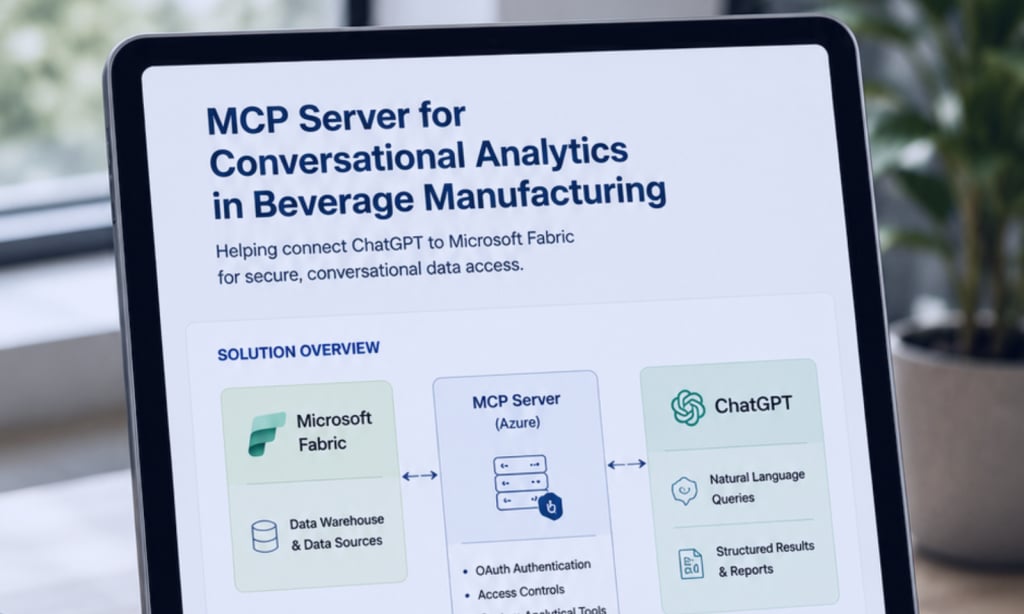
A US spirits producer and distributor had its operational data sitting in Microsoft Fabric, reachable only through analysts. Every recurring report and ad hoc question about warehouse figures went through a technical bottleneck.
deepsense.ai designed and deployed an enterprise-grade MCP server on Azure that connects ChatGPT to the client's Fabric environment using OAuth authentication and controlled data access. Business users now query approved datasets in natural language and get back summaries, tables, and reports. The result was a secure conversational interface to warehouse data for non-technical teams, cutting the dependence on manual reporting across operational, commercial, and financial questions. It illustrates the firm's typical shape of work, which leans toward production plumbing with governance attached rather than model training from scratch.
 Source: deepsense.ai
How Much Does deepsense.ai AI Development Cost?
deepsense.ai is the most expensive company on this list, at $100–$149 per hour with a $25,000 minimum project size, and it carries the highest cost rating here at 4.9/5. That combination is worth reading carefully: clients paying three times the regional average still rate value for money at the top of the scale. Engagements typically start through a structured entry point such as an AI Discovery sprint, a proof of concept, or an advisory review, which keeps the first commitment small relative to the rate.
What Do Clients Say About Working With deepsense.ai?
"Sky partners with deepsense.ai across a wide range of topics, including an ML model development, predictive analytics, credit risk, price elasticity, and AI consulting."
Kostis Manolitzas, Group Head of Data Science Innovation and AI, Sky
"We engaged deepsense.ai for an AI Advisory engagement with the aim of reviewing and enhancing our AI capabilities and practices. deepsense.ai was adept at identifying practical quick-win improvements in our AI operations, providing guidance for our long-term investment priorities in the AI domain and ensuring a thorough transfer of knowledge to our internal AI team throughout the engagement."
Mariusz Gralewski, CEO, DocPlanner
"At Unstructured, we have been delighted to partner with deepsense.ai, a collaboration that has significantly accelerated the development across our Product Roadmap."
Brian S. Raymond, Founder & CEO, Unstructured
Reviewers report almost no significant weaknesses, though a few note that initial alignment on business context could be tighter at the start of an engagement.
Why Do Businesses Choose deepsense.ai?
A decade of applied AI work with no side business in general web or mobile development.
ragbits and the firm's evaluation frameworks mean production concerns like reliability and testing are part of the standard toolkit rather than an afterthought.
Named partnerships with OpenAI, Anthropic, Google Cloud, AWS, and Anyscale give early access and escalation paths that smaller firms lack.
An NPS of 82 and 55% of new relationships arriving via referral are unusually strong retention signals for a consultancy.
Structured entry points (discovery, PoC, advisory) let an organization test the relationship before committing to a build.
Tooploox
Tooploox, now a Solvd Inc. company, was founded in Wrocław in 2012 and has grown to roughly 200 professionals, including a 40+ person R&D group of engineers and researchers, many holding or pursuing PhDs. That research arm is the differentiator: the team has published 30+ peer-reviewed papers at NeurIPS, ICML, ECCV, IJCAI, and WACV, holds multiple patents, and has collaborated with Stanford, Carnegie Mellon, ETH Zurich, INRIA, and Imperial College London. Over a decade it has worked with 100+ organizations including eBay, Ro, Light, Granular.ai, Voyage, and Statespace, across healthcare, life sciences, e-commerce, and agriculture.
Example project by Tooploox
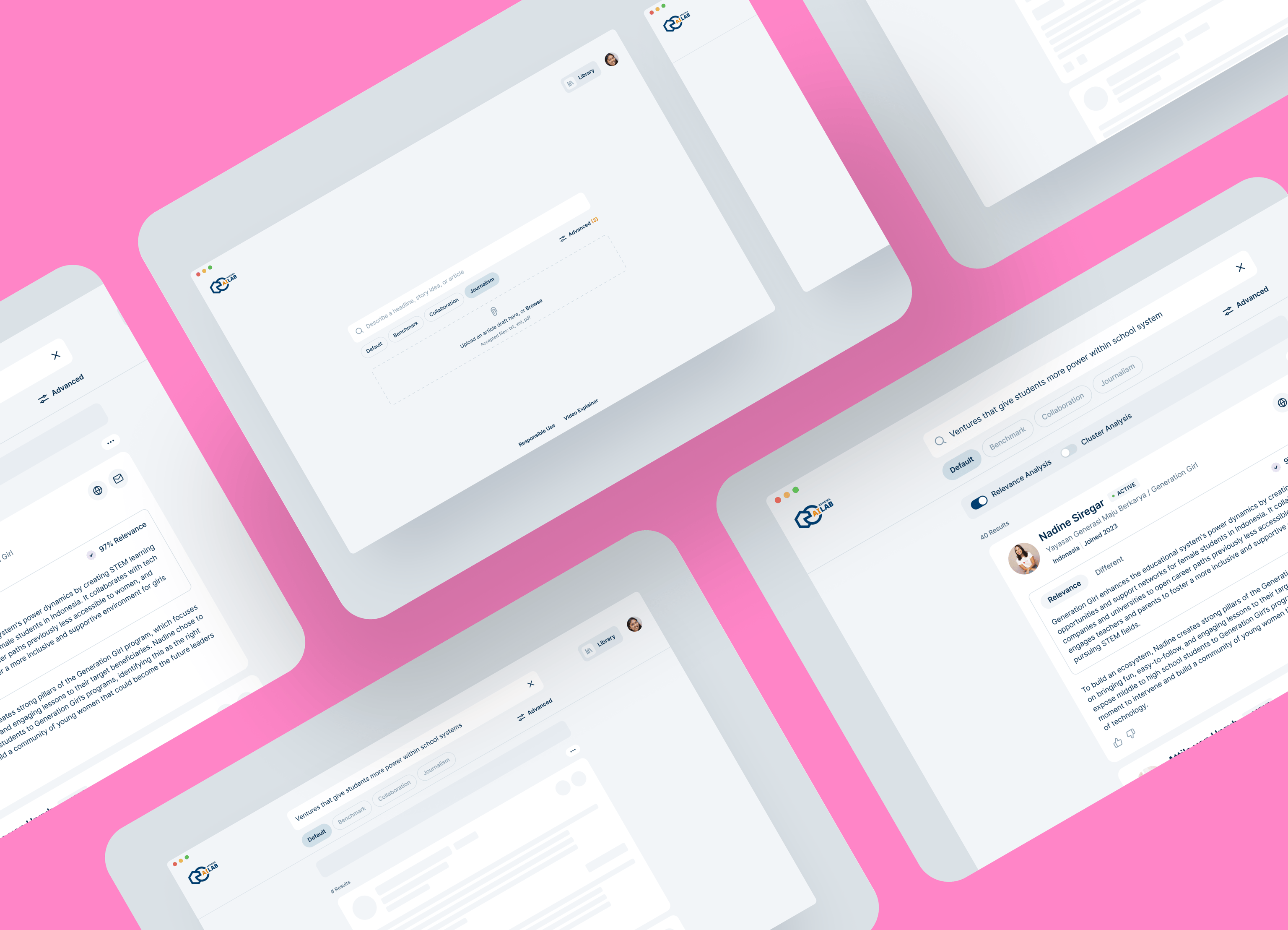
Ashoka, the global social entrepreneurship organization supporting around 4,000 fellows, had built an AI-powered semantic search tool over its own database. The prototype worked and had no user interface at all. Word spread internally, and Ashoka's small AI team ended up running hundreds of searches by hand and mailing the results back to colleagues.
Tooploox took on the design problem through Tech to the Rescue, the pro bono network Tooploox's CEO helped found. There was very little prior art to copy: designing interfaces for generative AI systems was a new discipline, so the team ran interviews with the partnership, selection, and PR teams who each used the database differently, mapped the journeys, and built a new interface around them. The outcome was a system any Ashoka employee can use after brief instructions, without a supervisor and without knowledge of the underlying prompts, which turned a one-person prototype into an organization-wide tool.
 Source: tooploox.com
How Much Does Tooploox AI Development Cost?
Tooploox charges $50–$99 per hour with a $25,000 minimum project size and a cost rating of 4.5/5. Reported budgets range from $30,000 to over $1 million, with the most common engagement across 27 reviews falling in the $50,000–$199,999 band. It sits in the middle of the Polish market on price, which is a reasonable position for a firm carrying a 40-person research group: you get access to genuine research capability without paying pure-consultancy rates for routine delivery work.
What Do Clients Say About Working With Tooploox?
"Tooploox's team had an amazing can-do spirit."
Odin Mühlenbein, Co-Lead AI Lab, Ashoka
"They are careful with quality, set a high bar for themselves, and execute with satisfactory speed."
Manoj Kintali, Head of Engineering, Salvo Health
"We're really impressed with their engineers' ability to learn new things."
Henry Bradlow, Co-Founder & CTO, Adaptive
The one consistent caveat: several clients have run into resource availability limits during periods of high demand, when Tooploox could not add people as quickly as requested.
Why Do Businesses Choose Tooploox?
Peer-reviewed publication at NeurIPS, ICML, and ECCV is a hard credential that very few agencies of any size can produce.
The Solvd Inc. affiliation adds enterprise governance and global delivery scale on top of the original R&D culture.
Product design capability for AI interfaces, demonstrated in the Ashoka work, is scarcer than model engineering and often the thing that decides adoption.
Academic partnerships with Stanford, CMU, ETH Zurich, and Imperial College give access to specialists for genuinely novel problems.
A flat, self-organizing internal structure that clients describe as easy to plug into.
Stepwise
Stepwise is the smallest company here and deliberately so. Founded in Warsaw in 2016 with 10 to 49 employees, it was named to the Deloitte Fast 50 Central Europe list of fastest-growing technology companies. Its operating model, which it calls EliteTeam, is a direct rejection of the volume staffing approach: instead of large groups weighted toward junior engineers, Stepwise assembles 5 to 15 regular and senior engineers supervised by a CTO, CIO, and solution architect. The data science practice is led by a PhD who previously worked on Twitter's algorithms, and C-level executives stay involved through delivery. The stack centers on OpenAI, Google Cloud, Vertex AI, BigQuery, Python, Kotlin, and Terraform.
Example project by Stepwise
PERMITS to Fly set out to build the world's first automated system for obtaining overflight and landing permits. The manual process it was replacing is brutally inefficient: roughly 3,000 permits a year, averaging three documents each, adding up to 10,000 documents and 11,000 working hours, all created by hand under ICAO and IATA standards where a filing error means delays or canceled flights.
Stepwise ran the engagement as a design-led discovery: kickoff workshops, user personas, a journey map of the existing application process, then wireframes and hi-fi designs validated through usability testing before anyone wrote production code. Testers described the resulting flow as "two clicks and the permit application is ready." Stepwise reports the delivered system produces cost savings of up to 90% and time savings of up to 80% against the manual process it replaces, alongside a monitoring layer that tracks every application through its stages. It is a useful reminder that the highest-value automation is often not the most technically exotic.
) Source: stepwise.pl
Source: stepwise.pl
How Much Does Stepwise AI Development Cost?
Stepwise lists $50–$99 per hour with a cost rating of 4.7/5, and the highest stated minimum project size on this list at $100,000+. That figure deserves a caveat: across 21 reviews the most common project size is actually $10,000–$49,999, and reported budgets run from $5,000 to over $589,000. The $100,000 floor reads as current positioning rather than a historical average, so a smaller engagement may still be worth a conversation. Either way, the senior-only team composition means you are paying for a higher average seniority per hour than the rate alone suggests.
What Do Clients Say About Working With Stepwise?
"Working with Stepwise has been a positive experience for our business's growth and development."
Keith Price, Co-Founder & Managing Partner, Ackwest Group
"Stepwise delivered the project with professionalism, efficiency, and exceptional quality."
Wojciech Liszka, Co-Founder & Managing Partner, Seerio
"They responded to our needs and offered professional advice."
Benise Joseph, Senior Program Associate, Caribbean Cooperative MRV Hub
A minority of reviews mention English proficiency among some non-native speakers on the team, though clients note it has not materially affected project outcomes.
Why Do Businesses Choose Stepwise?
Team composition skews senior by design, which matters disproportionately on AI projects where a wrong architectural call is expensive to unwind.
Deloitte Fast 50 Central Europe recognition is independent evidence of growth rather than self-reported.
Combined AI, data engineering, and cloud practice, so the data platform work that AI projects depend on does not have to be subcontracted.
Founders and C-level staff participate in project setup and stay reachable during delivery, which is realistic at this company size and rarely is at larger ones.
Design-led discovery, including usability testing before development starts, as the PERMITS to Fly project shows.
createIT
createIT is the vertical specialist here. Registered in Warsaw in 2011 and now 130+ specialists, the company traces its working history back further, to its two managing partners collaborating in college, and claims over twenty years of experience with complex software systems. It has concentrated its AI practice almost entirely on iGaming: player engagement, retention, personalization, and predictive analytics for B2B and B2C operators. Three quarters of its service mix is AI work (25% AI consulting, 25% AI development, 25% generative AI), with web and mobile making up the rest. It ships its own products, including PlayPatrol for automated casino game testing and WinWords AI for article generation. Clients span the USA, UK, Germany, Australia, Sweden, and Poland.
What stands out in createIT's methodology is a published ROI model. The firm assesses which processes are ready for automation, calculates expected impact using explicit formulas for time saved, error reduction, and output growth, and states plainly that if simpler automation works better than AI, it recommends the simpler option.
Example project by createIT
Bet25, an iGaming platform preparing for its November 2025 launch, had a hard deadline and a large problem: 5,426 slot games from 51 providers all needed pre-launch health checks, geolocation availability verification, and ongoing monitoring, and there were 7 days to do it.
createIT deployed PlayPatrol, its computer-vision testing tool that simulates a real player by finding and launching each game, placing bets, spinning reels, and comparing balances before and after each action to catch misconfiguration. Setup took the full seven days from kickoff: analysis of the casino UI, three parallel test accounts, a bot script to navigate games, and automated daily runs including geolocation checks. In the first month of monitoring the system caught 2,990 errors related to game integration and game code, all of them coordinated with providers for fixing before a player ever hit them.
) Source: www.createit.com
Source: www.createit.com
How Much Does createIT AI Development Cost?
createIT has the lowest entry point on this list at a $5,000 minimum project size, charges $25–$49 per hour, and holds a cost rating of 4.9/5, tied for the highest here. The most common project size across 16 reviews is under $10,000, which is consistent with a firm that does a lot of scoped automation work and productized tooling rather than multi-year platform builds. If you want to test an automation hypothesis without a six-figure commitment, this is the shape of engagement that supports it.
What Do Clients Say About Working With createIT?
"We are extremely satisfied with the cooperation."
Dominika Dziadosz, Marketing Specialist, KRUK S.A.
"They were always open to implementing changes."
Aleksandra Hołownia, Marketing Manager, Dealavo
"Even in difficult situations, we were able to find a solution."
Sabina Owczarczyk, Owner, AdStore
Some clients have asked for more transparent invoicing practices, specifically more regular billing intervals and clearer communication about charges.
Why Do Businesses Choose createIT?
Genuine domain depth in iGaming, which means the team already understands provider integrations, licensing constraints, and player lifecycle economics.
Proprietary tools like PlayPatrol turn a services engagement into something closer to a product purchase, with correspondingly faster time to value.
The published ROI methodology, including a stated willingness to recommend against AI, is a rare and useful form of vendor honesty.
A $5,000 minimum makes it viable for a first automation pilot rather than a strategic program.
Long client relationships and repeat engagements show up consistently across reviews.
Exposit
Exposit works out of Gdańsk, was founded in 2012, and has 100+ in-house employees with 275+ completed projects and tech leads averaging 11 or more years of experience. Its AI practice covers computer vision, AR/VR, and business process automation, with competence centers in those areas plus media streaming and Atlassian tooling. Roughly half its service mix is AI work (30% AI development, 20% AI consulting, 20% generative AI). The distinguishing credential is compliance: Exposit holds ISO 9001 and ISO 27001 certification and is an Atlassian Silver Solution Partner, working primarily in FinTech, healthcare, and education. It offers three cooperation models, from turnkey product development to team augmentation.
Example project by Exposit
For a client in the catering industry, Exposit built a mobile point-of-sale system for snack bar management at cultural events, integrated with a cloud platform. The team completed and partly rewrote an existing Android application, connected it to payment hardware, and added order history, phone-number authorization, and screen-rotation support, using Kotlin with RxJava, Room, and Retrofit. Customers order and pay by card or cash and receive a receipt with their order number.
One honest flag: this is a mobile engineering case study, and Exposit publishes no outcome metrics for it. The firm's computer vision and automation work is less publicly documented than its custom software portfolio, so a buyer evaluating Exposit specifically for AI should ask for AI-specific references during the first call.
How Much Does Exposit AI Development Cost?
Exposit charges $25–$49 per hour with a $10,000 minimum project size and a cost rating of 4.7/5. Reported project costs cluster between $15,000 and $50,000 with team sizes from 2 to 15 people, while the most common project band across 24 reviews is $50,000–$199,999. That pricing sits at the accessible end of the Polish market, and the ISO 27001 certification is unusual at this rate, since formal information-security certification is more typical of firms charging considerably more.
What Do Clients Say About Working With Exposit?
"We are very happy with the work we've done together."
Rada Ryzhykava, Head of Department & Product Owner, Bamboo Group OÜ
"The team met all the deadlines and was open to any inquiries regarding the project."
Pavel Batashou, CTO, Wizart Inc.
"Their project management style is very hands-on with lots of back and forth communication every day."
James Pursaill, CTO, Plend
As with several firms in this price band, reviewers mention that English proficiency varies among more junior staff, though senior communication is described as clear and responsive.
Why Do Businesses Choose Exposit?
ISO 9001 and ISO 27001 certification simplifies vendor security review, which is often the slowest step in enterprise procurement.
Established competence centers in computer vision and AR/VR rather than general-purpose AI positioning.
Three cooperation models, so the same partner can handle a turnkey build or drop specialists into your team.
Clients consistently report knowledge transfer that leaves their internal team more capable after the engagement.
A price point that makes long-running augmentation arrangements financially sustainable.
What Separates a Real AI Development Partner From an "Agent Washing" Vendor?
The clearest signal is whether a vendor can point to systems running in production under someone else's brand, with the operational scars to prove it.
The market gives you good reason to check. Gartner predicts that more than 40% of agentic AI projects will be canceled by the end of 2027, driven by escalating costs, unclear business value, and inadequate risk controls. In the same analysis Gartner describes widespread "agent washing," the rebranding of existing assistants, RPA, and chatbots as agentic products, and estimates that only around 130 of the thousands of vendors claiming agentic capability are real. MIT's finding that 95% of pilots deliver no measurable P&L impact points at the same underlying gap: generic tools stall in enterprise use because they do not learn from or adapt to actual workflows.
Four things to probe in a first conversation:
Request a production reference where the system has been live at least six months, then ask what broke during that time. Vendors who only demo have usually only demoed.
How do they measure whether model output is any good? A partner that cannot describe its evaluation harness, accuracy thresholds, or regression tests has no way to tell you when the system starts degrading.
Ownership needs to be settled in writing before kickoff: the model, the training data, the fine-tuned weights, the infrastructure. Monterail's SPIE build was deliberately structured so the client owns its Supabase backend outright.
Find out what they would refuse to build with AI. createIT publishes an explicit position that it recommends simpler automation when simpler automation performs better, and a vendor with no such line is selling technology instead of outcomes.
How Much Does AI Development Cost in Poland in 2026?
A senior developer in Poland costs $25 to $65 per hour in 2026, with AI and ML specialists carrying a 15% to 30% premium on top of standard rates. Against US and Western European benchmarks that represents a 35% to 55% saving for comparable seniority.
Region | Typical senior rate | Notes |
|---|---|---|
Poland | $25–$65/hr | Seniors average around $41.70/hr; lead and architect tier reaches $65/hr |
Wider Eastern Europe | $37/hr average, $40–$60 senior | Includes Ukraine and Romania |
Western Europe | ~$66/hr average, $64–$108 contractor | Roughly double the CEE average |
US, UK, Germany | $48–$130/hr senior | Widest spread of any region |
AI/ML specialization | Add 15%–30% | Applies across all regions |
Sources: index.dev European developer rates, lemon.io Poland rate calculator, Uvik global developer rates 2026.
Rates only tell you the input price. The number that determines your budget is the stage you are funding.
Stage | Typical range | Timeline | What you are buying |
|---|---|---|---|
Proof of concept | $10,000–$100,000 (focused enterprise PoC: $15,000–$60,000) | 6–8 weeks | Evidence that the approach works on your data |
MVP | $50,000–$180,000 | ~4 months | A real system in front of a real user group |
Production | $200,000–$1,000,000+ | Ongoing | Multiple models, deep integrations, governance, MLOps |
Two budget items catch buyers out. Moving from PoC to production typically requires a three to six times cost increase that procurement teams routinely fail to plan for, and data preparation, integration, inference, and maintenance add another 50% to 100% on top of the base build. Source: AI development cost analysis 2026.
Map that against the companies above and the market segmentation becomes obvious. createIT's $5,000 minimum and Monterail's and Exposit's $10,000 minimums support genuine pilot-scale work. deepsense.ai's and Tooploox's $25,000 minimums assume you have already decided AI is the answer. Stepwise's stated $100,000 floor assumes a funded program.
How Do You Choose the Right AI Development Company in Poland?
Start from the maturity of your problem rather than the size of the vendor. The question that sorts the field fastest is whether you need someone to tell you what to build or someone to build what you already know you need.
Engagement model | Best when | Watch out for |
|---|---|---|
Fixed-price discovery or PoC | The problem is clear, the solution is not, and you need a budget ceiling | Scope defined so tightly that nothing useful survives contact with real data |
Fixed-price MVP | The approach is validated and you want a working system before opening the budget | Change requests priced punitively |
Time and materials | Requirements will evolve, and you can steer week to week | No natural forcing function to ship |
Dedicated team | You have a roadmap of 6+ months and want continuity | Team composition drifting toward juniors after month three |
Staff augmentation | You have in-house AI leadership and need specific hands | You absorb all the integration and delivery risk yourself |
A few further checks are worth the time:
Get named CVs for the people who will actually write the code, plus what percentage of their week you are buying. Stepwise's EliteTeam model and deepsense.ai's roster of Kaggle winners and PhDs are both explicit answers to this question, and a vendor that dodges it has told you something.
Compare quotes on total cost to a working production system, never on hourly rate. A $45 per hour team that needs three attempts costs more than a $120 per hour team that ships once.
The data and infrastructure story matters more than the model story, because most failed AI projects fail in the plumbing. What happens to your data, where does inference run, and what does monitoring look like on day 90?
Specialism cuts both ways. A vertical shop like createIT will out-think a generalist inside iGaming and be a poor fit outside it, a full-stack studio builds the product around the model, and a pure-play consultancy goes deeper on the model while expecting you to own the product.
What Should You Ask About AI Compliance Before You Sign?
Ask which side of the EU AI Act's shifting deadlines your system falls on, because the timeline changed materially in 2026 and a lot of vendor material is now out of date.
Under the AI Omnibus law, obligations for standalone high-risk AI systems moved from August 2, 2026 to December 2, 2027, and rules for high-risk systems embedded in products moved to August 2, 2028 (Pinsent Masons). That delay is real, and it is narrower than the headlines suggest. Article 50 transparency obligations remain on their original August 2, 2026 timeline, meaning you still have to tell people when they are interacting with an AI system and label AI-generated content (Holland & Knight). If you are shipping a customer-facing assistant into the EU market, that clause applies to you this year regardless of your risk classification. The official implementation timeline is worth checking directly before you scope anything.
Practical questions for a prospective partner:
Are we the provider or the deployer of this system under the Act, and which obligations does that assign to each of us?
Where does inference run, and does any of our data leave the EU?
What logging and traceability will exist if we later need to demonstrate how a decision was made?
Do you hold ISO 27001, and can we see the scope statement? Exposit's certification is a concrete example of what this looks like when a vendor has done the work.
If our classification changes, what would it cost to bring this system into high-risk conformity?
An EU-based partner has a structural advantage on all of this, since they are subject to the same regulation and have usually already answered these questions for another client.
Which AI Development Company in Poland Fits Your 2026 Roadmap?
The most useful conclusion from comparing these six is that model expertise has stopped being the differentiator. Every company on this list can fine-tune a model, build a RAG pipeline, and stand up an agent. What varies by an order of magnitude is the surrounding discipline: whether the team can integrate with your existing systems, survive a security review, hand you ownership of your own data, and keep the thing running once the launch enthusiasm fades. That is precisely where the 95% of pilots that never reach P&L impact fall down.
So the useful selection question is which of those problems is yours. Buy advisory if you still need to know whether AI is the right answer at all, and pick a firm willing to tell you it isn't. Buy delivery when you know what to build and need a product engineered around the model. Buy research only when the result you want does not exist yet. Paying consultancy rates for delivery work, or delivery rates for research, is the most common and most expensive mismatch in this market.
Key Takeaways
Poland's draw is talent depth. It ranks first in the EU and fourth globally for the share of its workforce doing advanced AI work, an advantage that outlasts any rate arbitrage.
Hourly rates on this list span roughly six times over, from $25 to $149. That spread reflects what each business model actually prices: pure-play consultancies charge for research, evaluation, and MLOps, while full-stack studios charge for delivery.
Production is where the money actually goes. Moving from proof of concept to production typically multiplies cost three to six times, and data preparation, integration, inference, and maintenance add another 50% to 100% on top of the build.
Ask for production references rather than demos. Gartner expects over 40% of agentic AI projects to be canceled by the end of 2027 and counts only around 130 genuine agentic vendors among thousands making the claim.
The EU AI Act's high-risk deadline slipped to December 2027, but Article 50 transparency duties still apply from August 2, 2026. Establish which side of that line your system sits on before you scope it.
AI DEVELOPMENT COMPANY FAQ
)
Michał Nowakowski
Solution Architect and AI Expert at Monterail

Michał Nowakowski is a Solution Architect and AI Expert at Monterail. His strong data and automation foundation and background in operational business units give him a real-world understanding of company challenges. Michał leads feature discovery and business process design to surface hidden value and identify new verticals. He also advocates for AI-assisted development, skillfully integrating strict conditional logic with open-weight machine learning capabilities to build systems that reduce manual effort and unlock overlooked opportunities.