The New Default. Your hub for building smart, fast, and sustainable AI software
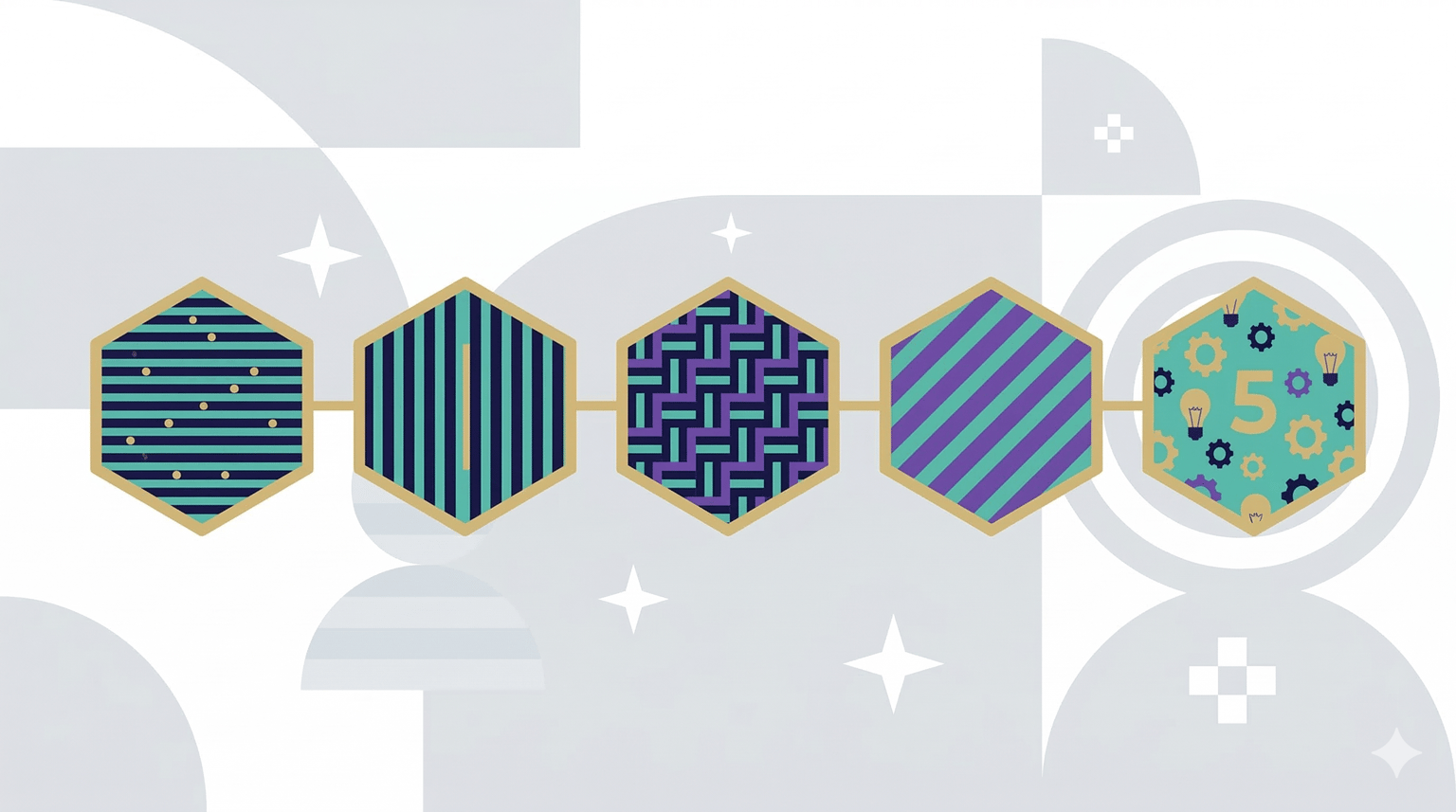
Table of Contents
and 6 more
Design thinking is a human-centered problem-solving framework, originally developed at Stanford's d.school. It structures product development around five stages: empathize, define, ideate, prototype, and test. Most products that fail didn't fail on execution. The team solved the wrong problem. Following these five rules in order, then looping back through them as you learn, is what separates products people want from products that merely got built.
Executive Summary
Products succeed when teams confirm they are solving the right problem before they build. Design thinking gives that work a repeatable order: empathize, define, ideate, prototype, and test. Coming back to earlier stages whenever testing reveals something new keeps the product aligned with user needs. McKinsey found that top-quartile design performers grew revenue 32 percentage points faster and delivered 56 percentage points higher shareholder returns over five years. Agile and Lean shape how teams deliver, and AI tools speed up each stage, while the order of the five stages keeps the product on target.
How Does Design Thinking Reduce Product Development Risk?
Settling the problem early protects the budget because the rest of product development depends on it. Choosing the right problem to solve decides whether a product earns back its development budget. When research is thin, teams make assumptions that shape the feature set and the launch plan. McKinsey's Business Value of Design study shows how common that is: over 40% of surveyed companies didn't talk to their end users during development, and only about 50% ran user research before their first design ideas. Every untested assumption adds cost that surfaces later when the team needs to rework parts of the product.
The define stage produces a precise problem statement, which gives the team one test for every later choice: does this serve the problem users described? That test focuses the budget on what users need and gives stakeholders a clear reason behind each trade-off. The business implication is risk and return: early research and a well-defined problem lower the odds of a costly miss.
How Does Design Thinking Turn User Research Into Revenue?
Revenue grows when user behavior drives product decisions, and product decisions drive business results. Research shows the team what users do, including where they hesitate or get stuck. A sharp problem statement turns those observations into a target, and prototypes turn that target into something users can react to before the team commits to a full build. Each round of testing feeds the reaction back into the next version.
Link in the chain | What happens | Business effect |
Observed behavior (Rules 1–2) | Research and problem definition show where users struggle | The team builds toward a defined need |
Tested prototype (Rules 3–4) | Ideas become prototypes users can react to | Weak ideas surface before the full build |
Product fit (Rule 5) | Usability and A/B tests confirm what works | The product matches user behavior |
Sales and revenue | Users adopt a product that fits their needs | Revenue and shareholder returns follow |
McKinsey's research supports the chain. Top-quartile design performers in the study excelled in all four areas of the McKinsey Design Index, including continuous iteration with end users, and the index shows a strong correlation between design strength and financial performance. The same study found that almost 60% of surveyed companies used prototypes only for internal production testing, late in development. In contrast, the most successful companies share early prototypes with outsiders, which brings user feedback into the loop sooner.
The five rules below put that chain into practice, stage by stage.
Rule 1: Empathize With Users Before You Build the Product
The rules start where every product should: with the people who'll use it. New products exist to solve problems for people, so the first rule is to build empathy for that problem before touching a solution.
Three methods do most of the work here:
Analytics and session recordings show what users do, which often differs from what they say they do in a survey.
Surveys and structured interviews surface motivations that raw behavior data can't explain on its own.
Competitive study shows which patterns have already been validated, and which mistakes are worth skipping entirely.
Study your future users directly, and study the products that already exist in the space. Which ones failed, and why? What made the ones that succeeded stick? Follow the must-do patterns your competitors have already validated, and you’ll avoid the mistakes they have made. It will save you from relearning the same lessons at your own expense. Some teams front-load this work into a dedicated discovery workshop instead of spreading research thin across the whole timeline.
However, empathy alone doesn't ship a product. It has to turn into a decision.
Rule 2: Define the Problem Your Customers Have
Once the research is in hand, the team combines it to assess whether a real problem exists and whether your solution is worth building. Is the value proposition clear? Is the price point realistic compared to what a customer would pay a competitor?
Framing the problem precisely at this stage pays off later because a sharp problem statement makes every downstream decision easier to evaluate. Pair qualitative user feedback with quantitative data and market sizing, using competitive analysis as the benchmark.That combination confirms you're solving a problem that justifies building for.
With the problem pinned down, the next rule is about resisting the urge to jump straight to one answer.
Rule 3: Generate Product Ideas Without Filtering Too Early
This stage is about volume and range: generate as many ideas as the team can, including the ones that feel impractical on first pass. Thinking past the obvious answer is the point.
Design sprints can speed up this stage considerably and surface angles a team might not reach on its own. Resist the urge to dismiss ideas that seem too simple or too obvious; some of the best solutions look boring right up until they work. Close the stage by writing down your strongest candidates and preparing to test them, since opinions alone won't settle which idea works.
Ideas are cheap at this stage. The next rule turns the strongest one into a prototype.
Rule 4: Build a Prototype That's Just Good Enough to Test
At this stage, the goal is a tactile representation of the idea, kept as simple as the test requires.
Hardware teams have a useful vocabulary for this, and it transfers cleanly to digital products too. A proof-of-concept confirms the core idea's viability, a 'works-like' prototype examines functionality, and a 'looks-like' prototype assesses form and feel. Shape the final version of your prototype around the feedback you gathered earlier, weighting the specific needs users described over whatever the team assumed they'd want.
A prototype only proves so much on its own. It gains its value when its intended users try it.
Rule 5: Test the Prototype With Users and Loop Back When Needed
Testing is where the idea meets its users. Skipping or rushing this stage wastes the work a team has already put in.
Modern testing usually combines a few complementary approaches:
Usability testing with users, watching where they hesitate or get stuck.
A/B testing to compare variations with user behavior, which carries more weight than opinions voiced in a meeting.
Component-level testing for reliability, especially on anything safety- or compliance-related.
Treat feedback here as the most valuable input in the process, since it tells you directly whether the product is ready to deliver. If users respond well, you're close to market-ready. If they flag friction, the right move is to return to ideation; a cosmetic patch on the current prototype won't fix an underlying problem.
That loop back to earlier stages is the whole point of the framework.
This entire process pays off in measurable terms. McKinsey's Business Value of Design study found top-quartile design performers grew revenue 32 percentage points faster than peers. Their shareholder returns outpaced peers by 56 points over the same five-year period. Teams that treat these five rules as an ongoing discipline tend to see that discipline reflected on the balance sheet.
How Do Agile, Lean, and AI Complement Design Thinking?
Design thinking now sits alongside Agile and Lean. Teams increasingly run all three side by side across a product's lifecycle. Design thinking decides what's worth building and why; Agile structures how the team ships it iteratively; Lean keeps the process free of wasted effort.
Methodology | Answers | Role in the process |
|---|---|---|
Design Thinking | What's worth building? | Discovers the right problem and solution |
Agile | How do we build it? | Structures iterative delivery |
Lean | How do we build it efficiently? | Cuts wasted effort from the process |
AI has accelerated how quickly teams move through each stage without changing the stages themselves. That compression is clear in how AI-assisted teams cut MVP timelines from months to weeks without skipping research or testing. Research synthesis, rapid prototyping, and even first-pass ideation now happen faster with AI-assisted tools in the loop. What AI can't do is decide which problem is worth solving, which is why the five rules still hold.
What Does Design Thinking Need to Deliver Results?
Results follow when four conditions are in place: leadership support, a link to the delivery workflow, a scalable starting point, and compliance checks built into testing. Each condition keeps the five stages moving from the first workshop to launch.
Condition | What needs to be in place | Payoff |
Leadership support | Executives treat design as a management topic and agree on measures such as usability scores | Research and prototyping budgets hold when priorities compete |
Delivery integration | Research and test findings flow into the Agile backlog | The team builds what testing confirmed |
Scalable starting point | One important product serves as a pilot | Early results build the case for wider adoption |
Compliance | Safety and regulatory checks sit next to usability testing | Issues surface before launch |
The best-performing companies in McKinsey’s study treat design as a top-management issue and track it with the same rigor as revenue and cost, and fewer than 5% of surveyed companies said their leaders could make objective design decisions. The study also found a strong correlation between financial success and protecting research and prototyping budgets when conditions tighten.
Delivery integration ties the five stages to the process the team already runs. Nielsen Norman Group recommends tracking research in the Agile backlog and feeding findings back into it. Silicon Valley Product Group describes the same idea as a discovery track that produces validated backlog items and a delivery track that turns them into releasable software.
In McKinsey's interviews, choosing one important upcoming product as a pilot showed far better financial results than trying to improve design across the whole company at once. Compliance follows the same logic. In medical devices, FDA guidance on human factors recommends iterative prototype testing with users during design. It also notes that interface flaws found at that stage cost less to fix than flaws found in final validation testing.
Key Takeaways
Design thinking structures product development into five stages: empathize, define, ideate, prototype, and test, looping back as the team learns more.
Defining the problem precisely before building protects the budget: every later decision gets one test to pass, and late-stage rebuilds become less likely.
McKinsey's research found top-quartile design performers grew revenue 32 percentage points faster and earned 56 percentage points higher shareholder returns than industry peers over five years.
AI-assisted tools speed up each stage without changing the stages or their order.
Design thinking delivers results when four conditions are in place: leadership support, delivery integration, a scalable pilot, and compliance checks built into testing.
How Does Design Thinking Lower Rebuild Costs in Product Development?
Following the five stages of design thinking lowers rebuild costs because the team builds on evidence from the start, so late-stage fixes become less likely. Returning to empathize or define when testing surfaces something new keeps that evidence up to date.
These stages work best as part of a larger system. If leadership support keeps each stage funded, the delivery team can build what testing confirmed.
If your team is planning to develop a new product, Monterail's product design team can run the discovery and testing stages with you.
Product development FAQ

Grzegorz Hajdukiewicz
Chief Delivery Officer

With over a decade of experience in the IT industry, Grzegorz has a proven track record of delivering complex projects on time and on budget. At Monterail, he leads a team of dozens of developers, designers, project managers, and business analysts, ensuring the successful delivery of software solutions for clients worldwide. Passionate about agile methodologies and continuous improvement, he constantly seeks new ways to optimize the delivery process.