The New Default. Your hub for building smart, fast, and sustainable AI software

Table of Contents
Choose staff augmentation when you need specific skills inside a team your own managers already run. Choose a dedicated team when you need a product area owned end to end by a unit with its own lead.
The decision comes down to one question: can you handle managing one or more additional engineers on your team, or would you rather define an outcome and hand the responsibility over to another team?
Staff augmentation adds individual engineers to a team you manage. A dedicated development team is a self-contained unit with its own lead, working on your product full time and owning features from planning through release. Both put experienced engineers on your product within weeks, the difference is that each demands a different input from you.
Executive Summary
Staff augmentation and dedicated teams solve different shortages. Augmentation closes a specific skills or capacity gap inside a team you manage, and it spends your managers' attention: onboarding, code review, and a clear answer to who owns which part of the system.
A dedicated team takes ownership of a product area end to end, and it spends something scarcer at many companies, which is the discipline to define outcomes and then let someone else make the decisions that follow from them.
Why Is It So Hard to Hire Senior Software Developers in 2026?
Because employers are overwhelmed with job applications to the point that they struggle to sift through them effectively, which extends the process and makes timing unpredictable even when the budget is unlimited.
Job postings for software engineers are up roughly 11% year over year, according to a Citadel Securities analysis of Indeed data, and TrueUp counted more than 67,000 open engineering roles at tech companies globally in March. The Pragmatic Engineer's analysis of Indeed listings found vacancies up in the US and UK, flat in Canada, and down in Germany and France.
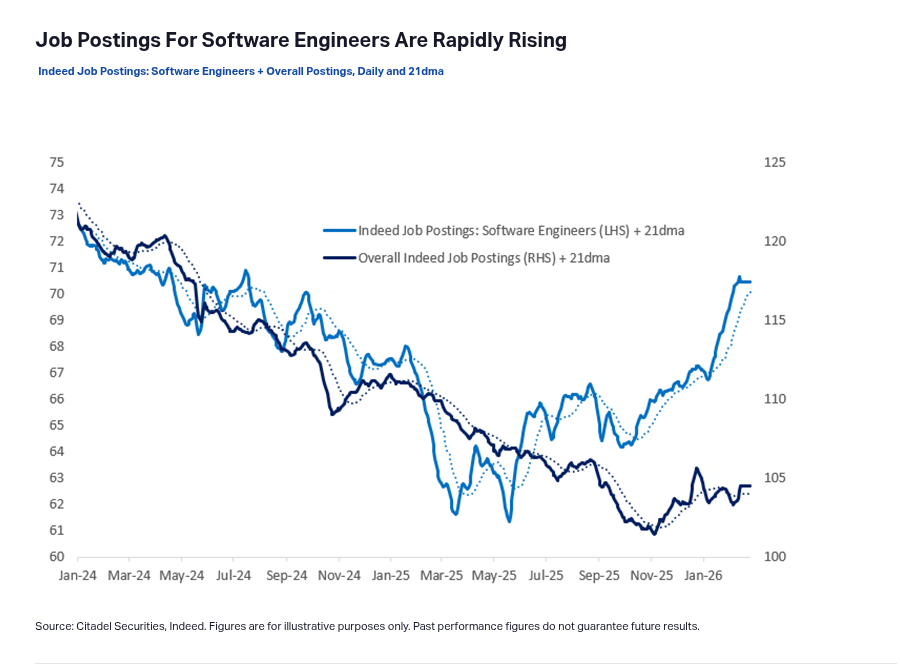
Filling a specific seat is a broken process at the moment. In The Pragmatic Engineer's survey of more than 50 hiring managers and job seekers, a fractional VP of Engineering at a Series B company reported that engineering manager and Staff+ roles stayed extremely difficult to fill despite paying at the 90th percentile. One senior infrastructure engineer at a fintech said: "My team has been looking for a new engineering manager for three months and we barely had any good applicants." Inbound volume exploded. One Seattle role drew 800 resumes in three months, and several managers said they had stopped reading inbound applications altogether.
The cost of hiring seems to have moved from money to attention. You can still find good people. What you cannot reliably do is determine when a particular senior seat will be filled, and that uncertainty, more than cost arbitrage, is what pushes teams toward external models.
What Is the Real Difference Between Staff Augmentation and a Dedicated Team?
The real difference is where decisions get made, and therefore how much product context has to be transferred rather than retained.
The engagement structure sets where decisions get made, that sets how much context has to be handed over rather than held, and the context that survives sets your delivery speed from about the third month onward. That, not the hourly rate, is your real cost per shipped feature.
This is why the two diverge on a curve rather than at a point. Augmentation front-loads its value. A specialist joins a team that already holds the context, and productivity arrives quickly because someone else is doing the remembering.
A dedicated team inverts that. As one engineer in a related Reddit thread described the first months like this: the team is still learning the codebase, discovering old technical decisions, and figuring out the organization, and it can feel like more management work at the start. Profit arrives later, when engineers know which parts of the system are fragile and can recognize when a new request will break something three modules away.
The same commenter named the condition that decides whether the second half of that curve ever arrives: "If the dedicated team still needs approval for every meaningful choice, the company hasn't really captured the full benefit of the model."
A dedicated team without delegated decision rights is a more expensive augmentation contract with extra coordination overhead.
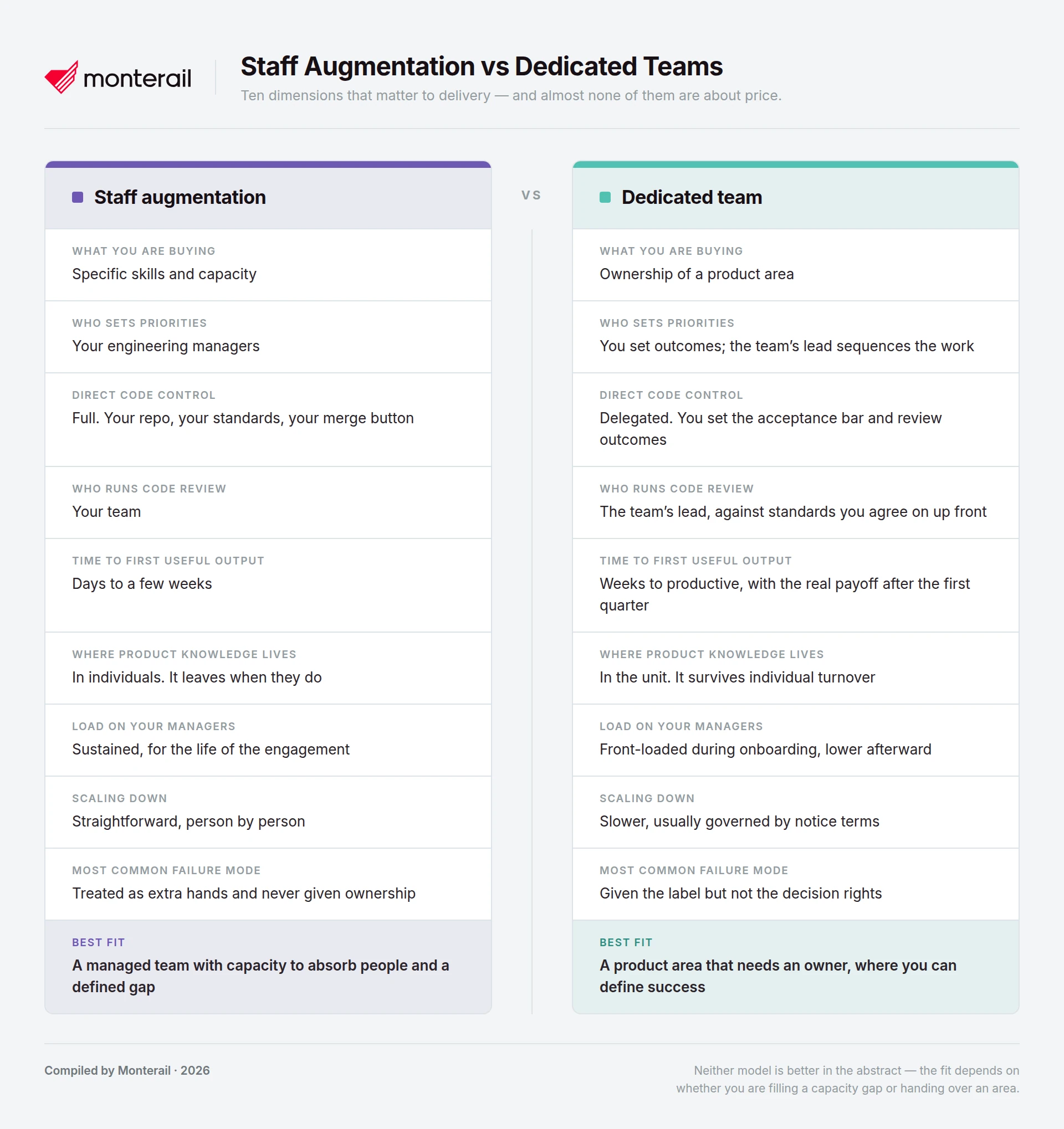
How Do Staff Augmentation and Dedicated Teams Compare Side by Side?
They differ on ten dimensions that matter to delivery, and almost none of them are about price.
When Should You Use Staff Augmentation?
Use it when the gap is specific, the team around it is healthy, and your managers have room to absorb someone.
A six-week React Native shortfall, a payments integration nobody in-house has done before, or a launch stretch needing two more pairs of hands are all clean cases.
You keep direct code control: the work lands in your repo, passes your review standards, and merges on your schedule. You can also end the engagement person by person, without renegotiating a contract.
The model earns its keep when the augmented engineer is treated as a member of the team rather than a queue for tickets. A delivery-side engineer in a Reddit thread described being embedded so deeply that new joiners assumed he was internal, and also being kept outside the team and used only to clear backlog. Same contract both times. The difference was whether the team let him own anything.
The failure mode is yours to prevent. Here’s a test worth keeping: everyone should be able to say without hesitating who owns a given surface area, and that person should sit in the same planning, reviews, and retros as the rest of the team. If your leads cannot answer that for the work you are about to hand over, adding people will cost you velocity before it adds any.
When Should You Hire a Dedicated Development Team?
Hire one when you need an outcome owned rather than tasks completed, and when the work will keep evolving. Products in active development, platform areas needing continuity across quarters, and second products that would otherwise compete with your core roadmap all fit. The unit arrives as a cross-functional team with its own lead, its own working agreements, and a delivery process it has already debugged, which is what you cannot buy by hiring five individuals at once.
This is also the model to choose when your own management layer is the constraint. If your engineering managers are already at capacity, augmentation adds to their load and a dedicated team does not, because coordination happens inside the unit.
Define what success looks like precisely enough that someone else can make daily decisions against it, and write down what the team owns, what escalates, and how priorities reach them.
Neither model is fixed-scope project outsourcing, which suits a defined deliverable you will not need to evolve.
On anything that keeps changing, repeated ramp-up costs will outrun whatever the fixed price saved you.
What Are the Hidden Costs of Staff Augmentation and Dedicated Teams?
The costs that surprise people are not rates. They are management time, the ramp to productivity, and contract terms that get treated as boilerplate.
How Much Management Time Does Staff Augmentation Really Take?
More than the headcount math suggests. Every augmented engineer needs a named owner for the area they touch, a place in your rituals, and review capacity from someone senior. There is no universal ratio, but there is a reliable signal: when your leads can no longer name the owner of each surface area, you have passed your absorption limit, and the next engineer will subtract from throughput.
How Long Does It Take an External Developer to Become Productive?
An augmented specialist can be writing useful code inside a week, because your team supplies the context. A dedicated team is slower to reach that point and faster once it does; four to eight weeks to working capacity is a reasonable planning assumption, against the six to twelve months it commonly takes to assemble an equivalent group through in-house hiring. Compare the two against the shape of the work: short and bounded favors the fast start, long and evolving favors the higher ceiling.
What Should Be in a Software Development Outsourcing Contract?
Five things worth reading closely rather than skimming. None of this is legal advice, and all of it belongs in front of your counsel before you sign a software development outsourcing contract.
Intellectual property assignment that runs unbroken along the whole chain, from the individual engineer to the vendor to you, including subcontractors, and that explicitly covers contributions produced with AI tooling.
Clarity on how you direct the work. Ask counsel in the engineer's jurisdiction, not only your own, how day-to-day direction affects worker classification, since augmentation puts you closer to that line by design.
Data terms covering who touches production data and from where, which is where GDPR compliance obligations usually bite in European engagements.
Replacement and notice terms, because the risk in augmentation concentrates in individuals.
An AI tooling clause, which most 2026 contracts still lack: which tools may run against your codebase, what happens to the code they see, and what retention the provider guarantees.
Can AI Agents Replace Staff Augmentation or a Dedicated Team?
No. Coding agents change what each model costs you, and on the current evidence they make the staffing decision matter more rather than less.
Adoption is already close to universal. DORA's 2025 State of AI-assisted Software Development report, drawn from nearly 5,000 technology professionals, found 90% using AI at work and more than 80% saying it raised their productivity. Demand for engineers rose over the same period, and Citadel Securities concluded that "it seems more likely that AI will be a complement rather than a substitute for labor in many areas."
What agents reliably change is where the bottleneck sits. DORA found AI adoption positively related to delivery throughput and product performance, and still negatively related to delivery stability: more change arrives, and more of it breaks. Thirty percent of respondents reported little or no trust in AI-generated code, so someone has to read it carefully. The binding constraint becomes review capacity and architectural judgment, which is exactly the resource staff augmentation already spends.
The gains are also not automatic on the codebases that matter most to you. In a randomized trial run by METR, 16 experienced developers worked 246 real tasks in large repositories they had contributed to for years, and allowing AI tools made them 19% slower even though they had predicted a 24% speedup and still believed afterward they had gained 20%. METR has since said developers are likely more sped up in 2026 than that early-2025 snapshot showed, and the result does not generalize to every codebase.
On a mature system, work shifts from typing to verifying. DORA explains why outcomes vary so widely, in a line that doubles as the staffing argument above: "AI doesn't fix a team; it amplifies what's already there."
Teams with fragmented tooling and fragile infrastructure mostly find that AI helps them generate technical debt faster.
So the question to ask a partner has moved past whether their engineers use AI. Ask two things.
First, how work gets picked up: does an agent take a task with full context of the current codebase, or does a developer paste a ticket into a chat window?
Second, how output gets verified: does the review step run the project and check behavior, or only read the diff? Those answers, and whatever AI code review tools sit behind them, separate a delivery process from a set of individual subscriptions.
Some partners package the arrangement as agentic delivery under human signoff; the label matters less than those two answers.
What Do You Need Before Bringing in an External Team?
Five conditions, and they are the same for both models.
Enough time zone overlap for real-time participation, so people attend planning, reviews, and retros as they happen instead of being briefed afterward. This matters more for augmentation, where the value depends on integration into your rhythm.
Named ownership of every surface area, mutually understood by the team rather than implied by an org chart.
Written decision rights: what the external group decides, what escalates, and how priorities reach them.
Real access. Repo, CI, staging, design files, and the product context that explains why the system looks the way it does.
An exit plan that does not depend on people. As an agency owner argued in the r/EngineeringManagers thread, employees churn everywhere, so continuity comes from readable code, delivered test suites, and knowledge sharing habits rather than from any individual's memory.
Treat this as a capacity question about your own organization rather than a procurement question about vendors.
Look at where your delivery system is actually constrained.
If it is skills inside a functioning managed team, augmentation fits and your managers pay for it.
If it is the management layer itself, or an outcome nobody currently owns, a dedicated team fits and your clarity about goals pays for it.
The companies that get good results from external engineering are the ones that were honest about which of those two bills they could afford before they signed anything. If you are weighing the two for a specific team, get in touch and we will work through it with you.

Key Takeaways
Staff augmentation buys skills and capacity under your management. A dedicated team buys ownership of an outcome. Match the model to the shortage you actually have.
Augmentation spends your engineering managers' attention. If that layer is already saturated, augmentation will cost you throughput.
A dedicated team without delegated decision rights is an expensive augmentation contract with extra coordination overhead.
Hiring in 2026 is unreliable on timing rather than on supply, which makes the fallback plan of waiting for the right hire more expensive than it used to be.
Coding agents raise throughput and reduce stability at the same time, so they increase the value of review capacity rather than replacing the people who supply it.
Staff Augmentation or Dedicated Team: FAQ

Grzegorz Hajdukiewicz
Chief Delivery Officer

With over a decade of experience in the IT industry, Grzegorz has a proven track record of delivering complex projects on time and on budget. At Monterail, he leads a team of dozens of developers, designers, project managers, and business analysts, ensuring the successful delivery of software solutions for clients worldwide. Passionate about agile methodologies and continuous improvement, he constantly seeks new ways to optimize the delivery process.