The New Default. Your hub for building smart, fast, and sustainable AI software

Table of Contents
The CMS you pick in 2026 decides how fast your team ships and how much friction piles up as the business grows into new channels and adopts AI workflows.
For CTOs, VPs of Engineering, and senior technical leaders, the CMS (Content Management System) has become a foundational layer of the digital platform. It shapes frontend performance, developer velocity, content governance, search visibility, localization, personalization, and how AI-driven workflows enter content operations.
Enterprise developers often choose headless CMS because it separates content management from the presentation layer. This means that the same content can serve a website, a mobile app, or any other frontend through an API instead of rebuilding it for each one.
This article compares Storyblok, Sanity, and Contentful for enterprise and scale-up teams weighing a headless CMS in 2026.
Executive Summary
Storyblok, Sanity, and Contentful differ in how much structure they predefine for you and how much they leave for your team to build. Storyblok predefines the most, giving editors visual guardrails out of the box. Sanity predefines the least, giving developers full control and responsibility for the content model. Contentful sits between the two, favoring predictability and governance over flexibility. In 2026, all three platforms are agent-accessible through MCP, so the differentiator has shifted from raw API quality to how well-structured your content already is. This means the right CMS choice depends on your team composition and business needs.
How Choosing the Right CMS Reduces Business Costs
Choosing a platform that aligns with team capabilities prevents vendor lock-in, where migration becomes expensive due to tightly coupled APIs or proprietary models. The right fit also keeps scaling limitations from surfacing as content volume or delivery channels increase.
Omnichannel delivery has become the baseline expectation. Content now needs to reach mobile apps, internal tools, digital signage, marketing automation, and personalization engines from a single source. The right CMS meets that expectation natively, as one interchangeable piece of a larger stack, which is exactly the push toward composable architectures driving CMS decisions today.
Get the choice wrong, and the costs compound. WordPress still powers over 60% of CMS-based sites, but its architecture is optimized for ease of use. It lacks the API-first, multi-channel delivery enterprise and scale-up teams need. That mismatch shows up later: organizations are switching CMS platforms more frequently than before, often after only a few years. Teams usually cite slow publishing cycles and rigid content models. Others point to poor editorial experience and unexpected cost increases, or an inability to support new channels without heavy workarounds.
The CMS market size reflects the stakes. It's estimated at USD 35.16 billion in 2025, projected to reach USD 79.30 billion by 2033. More platforms on the market means more ways to get the decision wrong.
Why CMS Architecture Moved From Headless to Composable and Agentic
What Is Headless Architecture?
A headless CMS keeps your content separate from how it's displayed. Content lives in one place, and an API pulls it into a website, an app, or anywhere else it's needed. This way, you're never managing duplicate copies. This model caught on because older systems were built for one channel at a time, usually just a website, and every new channel meant rebuilding the same content from scratch.
From Headless to Composable
Composable applies the same idea behind headless across your whole tech stack. Instead of one system handling content, digital assets, personalization, and search together, each becomes its own tool, picked separately and connected through APIs.
In practice: your CMS can be headless without your whole stack being composable, and you don't have to build it all at once. Many teams start with a headless CMS and add other composable pieces as they need them.
This shift happened because touchpoint sprawl broke systems built for single-channel websites. Mobile, IoT, voice, and spatial computing all demand delivery patterns a monolithic CMS was never built for. Cloud deployment reinforced the trend, since managing content at that volume needs infrastructure legacy suites can't match.
The Agentic Layer
Content in 2026 isn't only read by humans. AI assistants and autonomous agents now evaluate and act on it directly, which is why structured, single-source-of-truth content matters for Generative Engine Optimization (GEO). The Model Context Protocol (MCP) is now the standard interface between agents and the content layer, and all three platforms compared here ship it: Storyblok's MCP Server, Contentful's remote MCP, and Sanity's Agent API and MCP server.
The shift is from AI reading published content to agents querying schemas and creating or editing entries directly. Two guardrails matter here regardless of platform: nothing goes live without human review, and MCP access alone isn't enough without a good content structure.
What This Means for Development
Headless architecture aligns naturally with modern frontend frameworks like React, Vue, and Svelte. It also lets the same content reach different products and markets without being duplicated for each one. WordPress can technically run headless too, but it still lacks the structural and governance qualities discussed throughout this article.
Storyblok, Sanity, and Contentful: What Each Platform Is Built For
Storyblok
Storyblok is often positioned as the most editor-friendly headless CMS on the market. In Storyblok, content editors can see the final output as they work. This reduces friction between content teams and developers, and shortens the loop between a content change and a published page.
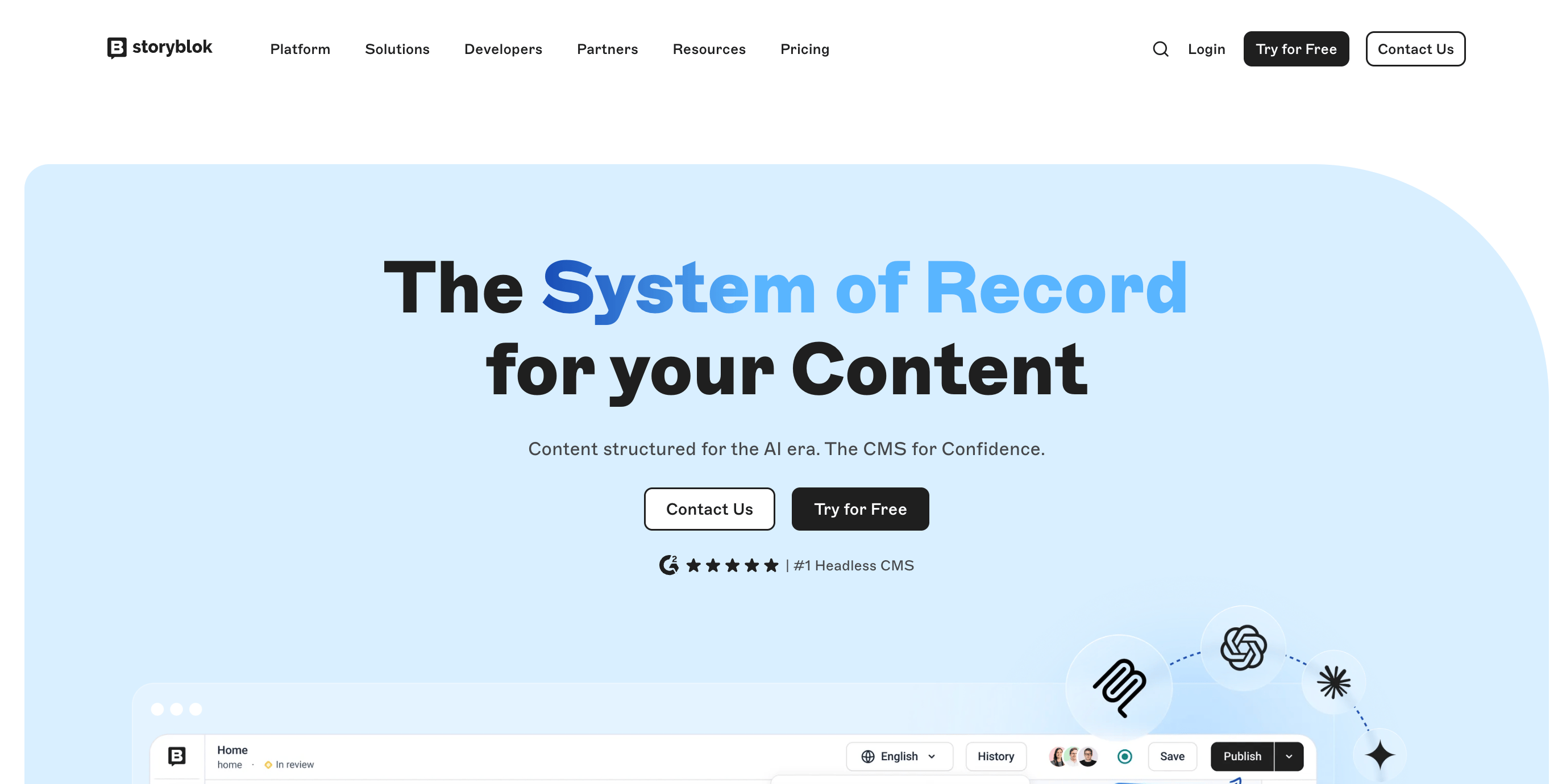
Storyblok’s Visual Editor gives editors a real-time preview alongside dev-defined, reusable components they assemble within design constraints. It's flexible enough for editorial autonomy, and structured enough to avoid breaking layout. Localization, versioning, and editorial workflows are built in, so multi-market teams don't need to bolt them on separately.
Pricing is tiered by usage, users, and features, with accessible entry plans that scale with traffic and locale count. Long-term cost forecasting matters once you're operating past the entry tier.
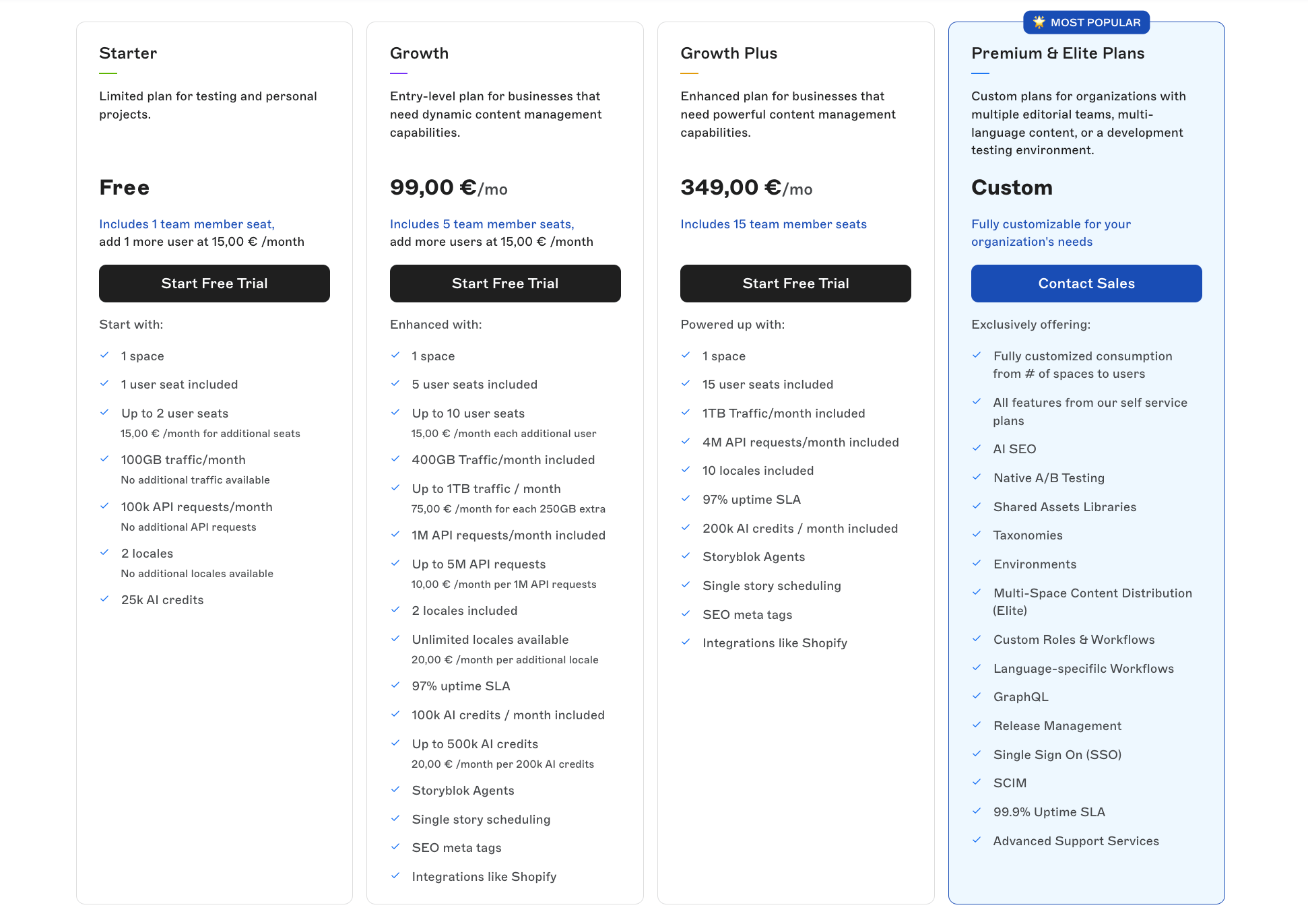
Storyblok is the strongest fit for teams with an established design system, multilingual marketing sites, and editors who need autonomy without breaking layout. It also offers an MCP Server, giving agents structured access to the content layer.
Sanity
Sanity is a content platform first and a CMS second. It treats content as structured data and lets teams build their own editorial environment. That control comes with a trade-off: teams need to invest in configuration and own it long-term.
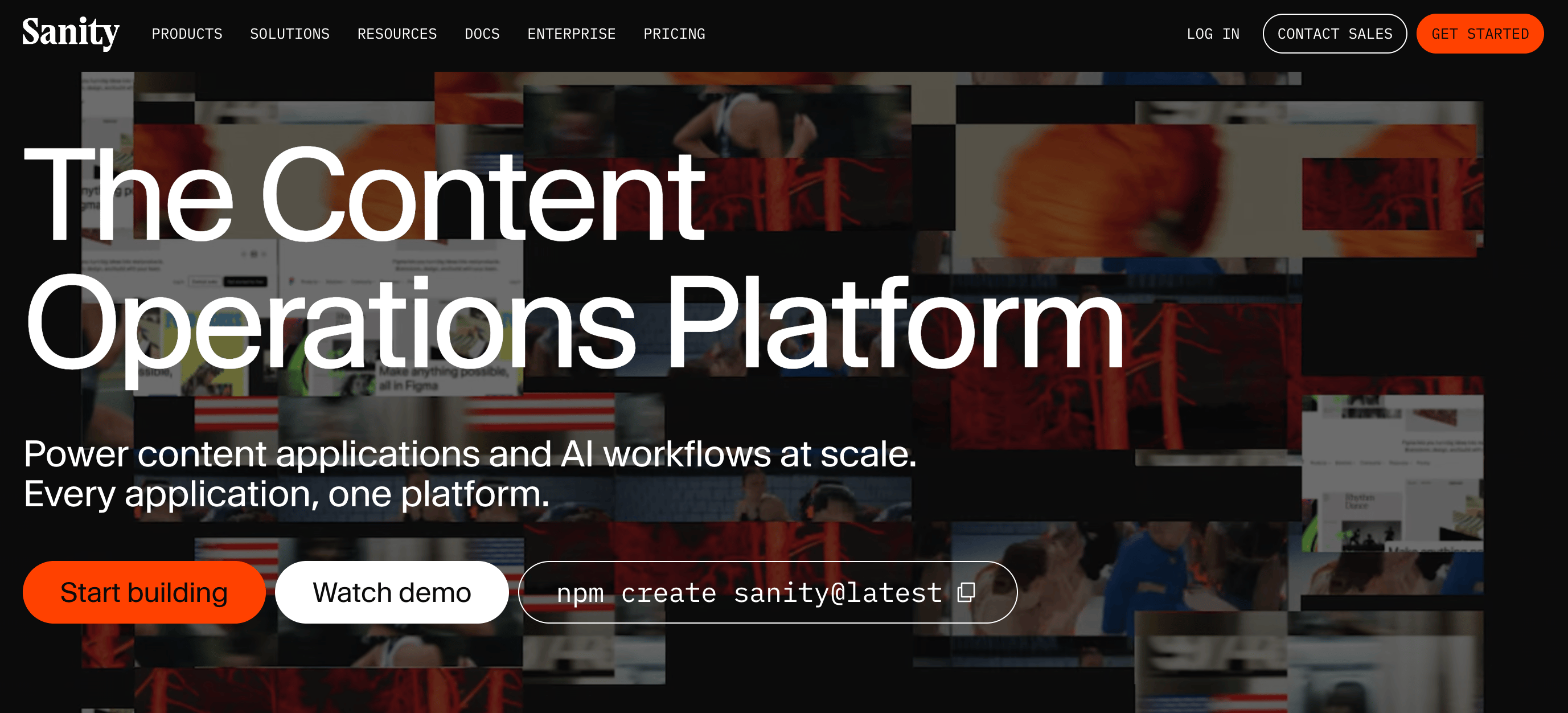
Its Studio is fully customizable in JavaScript, React, or Vue, and it offers native real-time multi-editor collaboration. GROQ, Sanity's query language, gives fine-grained control over how content is retrieved and shaped. If you're weighing frameworks for a setup like this, our Vue vs React comparison covers the trade-offs in more depth.
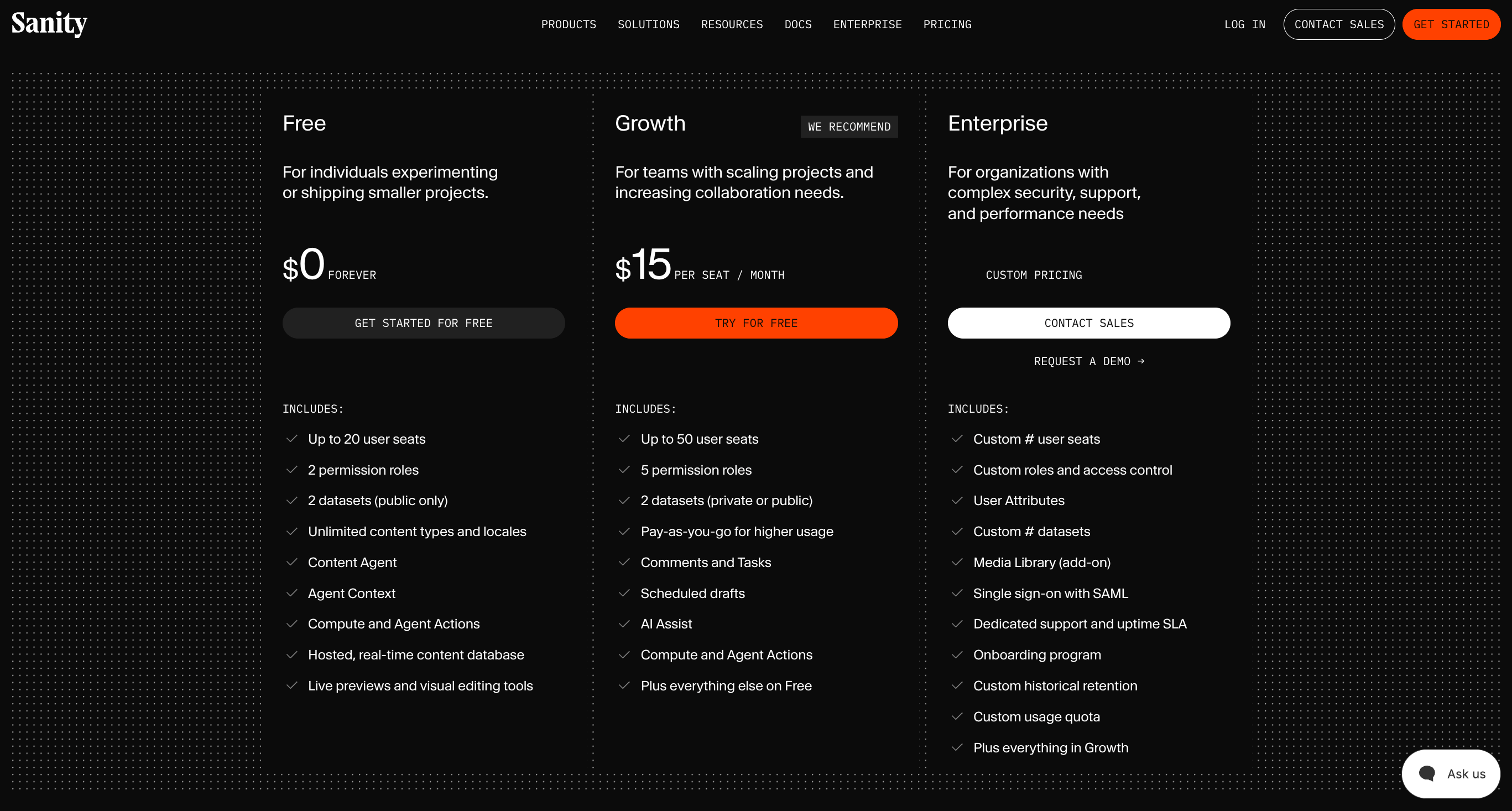
Sanity's pricing starts with a free tier for individuals and small projects, then scales through seats, permission roles, and AI-assisted features as teams grow. Enterprise moves to custom pricing and adds single sign-on and dedicated support.
In March 2026, Sanity repositioned itself as a "Content Operating System for the AI era", shipping Content Agent, Functions, an Agent API, and an MCP server. It's the deepest agentic tooling of the three platforms compared here.
Sanity fits technically mature teams comfortable owning a custom setup, especially in React or Vue environments. Our piece on scaling Vue development across industries is a useful next read if that's your stack.
Contentful
Contentful is one of the earliest headless platforms, built on years of enterprise adoption. It favors reliability, scalability, and governance over flexibility.
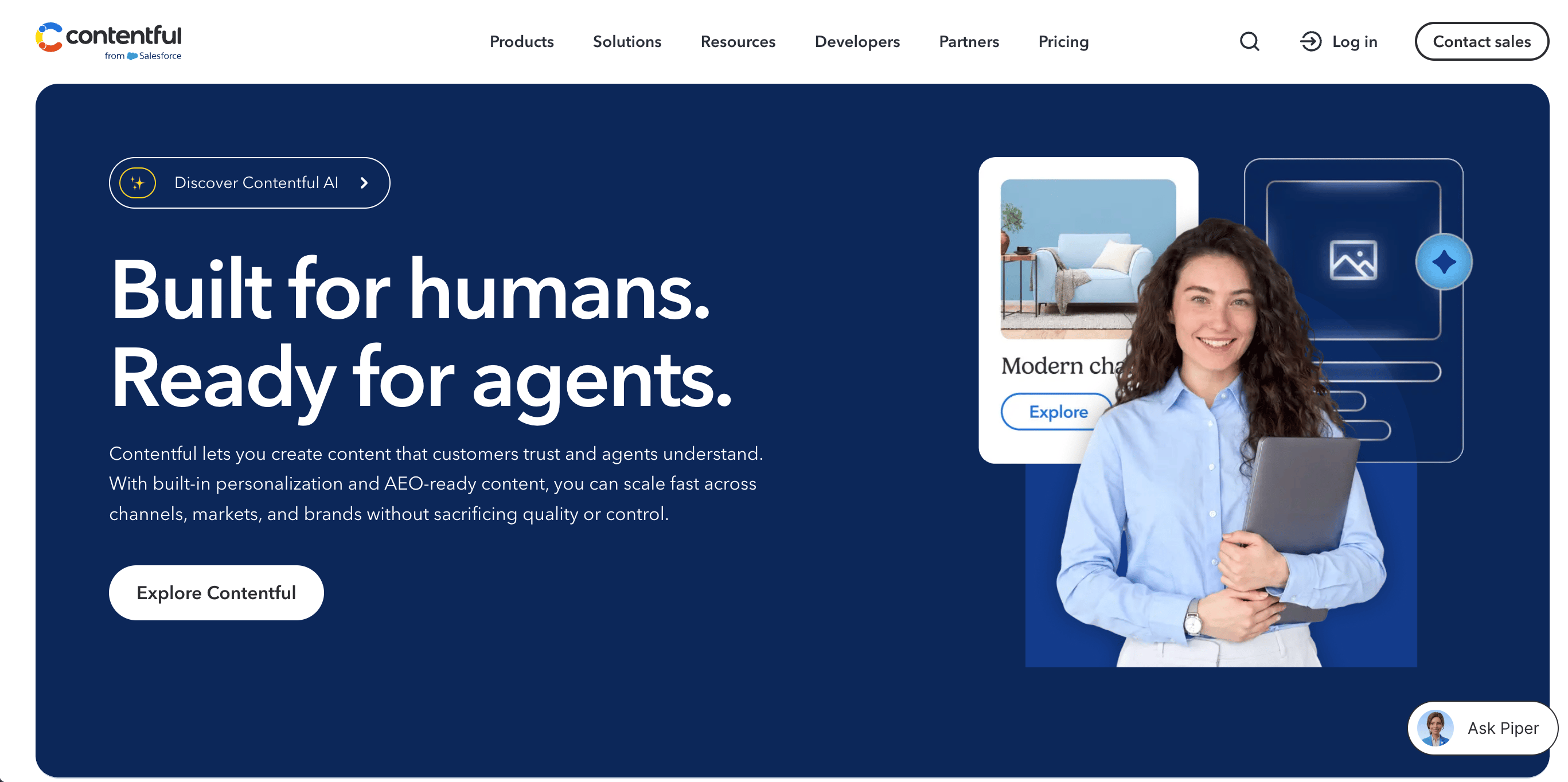
Explicit schemas and relationships keep editors working inside well-defined structures, and its API performance and global CDN are proven at enterprise scale. It also connects to a wide range of tools across analytics, commerce, and marketing.
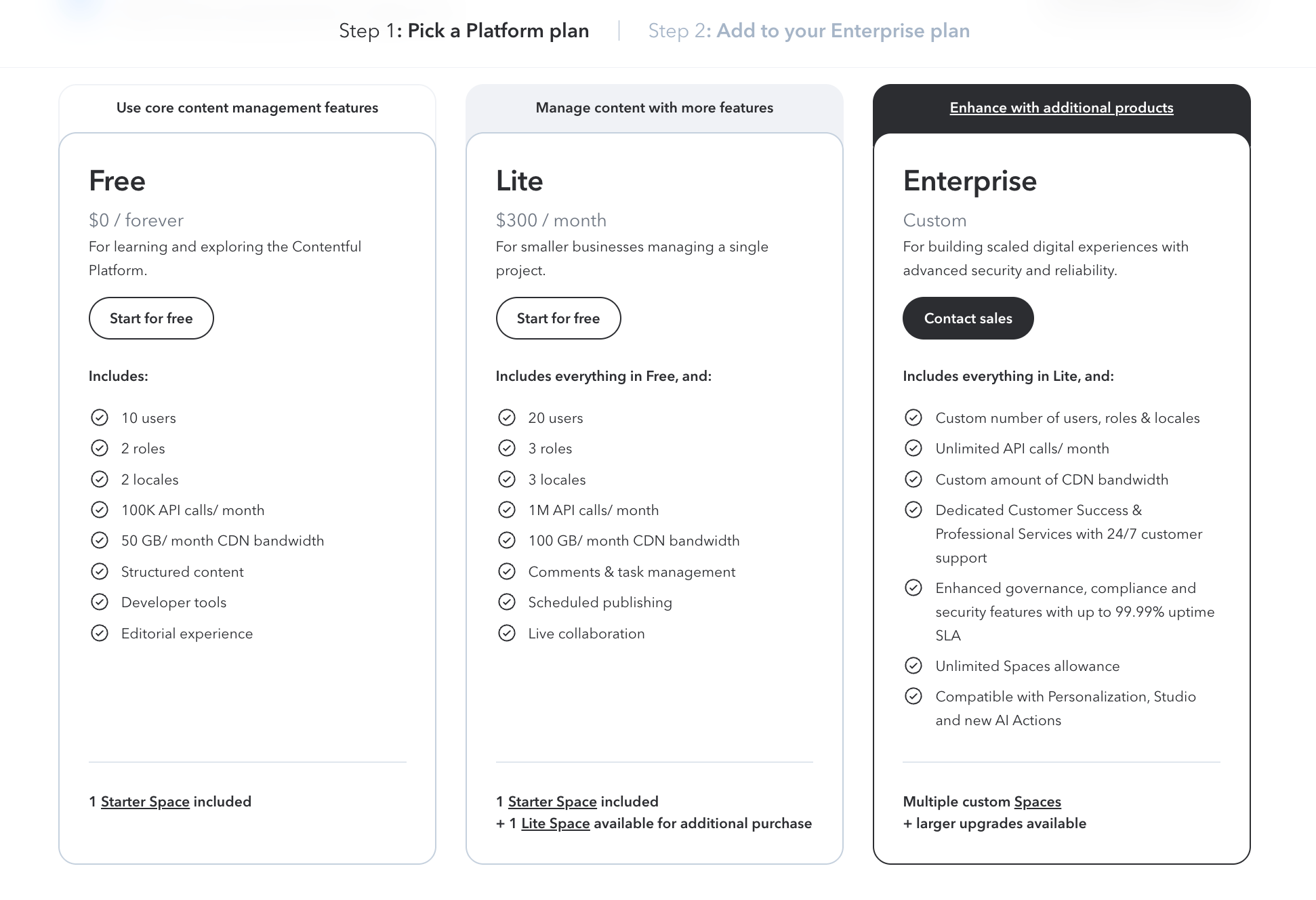
Contentful is usually the priciest of the three, though exact cost depends heavily on entry count, locales, and API usage. Enterprise plans need long-term budget planning, offset by strong SLAs and compliance support.
The biggest 2026 update: Salesforce signed the acquisition of Contentful on June 1 and completed it on September 1. Contentful now becomes the native content layer for Salesforce Headless 360 and Agentforce. That's a stronger fit if you're already built around Salesforce. Its remote MCP is now generally available.
Contentful is best for large enterprises with mature governance and long-term roadmaps.
Storyblok vs Sanity vs Contentful: Feature-by-Feature Comparison
On the surface, Storyblok, Sanity, and Contentful all tick the same boxes. They are API-first, cloud-based, and designed for modern frontend architectures. The following comparison focuses on the areas that most often determine long-term success.
Which CMS Has the Best Content Editing Experience?
Storyblok is the most intuitive for editors, Sanity is only as good as its implementation, and Contentful trades visual context for structure and consistency.
Storyblok's visual editing approach gives editors real-time previews close to the live site, cutting the effort needed to picture how a change will look in production. For landing pages and campaign sites, that visual feedback shortens the loop between a content change and a confident publish.
Sanity takes a more abstract approach: the editing experience runs on schemas and custom interfaces built by developers, so it can be tailored precisely. This means that the outcome depends heavily on how well it's built. When done well, it feels powerful; when rushed, it can confuse non-technical editors.
Contentful offers a structured, form-based experience. Editors work inside clearly defined fields and content types, which keeps output consistent but gives less visual context. This makes it a better fit for organizations with formal processes and repeatable content patterns.
Which CMS Offers the Best Developer Experience?
Sanity gives developers the most control, Storyblok balances flexibility with guardrails, and Contentful optimizes for predictability and low architectural risk.
Storyblok's component-based content model aligns naturally with modern frontend frameworks and design systems. Developers define the components, and the CMS enforces enough structure to prevent content sprawl. This way, teams get flexibility without building a fully custom CMS from scratch.
Sanity gives developers maximum control. Schemas are defined in code, the interface is customizable, and content is modeled exactly as required. That flexibility pays off in complex domains, but it also means the team owns governance and long-term maintainability.
Contentful's APIs are well-documented and consistent across projects. Customization is possible but intentionally bounded, which lowers architectural risk and simplifies onboarding for large teams. The trade-off is that it can feel restrictive for developers who want deeper customization.
Which CMS Performs Best at Scale?
Contentful is the most battle-tested option at enterprise scale, Sanity is strongest in real-time scenarios, and Storyblok performs reliably for standard content-driven workloads.
Storyblok delivers solid performance for most marketing and content-heavy use cases, backed by a global CDN and scalable infrastructure. Extremely high-throughput or near-real-time scenarios may require additional architectural work.
Sanity's live previews and real-time content updates enable collaborative workflows where changes need to be instantly visible. Performance holds up well when queries and schemas are designed carefully. Get that wrong, and it shows. This puts more of the responsibility on the development team.
Contentful's uptime guarantees and performance under heavy global load make it a common pick for organizations with strict SLAs, where downtime directly costs the business.
Which CMS Has the Best Collaboration Features?
Sanity enables real-time, multi-user collaboration, Storyblok supports structured role-based workflows, and Contentful is built around governance-driven review.
Storyblok provides role-based permissions and approval processes out of the box. Paired with visual previews, this supports structured, asynchronous collaboration across distributed teams and works well when responsibilities are clearly defined.
Sanity lets multiple editors work on the same content at once, closer to a collaborative document tool than a traditional CMS. That speeds up content production, but it needs strong editorial discipline to avoid conflicts.
Contentful's workflow and permission model supports formal review processes, which suits regulated environments or organizations with strict content controls. It's less dynamic than Sanity, but it trades that for clarity and predictability.
Which CMS Is Best for Global Content and Localization?
Contentful offers the most mature enterprise internationalization, Storyblok gives translators the best visual context, and Sanity is the most flexible (and most complex) to model.
Storyblok lets editors and translators preview localized content directly, which makes it easier to see how a translation affects layout and messaging.
Sanity's flexible schema design supports advanced localization logic and highly customized locale modeling. That flexibility suits complex use cases, but it raises implementation complexity and calls for content-modeling expertise up front.
Contentful treats localization as a first-class concern, with locale management, workflows, and permission controls built for enterprise-scale global operations and consistent governance across regions.
How Do Storyblok, Sanity, and Contentful Compare?
Criteria | Storyblok | Sanity | Contentful |
Editor usability | Visual, intuitive | Depends on implementation | Structured, predictable |
Developer flexibility | Balanced | Maximum control | Predictable, bounded |
Time to value | Fast for marketing sites | Slower, requires setup | Moderate, guided |
Customization depth | Medium | Very high | Limited by design |
Real-time collaboration | Limited | Native | Limited |
Governance & compliance | Medium | Custom-built | Enterprise-grade |
Enterprise scalability | High | High (with discipline) | Proven |
Internationalization | Visual, editor-friendly | Flexible, complex | Mature |
Agent/MCP readiness | MCP Server available | Native MCP, deepest agentic tooling (Agent API, Functions) | Remote MCP generally available |
Which One Matches Your Team: Storyblok, Sanity, or Contentful?
Storyblok fits best when you already have a design system and editors who need visual autonomy over layout, especially on multilingual marketing sites.
Sanity is the best choice when your team is technically mature and ready to own configuration long-term, in exchange for deep customization and real-time collaboration.
Contentful will suit you best when enterprise governance is your priority and proven scale matters more than flexibility.
Questions to Ask Before Committing to a CMS
By the time teams start comparing CMS platforms, the goal is usually clear: improve scalability or better support new channels. What's often underestimated is that many risks are organizational. Before committing to a CMS, address the questions below.
Does a Popular CMS Fit Your Team?
A platform's popularity in case studies or conference talks rarely reflects your organization's own constraints. What works well for a team with strong in-house frontend expertise can add unnecessary complexity for a team where marketing manages content.
Choosing a technically elegant platform without considering how content teams work creates issues later. Editors may struggle with abstract content models or lose confidence when publishing, even when the underlying architecture is sound. Involving both developers and content creators early in the evaluation surfaces these risks before they become expensive.
Is Headless CMS Hard to Learn?
Every headless CMS requires teams to think about content in a structured way. The differences between them lie in how much of that structure is predefined versus left for you to define. Platforms that require editorial interfaces defined in code need modeling experience up front. Highly flexible systems can overwhelm teams if nobody sets boundaries.
Running a proof of concept with the people who'll use the system daily exposes these problems early and gives a realistic read on onboarding effort. If your team lacks that headless experience internally, outsourcing non-core development can add specialized capacity to help you transition smoothly.
What Determines Total Cost of Ownership (TCO) for a CMS?
Licensing is only the starting cost. As usage grows, API usage, additional environments, roles, localization tooling, and governance features often become necessary. Enterprise pricing often requires long-term budget planning across regions or business units.
Model these costs explicitly. Include expected team growth, traffic increases, localization scope, and integration needs before scaling content volume and delivery channels.
In short, before committing to a platform, teams should have a detailed software estimate in place that accounts for both initial setup and long-term operational costs.
Is Switching CMS Platforms Complex?
Content structure decisions made during onboarding tend to persist for years. Once content is created and consumed by multiple applications, reversing those decisions gets expensive fast, especially once frontend logic is tightly coupled to a specific CMS's data model or API.
Evaluate export capabilities and content portability before you commit. A platform that supports structured, accessible exports reduces lock-in and keeps your options open.
Does Vendor Trajectory Matter When Choosing a CMS?
A CMS becomes part of how your team collaborates and scales content operations. This means that vendor roadmap and support model all matter beyond the initial launch.
Salesforce's acquisition of Contentful is a live example of why this belongs in the evaluation. It changes what choosing Contentful means for any team not already invested in Salesforce, a factor worth considering regardless of which platform you're evaluating.
How Do You Evaluate a CMS Before Committing? Six-Step Process
Assemble a cross-functional team: a development lead, a content or marketing representative, and a project or product manager. This way, architecture, usability, and operational risk all get a voice from the start.
Define must-have vs. nice-to-have. Use constraints like security, compliance, supported channels, localization, and integrations to eliminate options. Use preferences only to differentiate among the remaining choices.
Evaluate vendors against your own use cases. Consider your content types, multilingual scenarios, approval workflows, and complex page compositions. Don’t rely on the vendor's best-case demo.
Map how content flows. Look at how it's created, reviewed, published, updated, and retired across every delivery channel you have or plan to add, plus the integrations (commerce, CRM, analytics, personalization) that touch it.
Run a proof of concept. Small, time-boxed, on two or three shortlisted platforms, with the people who'll use it daily doing the publishing. Measure time-to-publish and editor confidence.
Assess the vendor. Check their support responsiveness, usage terms, product roadmap, and customer references from your industry.
Key Takeaways
The right CMS choice depends on team composition, not which platform ranks highest.
Pick Storyblok for editor autonomy, Sanity for configuration control, or Contentful for enterprise-grade governance.
Salesforce now owns Contentful, which is a plus for teams who already built around Salesforce.
All three platforms support MCP, so what matters now is how well you've structured your content.
TCO and the difficulty of reversing a migration are the two costs teams often underestimate.
The Best CMS Is the One That Suits Your Team
Storyblok, Sanity, and Contentful are all battle-tested platforms, and none of them is the wrong choice in the abstract. Fit comes down to your organization's own constraints, such as team composition and workflow, as well as growth trajectory.
If you're weighing a CMS migration or a first implementation, our engineering team can help you scope the delivery risk before you lock in a platform. Get in touch to talk through your specific constraints.
Headless CMS FAQ

Hubert Białęcki
Head of Technology at Monterail

As Monterail’s Head of Technology, Hubert brings a unique blend of technical expertise and strategic leadership to drive innovation and organizational growth. A graduate of Wrocław University of Science and Technology, Hubert has carved an impressive career path from JavaScript developer to technology executive, demonstrating both technical mastery and exceptional leadership capabilities. He excels at understanding complex organizational dynamics and implementing strategic changes that enhance team performance and company development.