The New Default. Your hub for building smart, fast, and sustainable AI software

Table of Contents
The best fintech software development company for your product is the one that can show you a regulated financial system it has already shipped, name the compliance framework it was audited against, and tell you who touched production data. Framework preferences and portfolio design are the easy part of this decision. In fintech, the expensive failures come from ledger logic that does not reconcile, a KYC flow that a regulator rejects, or a subcontractor in an undisclosed jurisdiction holding access to your logs.
That is a different buying problem from picking a generic web shop, and the market is large enough now that plenty of generic web shops describe themselves as fintech specialists. The global fintech market is projected at roughly $460 billion in 2026, and embedded finance has pulled software companies with no financial-services history into building payments, lending, and wallet features. The supply of vendors claiming domain depth has grown faster than the supply of vendors who have it.
Executive Summary
Fintech engineering budgets are dominated by two things that have nothing to do with feature count: regulatory surface area and integration depth. Compliance and banking line items typically consume 25% to 40% of total project cost, which means a vendor's hourly rate is a weak predictor of what you will actually spend.
Rates in 2026 span roughly $15 per hour in South Asia to $250 per hour in North America, and the companies at both ends of that range ship production financial systems. The variable that separates a good outcome from a rewrite is whether the team has delivered inside a regulated environment before and can produce the audit evidence to prove it.
The eight companies below cover that spread deliberately, so you can calibrate against your own stage, jurisdiction, and appetite for risk.
Best Fintech Software Development Companies in 2026
This list is not ranked. The eight companies here were chosen to show the range of what a fintech engineering partner can look like: teams of ten and teams of eight hundred, hourly rates from $25 to $199, headquarters in Poland, Ukraine, Cyprus, the Netherlands, Canada, the United States, Australia, and India, and specialisms that run from licensed core banking to crypto brokerage to multi-asset trading. The order shows that variety and carries no judgment of quality. All figures come from each company's public Clutch profile, its own site, and its published case studies, with sources linked throughout.
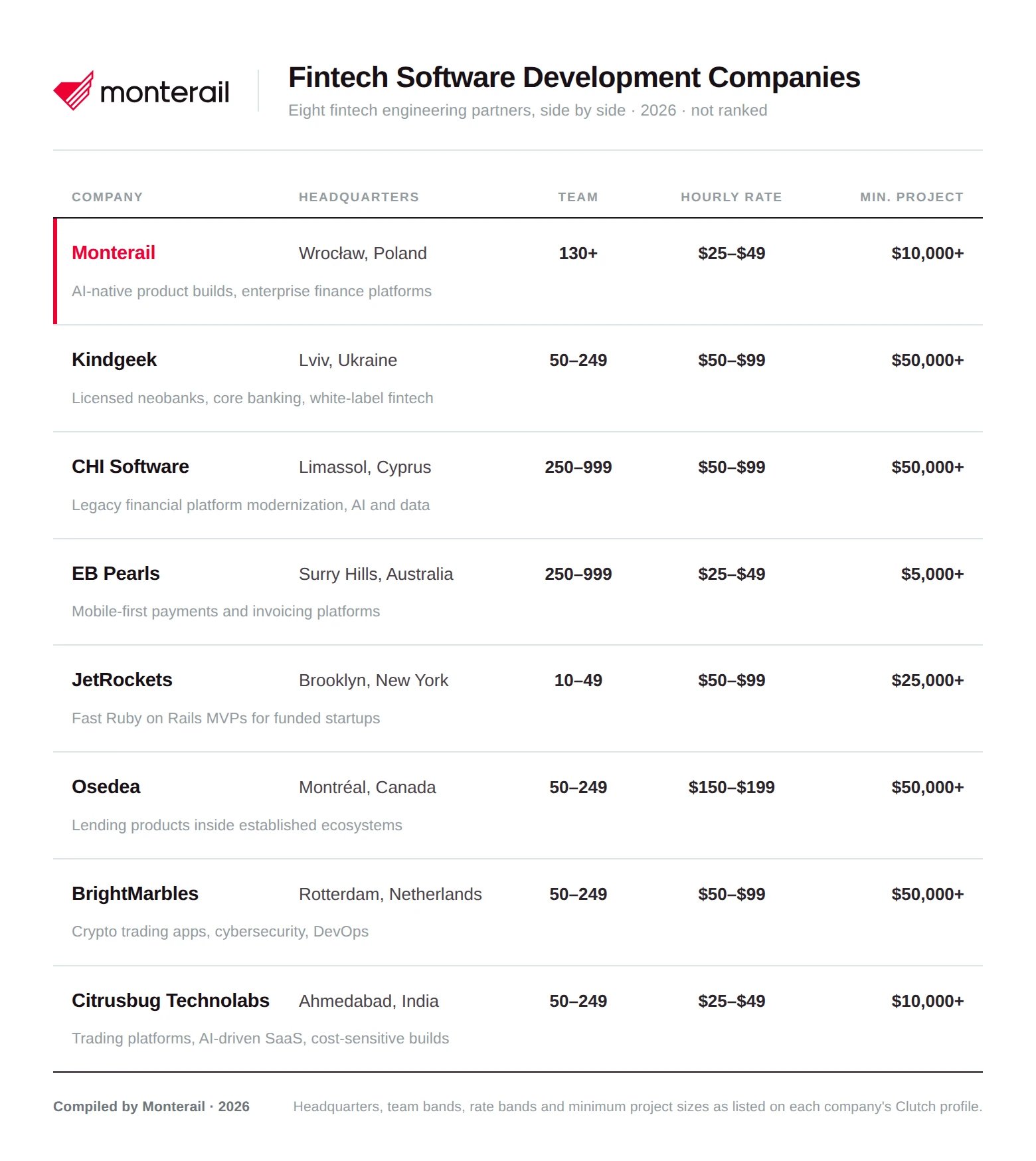
Where a company's public headcount differs from its Clutch employee band, both numbers appear in the profile below. Team-size bands on Clutch are broad, and several of these companies have grown past the band they are listed in.
Monterail
Monterail is an AI-native software development company founded in 2010 and headquartered in Wrocław, Poland, with 130+ in-house engineers, designers, and product specialists. The company has delivered 900+ projects across healthtech, fintech, HRTech, retail, and proptech, and works with recognized global brands including Bosch, DocPlanner, EY, Merck, and SharkNinja. It was named one of the fastest-growing tech companies in Central Europe by Deloitte in 2016 and 2017, listed in the Financial Times 1000 in 2018, and has since acquired three agencies, Untitled Kingdom, EL Passion, and Lakeview Labs, adding MedTech, product design, and mobile depth. Its current NPS is 71.
Example project by Monterail
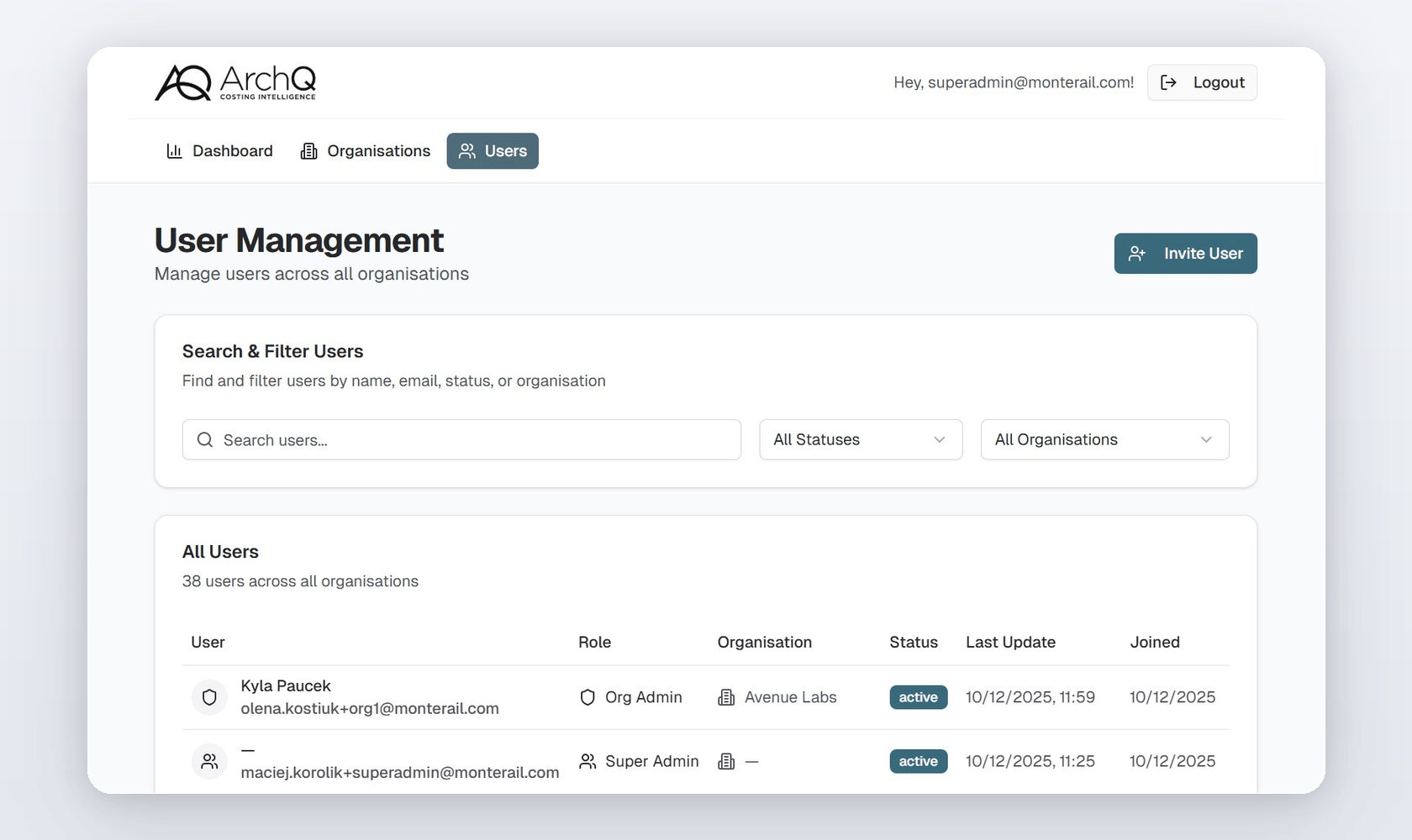
A UK construction founder had two decades of commercial cost expertise sitting in spreadsheets, legacy tools, and the heads of long-tenured staff, and wanted it codified into an AI cost-intelligence platform that CFOs and board members would trust. Monterail ran hypothesis-first discovery workshops where each assumption became a prototype feature, delivered an interactive AI-powered prototype two weeks after kickoff, and shipped a fully functional MVP in three months on a 500-hour budget with zero rework and no scope collapse. During pilot preparation the team found that the first prospective client's accounting data was incomplete and inconsistently structured, and paused the AI rollout rather than risk misleading outputs in front of the board. The platform passed its initial CFO and board-level pilot review without disrupting existing financial workflows. The full AI cost intelligence platform case study documents the architecture and the delivery phases.
How Much Does Monterail Fintech Development Cost?
Monterail's Clutch profile lists an average hourly rate of $25-$49 and a minimum project size of $10,000+, with a cost rating of 4.4 out of 5. Verified client reviews put actual project costs between $30,000 and over $1 million depending on complexity, and the most common web development engagement sits in the $50,000-$199,999 band across 18 reviews. That places Monterail at the lower end of the European rate table further down this page while operating in US-friendly time zones.
What Do Clients Say About Working With Monterail?
Clients tend to comment on speed of comprehension in unfamiliar domains and on the pace of the first deliverable.
"We moved from reactive scheduling to proactive, data-driven decisions. The ability to see a prototype in one day and scale it to an enterprise-ready solution so quickly was a game-changer for our resource management."
Bram Verstraeten, Senior Project Manager, SPIE Belgium
"I was impressed with the speed at which Monterail was able to grasp a complex and niche industry and translate that into a clear and practical system structure. I have confidence in their understanding of both the product vision and commercial context."
Amelia Christie, Director, Christie Constructive Limited
"If you want to outsource your coding to the lowest hourly rate, then Monterail aren't for you. If you want to build winning products at pace, then Monterail need to be on your shortlist."
Alan Buxton, CTO, Simfoni
The recurring criticism in Clutch reviews is design: several clients rated engineering above visual and UX craft, and a few brought in external designers for specific needs. The 2025 acquisition of EL Passion, a product design agency, was aimed at that gap, though reviews predating it still reflect the older mix.
Why Do Businesses Choose Monterail?
A 500-hour, three-month MVP with no rework is a useful signal for first-time founders who have never tested their scope against real engineering constraints
Discovery is structured to kill bad assumptions before production code, which is where fintech scope typically collapses
Long partnerships are the norm here, including a 12-year engagement with HR tech platform Cooleaf that scaled to 110,000+ users across 103 organizations
Official Vue.js and Nuxt partner status, with Ruby on Rails, React Native, Flutter, and Node.js in the core stack
Willingness to pause an AI rollout to protect board-level credibility, as it did on the construction finance platform, is the kind of restraint that regulated products need
Kindgeek
Kindgeek is a fintech product engineering company founded in 2013 and based in Lviv, Ukraine, listed on Clutch in the 50-249 employee band and stating a team of 211 specialists on its own site. It is the most narrowly focused company on this list: its clients are licensed fintechs, payment companies, neobanks, and enterprises building regulated financial products. Kindgeek reports 100+ regulated projects and platforms that have processed more than €10 billion, and holds ISO 27001:2023, ISO 9001:2015, PCI DSS, and GDPR credentials while describing itself as PSD3-ready. Its white-label catalog covers neobanks, e-wallets, personal financial management, core banking, acquiring, crypto, and lending.
Example project by Kindgeek
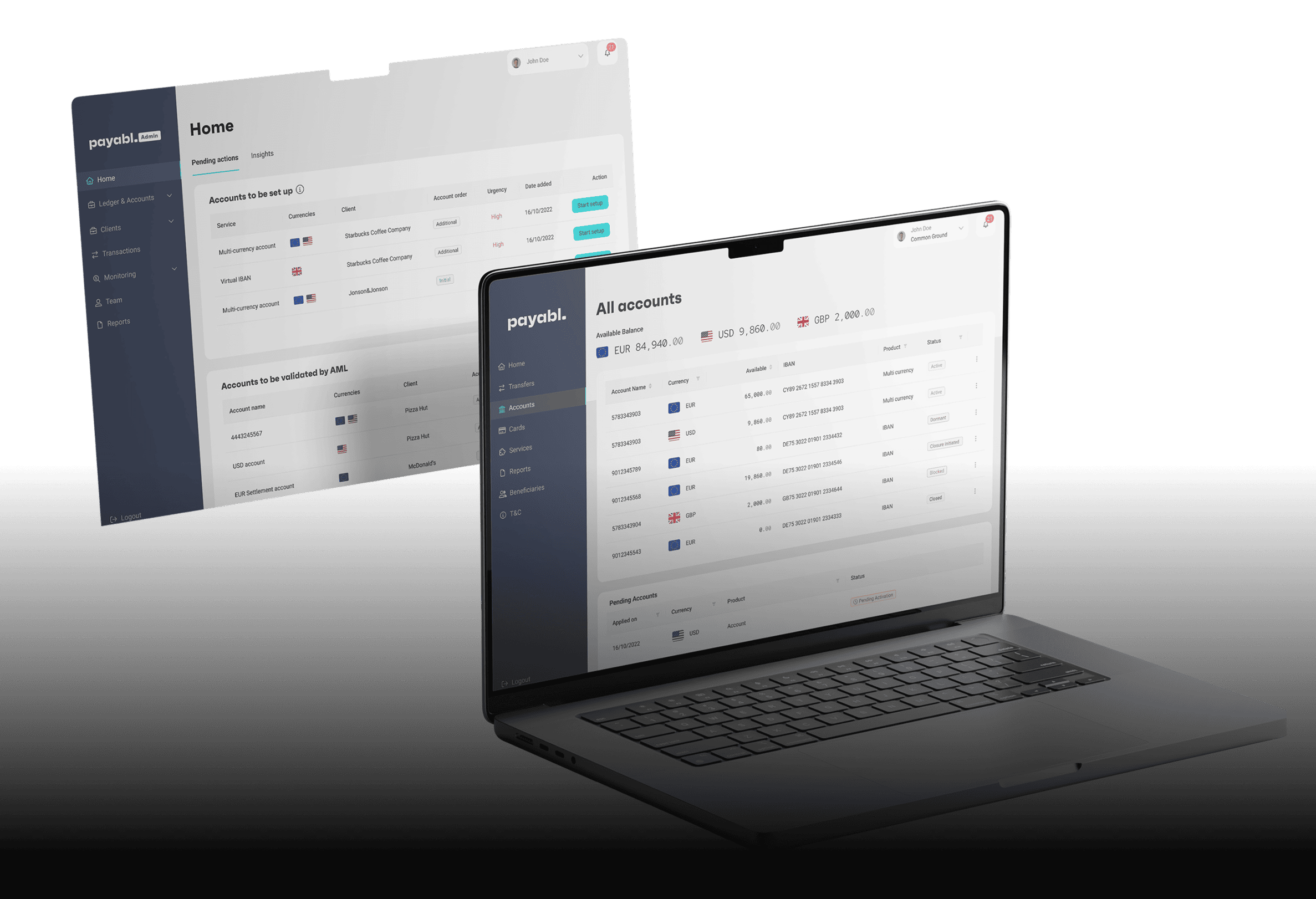
Cyprus-based payment provider payabl. needed a core banking application that would let merchants manage business accounts, transfers, and reporting in one place, and it needed the MVP in seven and a half months. Kindgeek put 11 people on a nine-month engagement running from November 2022 to July 2023, building an administrative portal and a client portal from scratch while migrating undocumented legacy PHP to Python for scalability. The administrative side covers onboarding and KYC review, transfer monitoring, custom AML flagging, a purpose-built general ledger for transaction balance and compliance tracking, and role-based user rights. Merchants got multi-currency accounts, internal and external transfers with configurable multi-level approval signatures, account and company-level statements, and beneficiary management. Details are in the payabl. core banking case study.
 Source: www.kindgeek.com
How Much Does Kindgeek Fintech Development Cost?
Clutch lists Kindgeek at $50-$99 per hour with a $50,000+ minimum project size and a cost rating of 4.7 out of 5. Client-reported budgets span $10,000 to $1 million, and the most common project size across 46 reviews is under $49,999, which suggests plenty of scoped modules and dedicated-team extensions alongside the larger greenfield builds. The rate sits above the Eastern European mid-market band below, which is what regulated-domain specialization usually costs.
What Do Clients Say About Working With Kindgeek?
Reviews emphasize precision against specific requirements and adaptation to business context.
"What stood out most about this company was their exceptional attention to detail and their unwavering commitment to delivering a tailored solution that precisely aligned with our specific needs."
"Their understanding of real-world business challenges and their ability to adapt to our specific goals were particularly impressive."
Volod Fedoriv, Co-founder, Remofirst
"Their understanding of real-world business use cases and their ability to adapt to our business needs were impressive."
Eduard Singer, CEO, neusinger GmbH
Some clients have reported turnover within specific expertise areas, which occasionally disrupted continuity and required stronger knowledge transfer. On a multi-year regulated build, ask how named roles are backfilled.
Why Do Businesses Choose Kindgeek?
Compliance is designed into the architecture rather than retrofitted, with PCI DSS, GDPR, and resilience-focused design as standing constraints
The €10B+ processed figure and 100+ regulated projects give you something concrete to reference-check
White-label components for neobanking, e-wallets, and lending can compress a licensed launch timeline considerably
Advisory work includes architecture review, compliance assessment, software audit, and technical due diligence, useful if you inherited a codebase you do not trust
Custom general ledger and AML monitoring built in-house for payabl. is direct evidence of money-movement engineering, which most generalist agencies cannot show
CHI Software
CHI Software started in 2006 as a ten-person web studio called City Hall Illustrations and now runs 800+ specialists across offices in Cyprus, Ukraine, Poland, and Spain, with Clutch listing it in the 250-999 employee band and its headquarters in Limassol, Cyprus. The company organizes into 16 engineering and 5 product support teams, opened an AI R&D center in 2019, became ISO 27001 and ISO 9001 certified at the end of 2021, and has partnered with Databricks on data work. AI development and generative AI account for 45% of its service mix, with fintech, edtech, and healthcare as core industries.
Example project by CHI Software
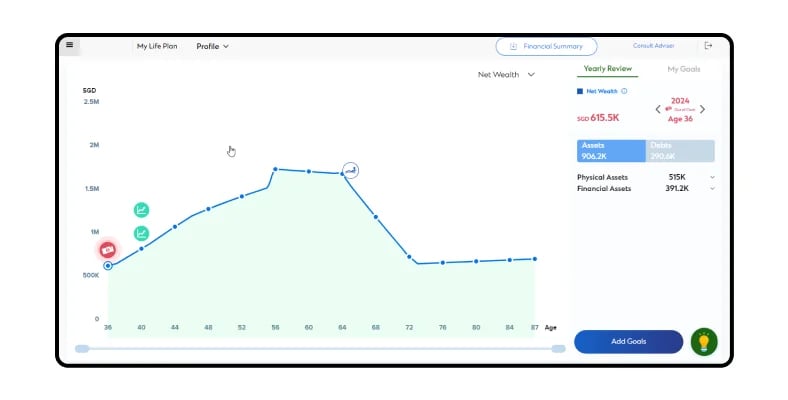
A Singapore fintech SaaS provider sold financial planning software to banks, insurers, and advisory firms, and its monolithic platform had become slow to release and hard to scale as enterprise demand grew. CHI Software ran a six-year modernization with a 12-person team, refactoring the codebase with comprehensive unit test coverage, migrating from monolith to microservices, integrating Stripe and Twilio for payments and communications, rebuilding the product's signature visualization with drag-and-drop event modeling on financial graphs, and moving to a cloud-native Azure DevOps environment supporting multi-currency and real-time analytics. The results were a 60% increase in customer engagement, an 80% scalability improvement, 20% higher sales for the banks and advisers using the platform, and SOC 2 compliance that lifted customer trust by 60%. The client expanded from Asia into Europe and the US. See the financial software modernization case study.
 Source: chisw.com
How Much Does CHI Software Fintech Development Cost?
CHI Software lists $50-$99 per hour, a $50,000+ minimum project size, and a cost rating of 4.8 out of 5 on Clutch. Reported engagements range from $3,000-$4,000 per month for smaller ongoing work to $100,000 for larger projects, and the most common project size across 25 reviews is $50,000-$199,999. The monthly retainer option matters for modernization work, where the engagement is measured in years rather than deliverables.
What Do Clients Say About Working With CHI Software?
The reviews are consistent on requirements translation and responsiveness.
"What stood out was CHI Software's ability to understand our requirements and translate them into practical solutions."
Andrey Yatsenko, CEO, UniRidge
"Their dedication to quality work and willingness to help as soon as possible are impressive."
David Gillo, VP of Business Development, Exelerate Smart Traffic Ltd
"The CHI Software team demonstrates very high communication and professional skills."
Anna Kravchuk, Head of Sales, SoftGroup
A few clients noted minor miscommunications early in engagements. With a company this size, the quality of the assigned project manager is worth interviewing for directly.
Why Do Businesses Choose CHI Software?
Six years on one financial platform is unusual proof of staying power for legacy modernization, where the risk is a vendor leaving mid-migration
Incremental modernization instead of a rewrite let the Singapore client keep shipping features while the architecture changed underneath
ISO 27001 and ISO 9001 certification plus delivered SOC 2 compliance work means the audit conversation starts from evidence
An 800-person bench can staff additional roles quickly when scope expands, which smaller shops cannot always do
Deep AI and data engineering capability, including a dedicated R&D center and a Databricks partnership, for teams adding intelligence to existing financial products
EB Pearls
EB Pearls is an Australian digital product engineering company founded in 2004, with a Sydney office in Surry Hills handling design, account management, and QA, and a Kathmandu engineering hub in Nepal running solution architecture, development, and testing. Clutch lists it in the 250-999 employee band; the company reports 360+ in-house full-time specialists, 1,400+ businesses served, 900+ software projects across 18+ industries, 97% client retention, a 98% on-time delivery rate over the past 12 years, and $9.6B+ in revenue delivered across client platforms. It has held the #1 global Clutch ranking for app development four years running, holds 72+ awards, and became ISO 9001 and 27001 certified in 2023. All development happens in-house with no third-party offshoring.
Example project by EB Pearls
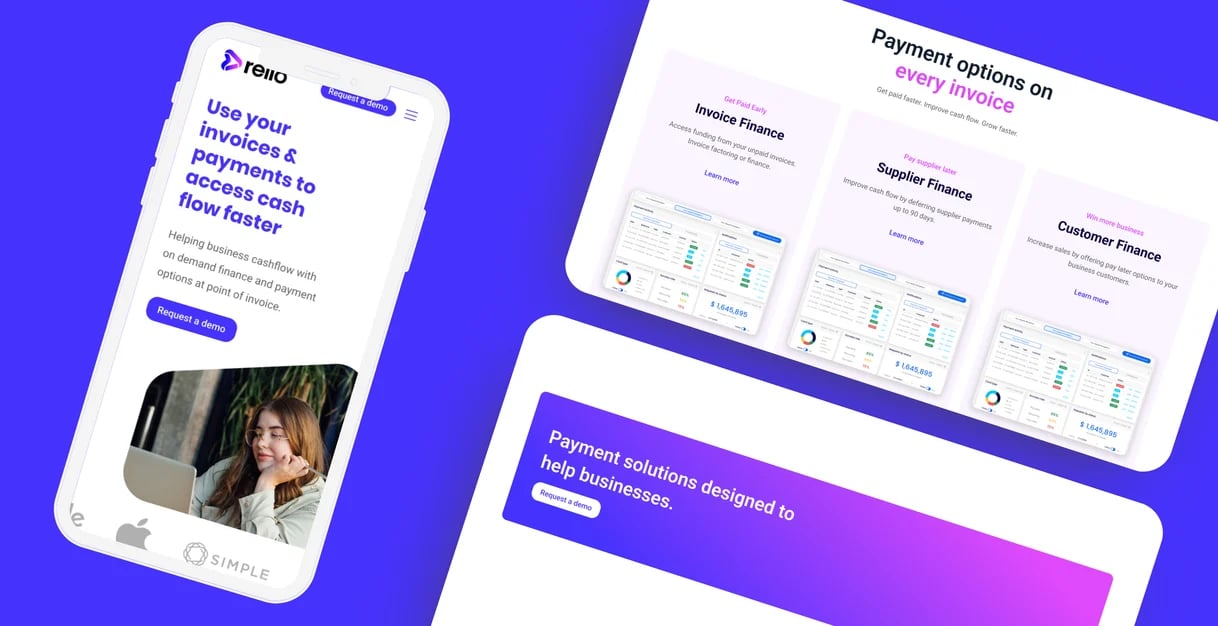
Australian fintech Rello needed one platform where businesses could issue invoices, collect payments, and access financing, replacing the three or more disconnected tools most of its customers were using. EB Pearls built the whole thing from the ground up, mobile apps, web dashboard, payment gateway, invoicing engine, embedded financing layer, and partner integration APIs, leading architecture, engineering, QA, and ongoing delivery across Flutter, Node, React, and AWS. Customer interviews had surfaced one dominant complaint, that businesses knew money was coming but could not see where it was, so the design goal became fewer steps and continuous transaction visibility rather than more features. After consolidation, transaction volume rose 38%, payment delays fell 32%, weekly manual reconciliation collapsed into a single workflow, and the number of systems needed to run payments went from three or more down to one. The Rello payments platform case study covers the design reasoning.
 Source: ebpearls.com.au
How Much Does EB Pearls Fintech Development Cost?
EB Pearls has the lowest entry point on this list, with a $5,000+ minimum project size, an average hourly rate of $25-$49, and a cost rating of 4.8 out of 5. Reported project costs run from $28,000 to $300,000 AUD, and the most common project size across 55 reviews is under $49,999. Cost transparency comes up repeatedly in reviews, with one Vodafone client contrasting EB Pearls' itemized estimate against vague quotes from other agencies.
What Do Clients Say About Working With EB Pearls?
Post-launch support and honest scoping advice dominate the feedback.
"What impressed us most was that the support did not stop at launch. When issues came up, they were responsive, clear, and easy to work with. It felt like we had a partner behind the product, not a team that disappeared after the initial job was done."
Fidaa Haddad, Founder, Rello Pay
"EB Pearls didn't just deliver what we asked for; they brought insight, experience, and integrity to every discussion."
Andrew Penn, Board of Advisors, Glow Services Corp
"The Discovery phase saved us from making expensive mistakes, which we didn't even realise were there. It challenged some of our early assumptions, clarified what actually needed to be built first, and gave us a much stronger foundation before development started."
Kym Herbert, Product Lead, Optus
Some clients have flagged gaps in proactive status updates. If you need weekly written reporting, put it in the contract.
Why Do Businesses Choose EB Pearls?
Twenty-one years of continuous operation, with 97% of clients returning, is a rare retention figure in an industry with high churn
The Built to Last framework assigns a named product lead from kickoff through post-launch and assigns IP at every milestone
Milestone-based payments with scope locked before development starts limits the change-order exposure that inflates fintech budgets
Genuine willingness to say no: the company has rebuilt more than fifty products originally built by cheaper teams and argues openly against day-rate shopping
Australian time zone coverage with Nepal-based engineering gives Asia-Pacific clients same-day turnaround at offshore rates
JetRockets
JetRockets is a women-owned, Brooklyn-based Ruby on Rails agency founded in 2012, listed in the 10-49 employee band on Clutch while reporting 50+ developers and 100+ completed projects on its own site. It is the smallest and most specialized team here: Rails, Hotwire and Turbo, React, React Native, and AWS, with fractional CTO and senior leadership engagements always led by the co-founders rather than staffed to juniors. Clutch named it a Top Ruby on Rails Development Company and #2 women-owned software developer in the US for 2026. CTO Igor Aleksandrov has worked in Rails since 2008 and is a recognized Docker Captain.
Example project by JetRockets
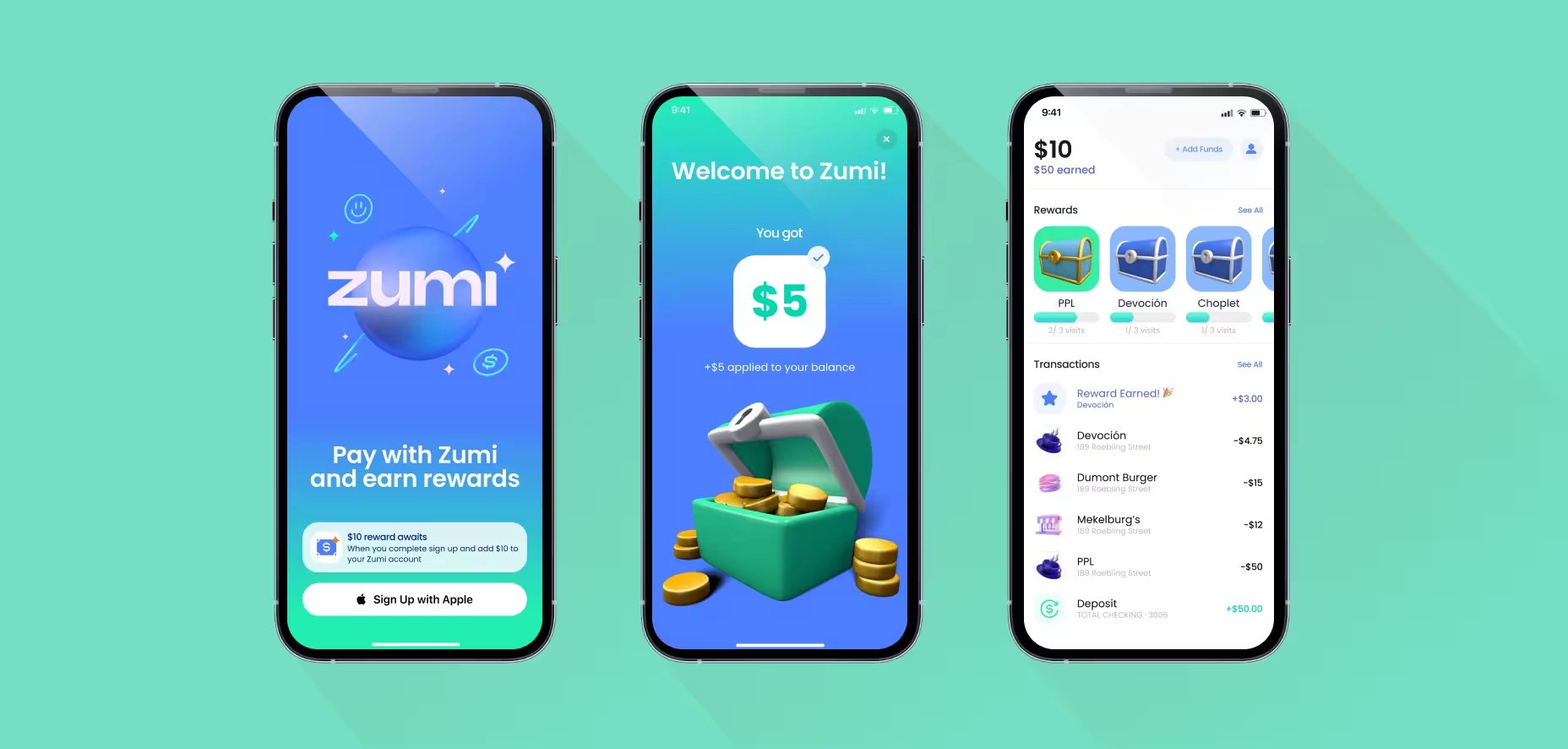
DVx Ventures needed Zumi, a consumer app that layers automatic rewards onto in-store purchases at small merchants, built and launched fast. JetRockets shipped the MVP in under two months including the bug-fixing phase, on a stack of Ruby on Rails, PostgreSQL, GraphQL, Redis, Sidekiq, React, and Apollo. The build covered identity verification and onboarding, a gamified rewards system tracking merchant purchase milestones, funding the Zumi card through Plaid with an auto-reload trigger when the balance drops below $10, a categorized transactions list, Apple Wallet provisioning, and push notifications for purchases, declines, and earned rewards. The MVP let the fund test its hypotheses on schedule, and JetRockets became DVx Ventures' preferred development partner. The Zumi portfolio entry walks through each user flow.
 Source: jetrockets.com
How Much Does JetRockets Fintech Development Cost?
Clutch lists JetRockets at $50-$99 per hour with a $25,000+ minimum project size and a cost rating of 4.7 out of 5. Reported project costs span $10,000 to over $500,000, with the most common web development engagement at $50,000-$199,999 across 10 reviews. For a US-based team, that rate is well below the North American benchmark in the table below, which is the practical argument for a boutique agency with a distributed engineering team.
What Do Clients Say About Working With JetRockets?
Founders without technical backgrounds are the clearest voice in these reviews.
"The time it has taken them to build this app is our biggest KPI; we needed to launch this product very fast, and JetRockets was able to have everything ready in under two months, including the bug-fixing phase."
Sid Shankar, Head of Product, Zumi (DVx Ventures)
"Organized and transparent, JetRockets never overpromises on their work. They're responsive in tackling issues that arise at any hour and always keep the bigger picture in mind."
Kinjal Amin, Co-founder, Bastion (Tower Fund Services)
"Their team delivers on time and is very communicative. They've taken ownership of the project when necessary; they are very responsible."
Nir Badichi, Product Manager, eBay
One client raised team turnover and NDA compliance as problems, which is worth probing given how sensitive fintech engagements are. Ask directly about named-team continuity and confidentiality controls before signing.
Why Do Businesses Choose JetRockets?
Co-founders lead senior engagements personally, so the people who set the architecture are the people you interviewed
Under two months from brief to launched MVP is a defensible benchmark for seed-stage products with a funding clock
Deep Rails specialization, unbroken since 2008, suits fintech teams that want a mature framework and a small surface area of technical risk
Strong track record with non-technical founders, translating financial product ideas into scoped builds without jargon
Small enough that the engagement is a relationship rather than a ticket queue, which several clients describe as the reason they stayed
Osedea
Osedea is a Montréal-based innovation firm founded in 2011, in the 50-249 employee band, working across AI, software engineering, product design, data engineering, and robotics for manufacturing, health, mining, agri-food, and finance clients. It has been SOC 2 Type II compliant since 2022, is an AWS Select partner and certified Google Cloud practice, partners with Mila, Quebec's AI research institute, and with Boston Dynamics on robotics. AI development and AI agents make up half its service mix. It was named to Canada's Top Growing Companies and Leaders de la croissance in 2023, and Montreal Top Employers in 2024. It operates in nine languages from a single time zone.
Example project by Osedea
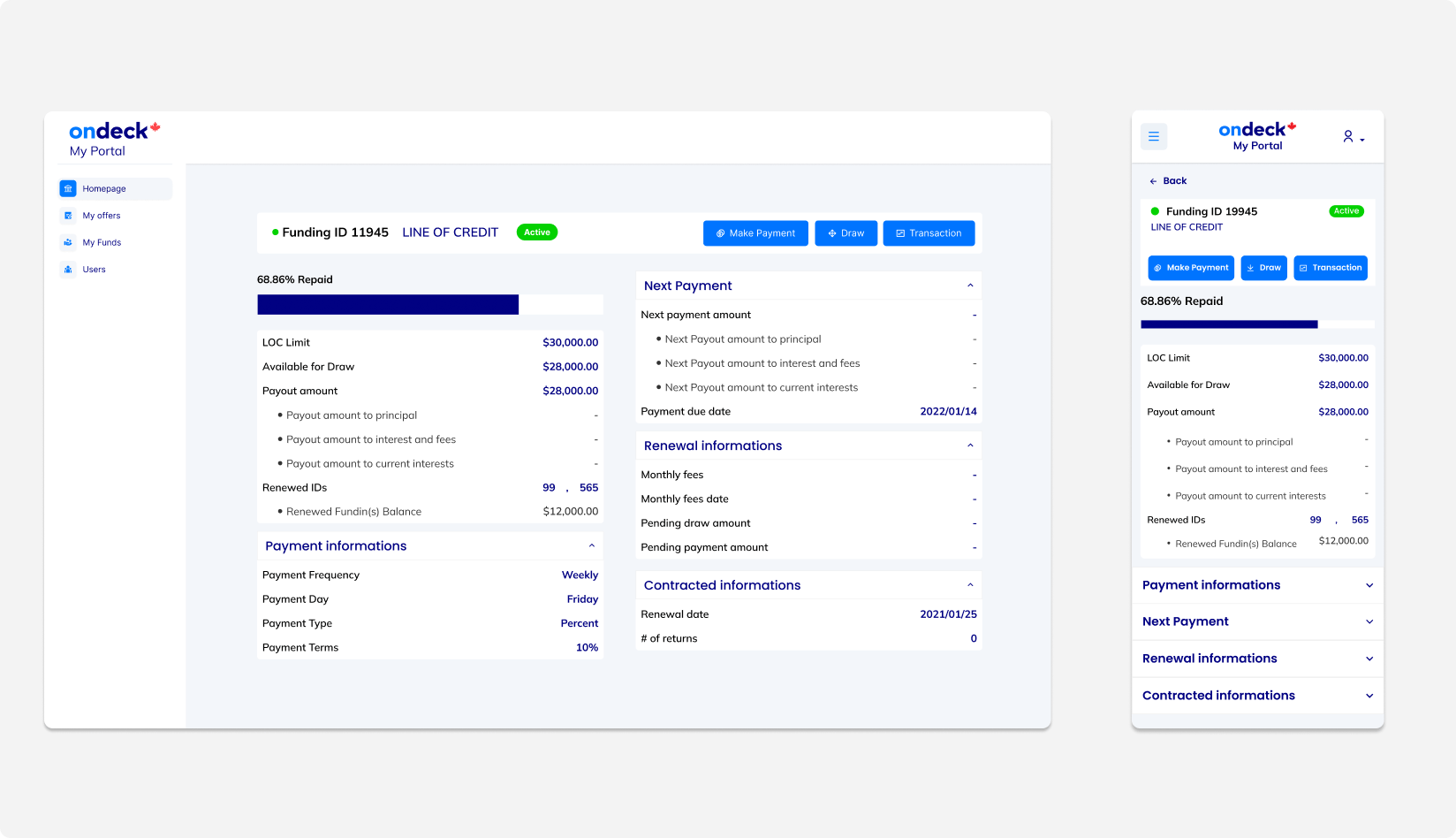
Journey Capital, formerly OnDeck Canada, provides fast online financing to Canadian small and medium businesses, and wanted to add a business line of credit alongside its existing term loan and cash advance products. That meant extending a well-built but unfamiliar codebase, so Osedea spent real time reading it before writing anything. The harder problem was financial: large Excel sheets of business rules governed how interest accrues on a revolving facility where owners draw what they need and pay interest only on what they borrow, and those rules had to integrate with existing merchant statuses and funding mechanisms. Osedea built the backend in Java with Spring, the frontend as an Angular web application, all inside AWS, with its SOC 2 compliance giving Journey Capital assurance on data handling. The Business Line of Credit launched in June 2022 and became a cornerstone of the client's operations, bringing in new customers alongside existing ones. Osedea remains their primary software partner. Full write-up in the Journey Capital case study.
 Source: www.osedea.com
How Much Does Osedea Fintech Development Cost?
Osedea is the most expensive company on this list, at $150-$199 per hour with a $50,000+ minimum project size and a cost rating of 4.7 out of 5. Reported project costs run from $10,000 to over $500,000, with the most common custom software engagement at $50,000-$199,999 across 9 reviews. That rate is squarely in the North American band below, and buys onshore Canadian delivery, a single time zone, SOC 2 Type II attestation, and research-grade AI capability through the Mila partnership.
What Do Clients Say About Working With Osedea?
Design thinking before implementation is the theme clients return to.
"What stood out most about Osedea was its customer-centric approach, focusing on design, user experience, user stories, and practicality before diving into technical implementation."
Nicholas Nadeau, CTO, SmartOne.ai
"They are a great development team that can handle any challenge thrown at them."
Kyryll, Director of Applied Innovation, Promark
"We really got along well with the team, and the whole project felt very collaborative."
Some clients have said they would like more domain-specific experts on the bench. Osedea's finance work is real, though finance is one industry among several in its practice, so ask which specific engineers would carry your financial domain knowledge.
Why Do Businesses Choose Osedea?
SOC 2 Type II compliance since 2022 removes a common blocker when a fintech's own enterprise customers run vendor security reviews
Journey Capital shows Osedea can add a regulated financial product to a live system without disrupting operations, which is a narrower skill than greenfield building
Onshore Canadian delivery in a single time zone, with bilingual and multilingual teams, for organizations with data residency or language requirements
A flat, non-hierarchical structure where teams operate as intrapreneurs, which clients connect to responsiveness and initiative
The Mila partnership and a 50% AI service mix give access to current AI research alongside applied tooling
BrightMarbles
BrightMarbles Group is a Rotterdam-headquartered engineering group founded in 2016, operating from five hubs with 160+ experts averaging over seven years of experience each, and 65% of the team at senior engineer, team lead, or architect level. Clutch lists it in the 50-249 employee band. Services span software development, cybersecurity, data science, DevOps, and creative work, with cybersecurity, mobile, and web development each at 20% of the mix. It is a Microsoft Gold Partner, an Adobe Solution Partner, ISO/IEC 27001 certified, and vetted by Digital Knights as top 7% of Europe's tech talent. The group describes itself as a startup builder with seven unicorns in its client portfolio, and reports that 95% of clients become long-term partners and 90% of new clients arrive by referral.
Example project by BrightMarbles
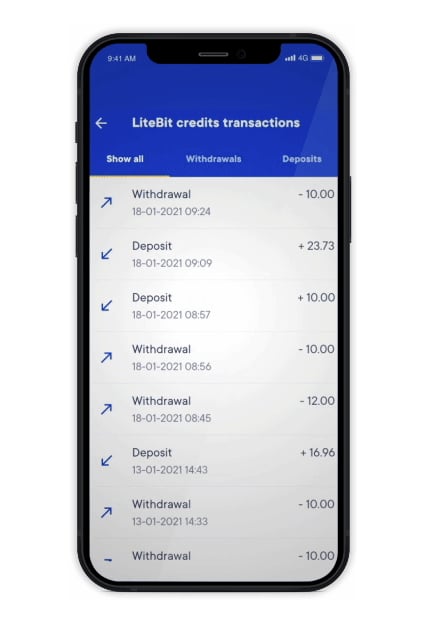
LiteBit was one of Europe's fastest-growing cryptocurrency brokers and was voted best crypto broker in 2019, and its mobile roadmap had become a bottleneck. The existing iOS app was React Native, the Android app did not exist, and building both in parallel was draining the development team. While one team continued on React Native, BrightMarbles built a cross-platform Flutter app for Android and iOS, and inside six months the Flutter build had surpassed the React Native application and hit every requirement ahead of schedule. Focus shifted entirely to Flutter, cutting development and maintenance costs while opening the Android segment. The app has passed 260,000+ installs and lets over 600,000 traders buy, sell, and store 59 listed cryptocurrencies. The LiteBit case study has the delivery timeline.
 Source: brightmarbles.io
How Much Does BrightMarbles Fintech Development Cost?
BrightMarbles lists $50-$99 per hour, a $50,000+ minimum project size, and the highest cost rating on this list at 4.9 out of 5. Specific figures are not detailed in its Clutch review summary, and the most common project size across 37 reviews is $50,000-$199,999. Reviewers consistently describe the pricing as competitive against the quality delivered, with several noting delivery under budget constraints.
What Do Clients Say About Working With BrightMarbles?
Crypto and fintech domain fluency is what the flagship client emphasizes.
"BrightMarbles is our strategic development partner. They heavily influenced what LiteBit is today, sharing a big part in achieving our success. With a deep understanding of both the Crypto and Fintech industries and their engineer's excellence, they helped LiteBit position as one of the fastest-growing and respected cryptocurrency brokers globally."
Erwin Veldhuis, CPTO, LiteBit
"We were particularly impressed with their responsiveness to our needs. Not to mention their ability to integrate seamlessly into our team as an augmentation."
Nevena Nikolic, Partner & Project Director, Vega IT
"Usually there is a period when new people need to adapt to the project, but their guys took the deadline seriously and we managed to finish some of the features in the first days of our cooperation."
Luka Ćurčić, Co-Founder & CEO, Marble IT
The most common suggestion in reviews is that BrightMarbles could grow its team to handle larger volumes or more simultaneous projects. Confirm bench availability before committing to a parallel multi-track roadmap.
Why Do Businesses Choose BrightMarbles?
A senior-weighted team, with 65% at lead or architect level and seven years of average experience, reduces the supervision overhead on complex financial logic
In-house cybersecurity alongside development is unusual and directly relevant to crypto and payments work
Demonstrated ability to switch a client's mobile strategy mid-flight, replacing React Native with Flutter in six months without losing ground
Microsoft Gold Partner status and ISO/IEC 27001 certification for organizations that require formal vendor credentials
Seven unicorns in the portfolio and a 92% employee retention rate, meaning the engineers who learn your domain are likely to still be there next year
Citrusbug Technolabs
Citrusbug Technolabs is an AI-first product engineering company founded in 2013 in Ahmedabad, India, in the 50-249 employee band, with 12+ years of operation and 320+ client companies worldwide. Its work centers on scalable SaaS platforms, LLM-driven applications, and enterprise automation, using model fine-tuning, RAG architectures, and modern DevOps. AI development is its largest service line at 20%, followed by custom software development and IT strategy consulting. Its client list includes Bosch, Deloitte, HSBC, Allianz, McKinsey, and Flipkart, and leadership includes co-founders with IIT credentials and prior director roles at Instinctools India. It is Clutch-certified in custom software development and web development, and covers three time zones.
Example project by Citrusbug Technolabs
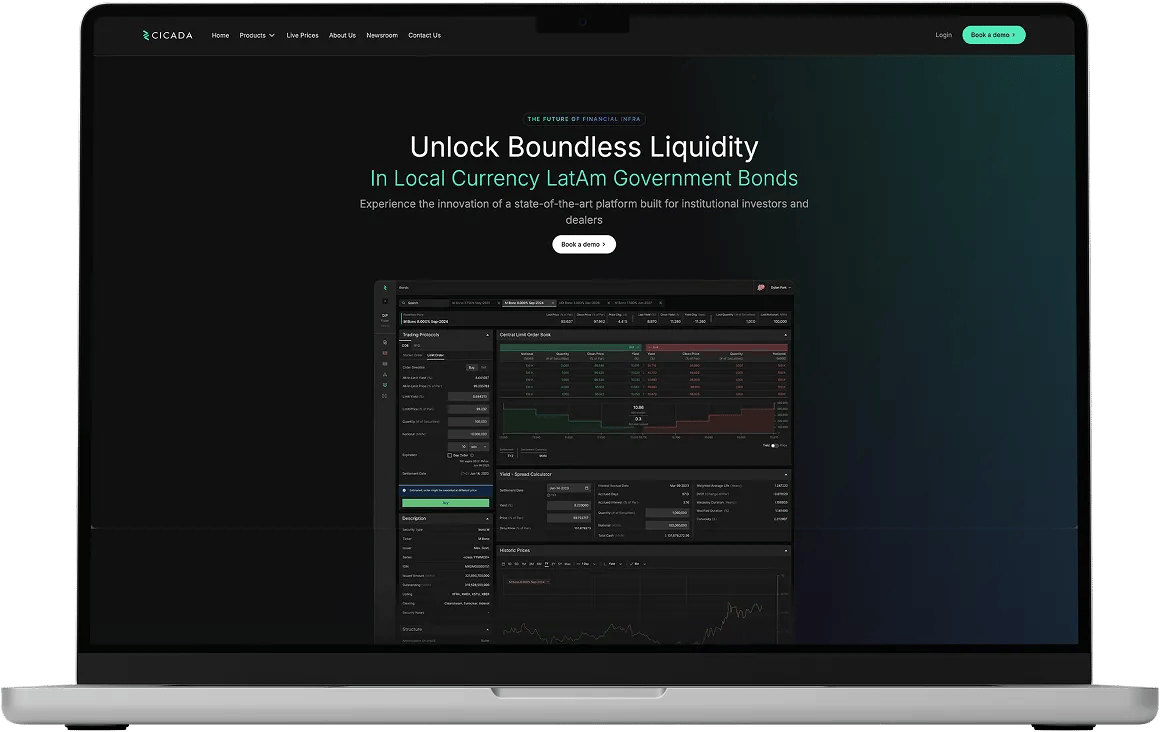
Cicada is a trading platform built for individuals and institutions dealing in stocks, bonds, futures, and options, and it needed to serve novices and professionals from the same interface while staying reliable under variable market conditions. Over a one-year engagement Citrusbug handled UI/UX and prototyping, a React frontend with Django-based APIs for trading logic, multifactor authentication with role-based access control, and analytical tooling including Yield Analysis Scenario calculators and real-time market streams. Delivered outcomes were four-plus asset classes supported, 99.99% system uptime, sub-200ms order execution latency, and 100% MFA and role-based security coverage across user roles. The Cicada trading platform case study lists the delivery phases.
 Source: citrusbug.com
How Much Does Citrusbug Technolabs Fintech Development Cost?
Clutch lists Citrusbug at $25-$49 per hour with a $10,000+ minimum project size and a cost rating of 4.7 out of 5. Reported project costs run from $10,000 to over $125,000, and the most common custom software engagement is $10,000-$49,999 across 15 reviews. That is the low end of the global rate table below, and the reason cost-sensitive teams shortlist India for well-specified builds.
What Do Clients Say About Working With Citrusbug Technolabs?
Reviewers describe the team as an extension of their own rather than an external vendor.
"I am impressed by their genuine, transparent communication and how their development team operates so closely with us that it felt like an extension of our own team."
Amir Ossanloo, Founder, Sunstrike Corp.
"What stood out most was the exceptional dedication of the entire team; every member consistently went above and beyond to ensure the project's success."
Arijit Mukherjee, CEO, Repodime Systems
"Their team took the time to sit with our medical staff, listen to their daily challenges, and design solutions that felt natural in use. That human-centered approach is rare in software development and is what made the collaboration so successful."
Managing Director, German healthcare company
The consistent criticism is written documentation: clients rate the technical conversations highly but want more durable written references for their own teams. On a regulated build where documentation is part of the audit trail, negotiate deliverable documentation explicitly.
Why Do Businesses Choose Citrusbug Technolabs?
The lowest effective cost on this list for a well-specified build, at $25-$49 per hour with a $10,000 entry point
99.99% uptime and sub-200ms order latency on Cicada are the performance numbers that matter for trading products
Structured AI integration rather than bolt-on features, with fine-tuning and RAG architectures in regular use
Project management discipline is a recurring theme in reviews, with clear timelines tracked in Jira and Trello and regular progress meetings
320+ client companies over 12 years across healthcare, fintech, real estate, logistics, and enterprise SaaS, including work touching HSBC and Allianz
What Makes a Great Fintech Software Development Company?
A great fintech development company can produce evidence for three things: that it has shipped inside a regulated environment, that it knows exactly who touches your data, and that it treats money movement as an engineering discipline with its own correctness requirements.
Start with regulated delivery evidence. Every certification named on this page is checkable. PCI DSS is the sharpest filter, because all PCI DSS 4.0 requirements, including the 51 controls that were previously future-dated, became mandatory on March 31, 2025, with no remaining grace period. Vendors that validated in 2024 while treating those controls as optional will fail their next assessment. If you handle card data in the EU, you may need both PCI DSS and DORA operational resilience evidence, with different owners and review cycles. Kindgeek's ISO 27001 and PCI DSS credentials, CHI Software's delivered SOC 2 work, and Osedea's SOC 2 Type II attestation are all examples of the artifact you should be asking for.
Compliance fluency shows up in how a team answers questions. A specialist handles KYC customer identification requirements, Regulation E disclosures, or PCI scope boundaries by describing what they did on a real build. Generic answers signal limited financial-industry exposure, and that is the most reliable tell in vendor screening.
Subcontracting transparency. This is the most underestimated risk in fintech outsourcing. You need to know who writes the code, who administers environments, who can read logs, who might touch production data, and which jurisdictions are involved. EB Pearls' insistence that all development happens in-house across its own two hubs is a direct answer to that question. Any vendor who cannot answer it in one sentence has a supply chain you have not seen.
Ledgers, reconciliation, idempotent transaction handling, multi-currency rounding, and approval hierarchies are where fintech builds actually break, so probe money-movement correctness directly. Kindgeek's custom general ledger and AML monitoring for payabl., and Osedea's work translating spreadsheets of revolving-credit interest rules into production code, are the kind of specifics that separate financial engineering from CRUD development.
Integration depth is the last check. Stripe, Plaid, Twilio, banking-as-a-service providers, core banking systems, and accounting platforms all behave differently under load and failure. Ask which of these the team has integrated, and what broke.
How Much Does Fintech Software Development Cost in 2026?
A validation MVP runs roughly $40,000 to $150,000 over three to six months, a production-ready compliant application runs $120,000 to $300,000 or more over six to twelve months, and an enterprise platform starts around $300,000 and takes twelve to eighteen months or longer. The number to hold onto: compliance and banking line items typically account for 25% to 40% of total project cost, which is why cheap hourly rates do not translate proportionally into cheap fintech projects.
Hourly rates by region, 2026
Region | Mid-level | Senior | Notes |
|---|---|---|---|
North America (US, Canada) | $80-$150 | $120-$250 | California and New York reach $300/hr for specialist work |
Western Europe | $70-$120 | $90-$150 | Common for regulated platform builds with EU data residency |
Eastern Europe (Poland, Ukraine, Romania) | $30-$55 | $45-$90 | Strongest quality-to-cost ratio outside Asia, European hours |
Latin America (Mexico, Colombia, Brazil) | $35-$60 | $50-$95 | Rates fell about 7% in 2025; best US time-zone overlap |
South and Southeast Asia (India, Vietnam, Philippines) | $15-$30 | $30-$65 | Lowest cost tier, largest talent pool, widest quality spread |
Sources: Codebridge, Qubit Labs, and Aalpha. Fintech, cybersecurity, blockchain, and AI specializations carry a premium within every band.
Total cost by build scope
Build scope | Typical cost | Timeline | What drives the number |
|---|---|---|---|
Validation MVP | $40,000-$150,000 | 3-6 months | Feature count kept minimal; one market, one currency |
Production-ready compliant app | $120,000-$300,000+ | 6-12 months | Audit evidence, penetration testing, KYC and AML flows |
BaaS-based neobank MVP | $150,000-$400,000 | 4-6 months | Sponsor bank integration, card issuing, ledger design |
Enterprise platform or modernization | $300,000-$500,000+ | 12-18+ months | Legacy migration, multi-market rollout, SOC 2 or DORA |
Sources: Saigon Technology, Purrweb, and Bolder Apps.
Cross-referencing the companies above against these benchmarks is instructive. Monterail, EB Pearls, and Citrusbug all sit in the $25-$49 band; Kindgeek, CHI Software, JetRockets, and BrightMarbles occupy $50-$99; Osedea alone is at $150-$199. A US or Western European buyer engaging any of the first seven is buying a rate below the local benchmark, and the real comparison is against internal hiring plus recruitment time, not against the cheapest quote on the shortlist.
Red Flags and the Questions to Ask Before You Sign
Most bad fintech engagements are diagnosable during the sales process. These are the signals that appear before a contract exists.
A vendor that pushes back on a paid discovery phase or a short calibration workshop is telling you how it expects the relationship to run. Discovery is where fintech scope gets tested against reality, and skipping it is how budgets double.
Watch for security described as a feature instead of a property of the architecture. A team that cannot explain how it protects user data without reaching for marketing language has already answered the question.
Vague subcontracting is disqualifying for a regulated product. Ask for a named list of every organization and jurisdiction that will have access to code, environments, logs, and production data, and treat hesitation as a no.
Compliance answers with no project behind them. Ask about KYC customer identification, Regulation E disclosures, or PCI scope, then listen for whether the reply contains a specific past engagement.
Push back when you are offered case study PDFs and you asked for reference calls. You want clients you can speak to, with comparable compliance and integration complexity, and you want to ask each of them what went wrong as much as what went right.
Day-rate-only comparisons hide the real number. EB Pearls has rebuilt more than fifty products that clients originally built with cheaper teams, and reports that the rewrite always costs more than the original build. Rework risk belongs in your cost model.
Sources worth reading in full before a vendor selection: WislaCode on early red flags in fintech outsourcing, OpenForge's fintech vendor due-diligence checklist, and EVNE Developers on due diligence for development partnerships.
How Do You Choose the Right Fintech Development Partner?
Start from your regulatory surface area, then your stage, then your time zone, and let rate be the last filter rather than the first.
If you are validating an idea, you need speed and scope discipline more than compliance machinery. A small senior team that ships in weeks, of the kind JetRockets demonstrated on Zumi or Monterail on the construction finance platform, is worth more than a large bench. Budget $40,000 to $150,000 and expect to throw some of it away, which is the point of validation.
Licensed products change the calculus, because compliance capability stops being negotiable. You want a partner who has built inside PCI DSS or DORA constraints, can hand your auditors evidence, and has designed a general ledger before. Kindgeek's regulated portfolio is the archetype here, and the price of that specialization shows up in the rate.
Modernizing a platform that already carries revenue puts continuity above velocity. CHI Software's six-year incremental migration for the Singapore fintech is the shape to look for: the client kept shipping features while the architecture changed underneath. Ask candidates how they would sequence the migration and what they would deliberately leave alone.
Extending a live financial product calls for a team willing to read code before writing it, and one whose own security posture will survive your customers' vendor reviews. Osedea's Journey Capital engagement is a clean example, with SOC 2 Type II doing real work in the sales conversation.
On time zones, decide whether you need same-day iteration or overnight throughput. Eastern Europe gives European hours with meaningful US overlap, Latin America gives the closest match to US hours, and Asia-Pacific teams work best where the handoff is well specified. EB Pearls' Sydney and Kathmandu split is one answer, Osedea's single Montréal time zone is another.
On rate, compare the total cost of the first eighteen months, including the compliance line items, the discovery phase, and a realistic allowance for rework, against the cost of hiring the same team in-house. The vendor with the lowest hourly rate is rarely the vendor with the lowest total.
Which Fintech Development Partner Fits Your 2026 Roadmap?
The pattern running through all eight companies is that hourly rate tracks regulatory surface area and geography far more closely than it tracks quality. BrightMarbles has the highest cost rating on this list at 4.9 out of 5 while charging $50-$99 an hour. Monterail, at $25-$49, delivered a board-approved MVP in three months with zero rework. Osedea charges three to four times more than Citrusbug, and the difference buys onshore Canadian delivery and SOC 2 Type II rather than better code. Meanwhile the compliance and banking work that consumes a quarter to two-fifths of your budget costs roughly the same regardless of who writes the code, which compresses the real gap between a $30-an-hour vendor and a $150-an-hour vendor considerably.
Price, then, is the wrong thing to agonize over. Spend that energy on a harder question: has the team in front of you built a ledger that reconciled, passed an audit someone else scheduled, and told a client no at least once?
Key Takeaways
Compliance and banking line items run 25% to 40% of a fintech project's total cost, so hourly rate explains less of your final invoice than most shortlists assume.
All PCI DSS 4.0 requirements have been mandatory since March 31, 2025. Ask any prospective partner which controls it has implemented and when it was last assessed.
Subcontracting transparency is the highest-value question in vendor screening: who writes code, who administers environments, who can read logs, and in which jurisdictions.
Rate bands correlate with geography and regulatory specialization rather than delivery quality. The highest cost rating in this group belongs to a mid-band vendor, and the fastest documented MVPs came from the two cheapest.
Match the partner to your stage. Validation rewards small senior teams and scope discipline; licensed products reward regulated-domain evidence; modernization rewards vendors who stay for years.
Fintech Software Development FAQ

Grzegorz Hajdukiewicz
Chief Delivery Officer

With over a decade of experience in the IT industry, Grzegorz has a proven track record of delivering complex projects on time and on budget. At Monterail, he leads a team of dozens of developers, designers, project managers, and business analysts, ensuring the successful delivery of software solutions for clients worldwide. Passionate about agile methodologies and continuous improvement, he constantly seeks new ways to optimize the delivery process.