The New Default. Your hub for building smart, fast, and sustainable AI software
Table of Contents
The best healthcare app developer with FDA experience can show you regulated software it has shipped and put you on the phone with a client whose product went through review. Almost any team handles HIPAA; far fewer have shipped inside an FDA- or CE-regulated program. Once your product is meant to diagnose, treat, prevent, or monitor a condition, it likely qualifies as Software as a Medical Device (SaMD), and many founders learn only after launch that they needed a 510(k) they never filed.
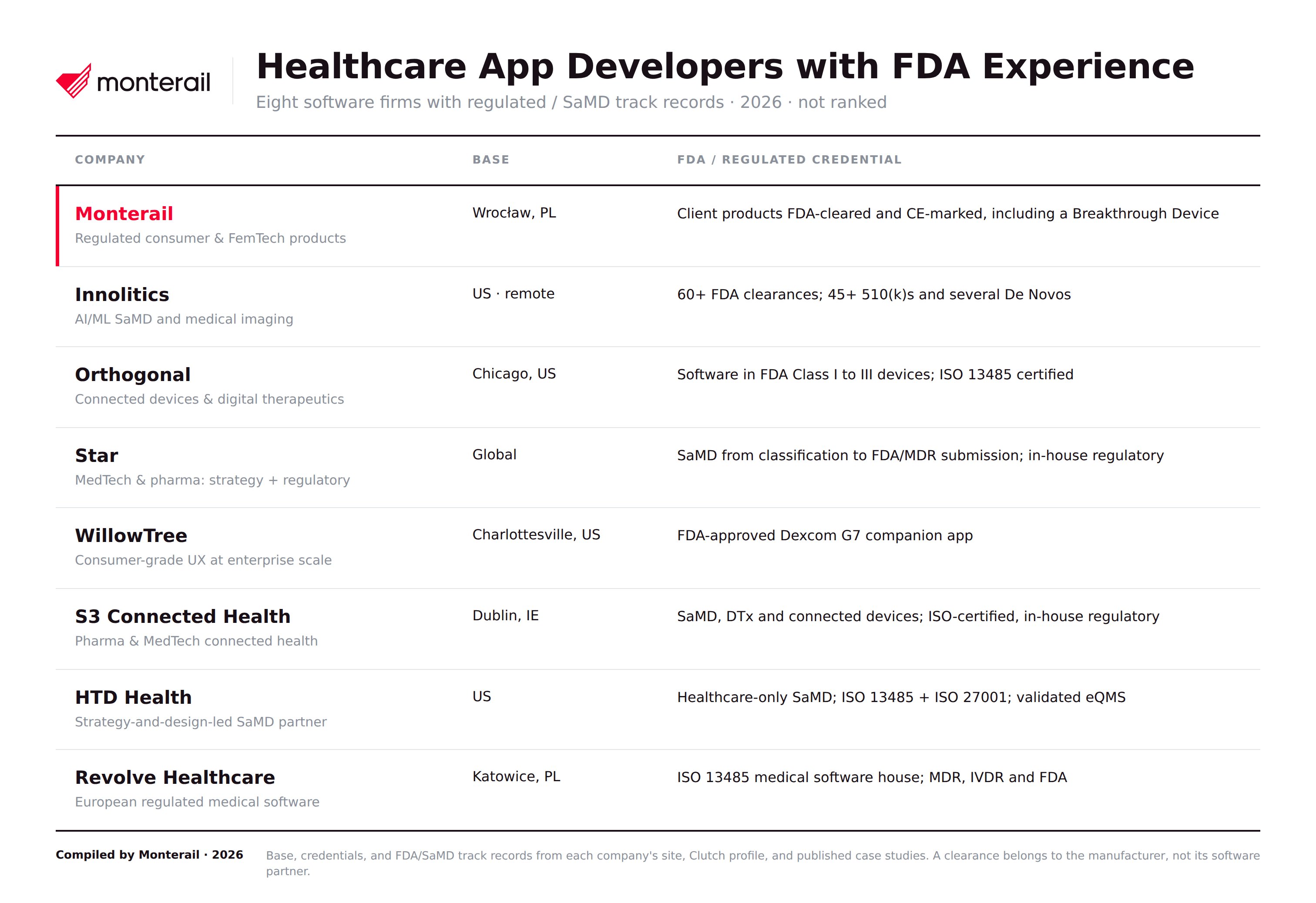
The eight companies below all have a documented track record in regulated SaMD work, with clients building for FDA- and CE-regulated markets. For a Europe-first or cross-industry view, see Monterail's Top Healthcare Software Development Companies in Europe and its global roundup. After the list come 2026 clearance-cost benchmarks and the questions to ask before you sign.
Executive Summary
FDA experience is the sharpest filter when hiring a healthcare app developer: it separates teams that grasp the wellness-versus-SaMD boundary from those that will hand you a compliance problem. The SaMD market (roughly $3.8 billion in 2025, projected to exceed $19 billion by 2030) means FDA scrutiny of medical software and the cost of misclassifying both keep rising.
Classification is the biggest cost variable, adding $150,000 to $2 million or more on top of a standard app, with 12 to 18 months from finished build to a live product. Choose based on proximity to your risk class first: a partner that builds design controls, risk files, and cybersecurity documentation from sprint one clears faster than one gathering evidence before submission.
The eight companies below span that range on purpose, so you can calibrate against your own risk class, market, and stage.
Top Healthcare App Developers with FDA Experience in 2026
This list is not ranked. Monterail appears first because this is Monterail's blog; the other seven are ordered to show contrast, not merit. Between them they cover teams from roughly a dozen to over a thousand people, four continents, and FDA work that ranges from cleared AI/ML imaging diagnostics to connected Class III device software to consumer-grade companion apps. The bar for inclusion is a documented track record in regulated medical software, ISO 13485 or IEC 62304 practice and clients whose products are built for FDA- or CE-regulated markets, rather than a claim that any agency owns a clearance, since a clearance belongs to the manufacturer, not its software partner. Every figure below comes from the companies' own Clutch profiles, websites, and published case studies, and each is linked where a source exists. Where a company's public headcount differs from its Clutch band, both appear in the profile.
Monterail
Monterail is a 130+ person European software development company founded in 2010 in Wrocław, Poland with 900+ projects delivered globally. It has shipped 75+ health products and contributed to 15+ regulated medical devices, with clients including Merck, Elvie, Eargo, Remedee Labs, Vave Health, and ConvaTec. Products worked on under Monterail's watch have earned FDA clearances, CE marks, and an FDA Breakthrough Device Designation. It is one of a very small number of firms that combine product design, software engineering, connected-device work, and regulated-software architecture in a single team. Monterail offers end-to-end software development services thanks to HealthTech Universe—a partner network spanning regulatory, clinical, hardware, legal, and market-access expertise.
Example project by Monterail
Elvie, a British FemTech company, set out to bring the world's first wireless breast pump to market, which meant building native iOS and Android companion apps to meet FDA and EU medical-device requirements. The apps had to control two pumps at once over Bluetooth and sync session data reliably, so Monterail built the mobile layer from scratch with a unified BLE abstraction across pump generations, a custom data-sync service, an automated hardware-in-the-loop test rig, and design controls and IEC 62304 lifecycle records written as development happened. The engagement ran as one continuous 11-year partnership, staffed daily by a consistent six-to-seven-person team across three product generations. Read the Monterail HealthTech work.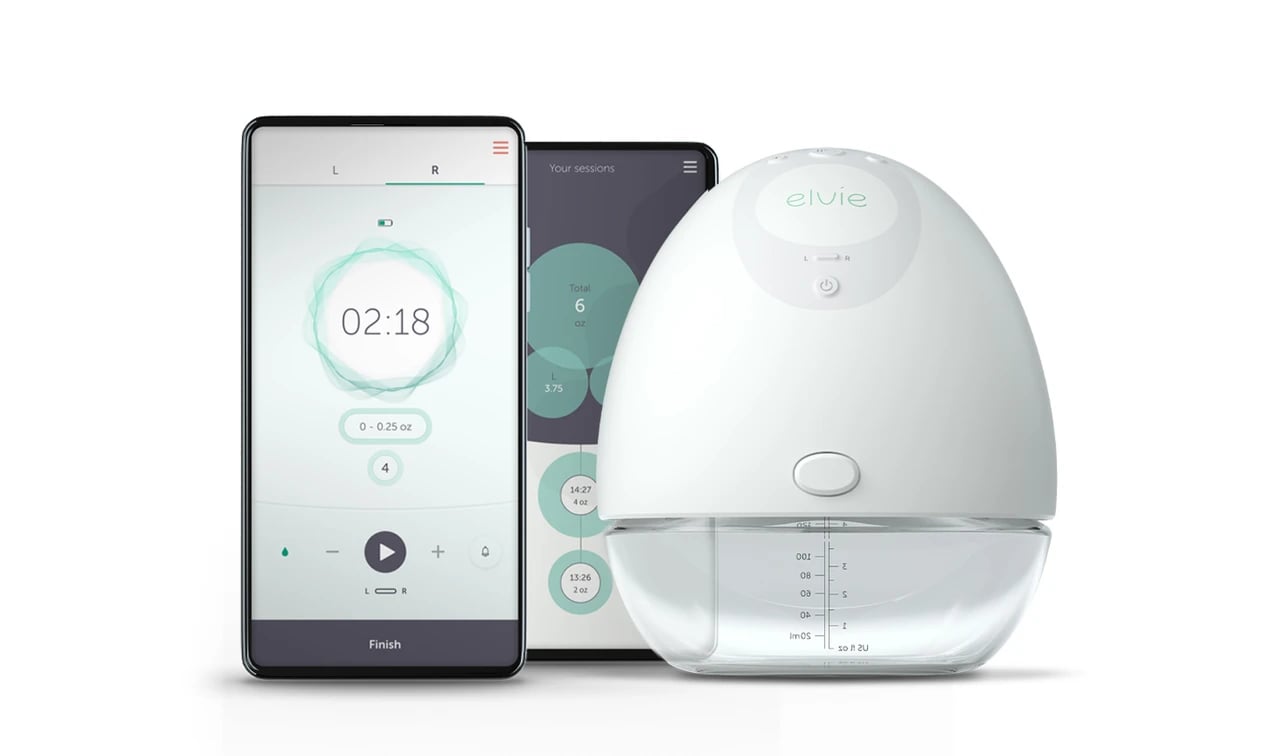 Source: www.monterail.com
How much does Monterail healthcare development cost?
Monterail's Clutch profile lists an average hourly rate of $25 to $49 and a minimum project size of $10,000+, with a cost rating of 4.4/5. For corporate R&D teams that want to de-risk before committing to a full build, it also offers a scoped Regulatory Architecture Workshop (about $30,000) as an entry point. European delivery rates make it one of the more cost-efficient partners on this list for regulated work.
What do clients say about working with Monterail?
"They know how to reach out to the end-user through the product."
Tania Boler, Founder, Elvie
"They showed their sensitivity to the particular cultural context of this project."
Alexander Hoffman, Head of Digitization Africa, Merck
The honest caveat in older reviews is visual polish: several clients rated Monterail's engineering above its design and UX craft.
Why do businesses choose Monterail?
Both breadth and regulated depth at once: 75+ health products and 15+ regulated medical devices, with client products that have reached FDA clearance, CE marking, and a Breakthrough Device Designation.
Regulatory documentation written as development happens: design controls, a traceability matrix, and IEC 62304 lifecycle records from day one.
A practice led by a founder who built and sold a MedTech agency, which shapes what gets refused in sprint one.
Hardware and software co-engineering, for example, advising Elvie's hardware team on embedded software and chipset selection, at European rates.
Innolitics
Innolitics is a remote-first US company that has helped medical-device firms reach market since 2012, working at the intersection of software engineering and FDA regulatory strategy. It is unusually specialized: the team focuses on AI/ML Software as a Medical Device and medical imaging, and keeps three full-time regulatory consultants in-house alongside its engineers. Across its history, the company reports contributing to 60+ FDA clearances, including 45+ 510(k) submissions and several De Novos, with particular depth in radiology, cardiology, and oncology imaging.
Example project by Innolitics
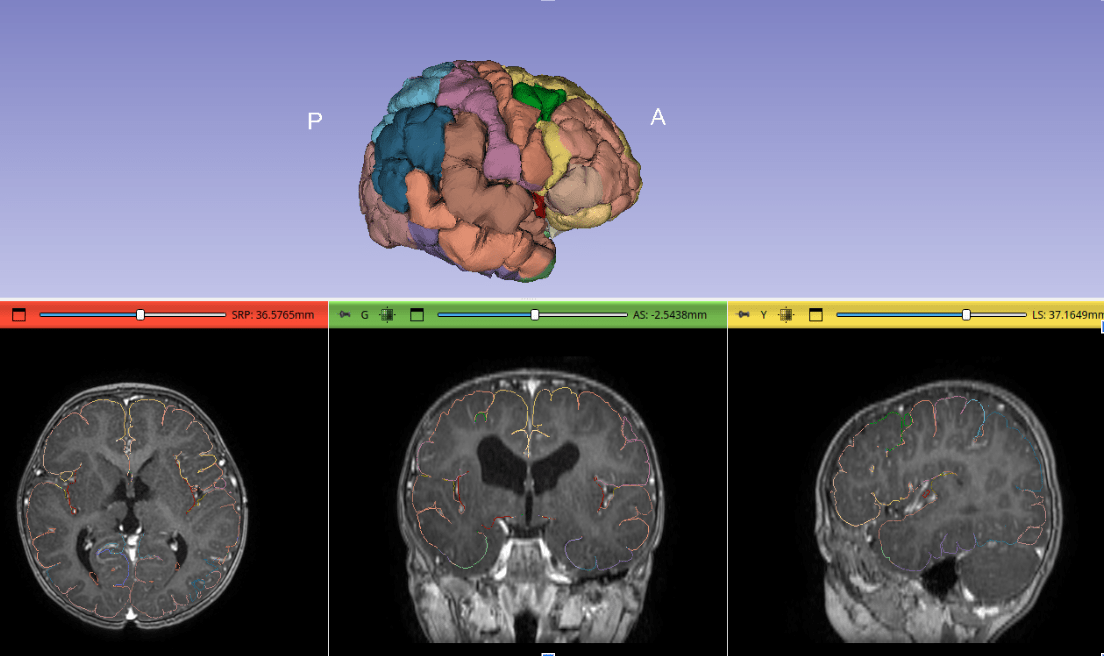
Innolitics built and cleared GyriCalc, a first-of-its-kind pediatric neuroimaging diagnostic, taking it through the full cycle from engineering to FDA clearance (K250686) in July 2025. The same team has cleared an AI cardiomegaly detector end-to-end in under a year and delivered DICOM image-processing SaMD from build to 510(k). Because the engineers also write the design history file and cybersecurity documentation the submission needs, clients avoid the common trap of finishing the software and then spending months reconstructing evidence for the FDA. Read the Innolitics SaMD case study.
 Source: www.innolitics.com
How much does Innolitics cost?
Innolitics does not publish hourly rates; engagements are scoped to the regulatory pathway and clinical evidence involved. It positions itself as a premium specialist and offers timeline guarantees, such as an AI/ML SaMD submission in roughly nine months. For budgeting, treat it against the benchmark ranges in the cost guide below, where an FDA-regulated build runs $500,000 to $2 million or more.
What do clients say about working with Innolitics?
"Innolitics got me here 3 years ahead of schedule and $4 million under budget."
Co-Founder, AI Metrics, and Chair of Diagnostic Imaging, St. Jude Children's Research Hospital
Clients repeatedly credit the team with owning the whole submission package, from documentation and risk management to cybersecurity, and with resolving FDA hold letters that stalled other consultants.
Why do businesses choose Innolitics?
Software engineering and FDA regulatory work come from the same team, which removes the handoff gap where most SaMD projects lose time.
Deep, specific expertise in AI/ML and medical imaging, including the algorithm-validation questions FDA reviewers ask.
A record of rapid clearances and Breakthrough Device Designations, often ahead of schedule.
By its own account,, it is not the right fit for firmware-heavy work, so it is strongest in application-level SaMD across web, mobile, cloud, and imaging.
Orthogonal
Orthogonal is a Chicago-based product-development firm, founded in 1998 that has focused on medical-device software for over a decade. It builds SaMD, digital therapeutics, and connected medical-device systems, and its software has shipped inside FDA Class I, II, and III devices. The firm runs an ISO 13485:2016 quality system certified by BSI, with Agile processes compliant with IEC 62304, ISO 14971, and AAMI TIR:45, and it works with clients including Novo Nordisk, Tandem Diabetes Care, and Nanowear. At roughly 61 people, it is a boutique rather than a volume shop.
Example project by Orthogonal
For EBT Medical, a venture-backed startup spun out of the University of Toronto, Orthogonal built the companion software for NiNA, a wearable neuromodulation device that treats overactive bladder with noninvasive 30-minute sessions worn on the calf rather than an implant. The team shipped cross-platform iOS and Android apps (NiNA Care) in Flutter, connected them to the device over Bluetooth Low Energy with 1:1 bonding for security, stood up an AWS cloud backend, and wrote a custom over-the-air firmware-update protocol, all under design controls with a full risk assessment and verification protocol. The detail that shows real regulatory fluency: they architected the system to run multiple app versions at once and move patients between them, so it could support EBT's multi-arm clinical trial. Read about the case study.
 Source: www.orthgonal.io
How much does Orthogonal cost?
Orthogonal does not list public rates; as a regulated-device specialist,, it prices by risk class and the lifecycle scope of each program. Expect premium, US-based pricing appropriate to Class II and III work, and benchmark it against the pathway costs in the guide below, where Class III programs run into the millions once clinical evidence is included.
What do clients say about working with Orthogonal?
"We chose Orthogonal because they know how to develop great medical device software under design controls."
Mike Labbe, VP of R&D, EBT Medical
Why do businesses choose Orthogonal?
Rare depth in connected devices and digital therapeutics at Class II and III risk, not just standalone apps.
An audit-ready ISO 13485 quality system and Agile processes built to satisfy IEC 62304 and ISO 14971.
Industry leadership on the hard questions, including Agile in regulated environments and cloud computing for devices, which shows up as fewer surprises during review.
A client roster of large pharma and device manufacturers that vet partners heavily before signing.
Star
Star is a global product engineering and consulting firm founded in 2008 with around 750 to 900 people and, by its own description, no single headquarters but "front doors" across Silicon Valley, London, Munich, Copenhagen, Kyiv, and Wrocław. Its dedicated HealthTech Practice builds SaMD, digital therapeutics, and connected-device platforms, taking medical software from classification strategy through FDA and MDR/IVDR submission readiness. Star runs in-house Quality and Regulatory Consulting led by a certified ISO 13485 and ISO 27001 lead auditor, and deepened its MedTech engineering by acquiring the SaMD specialist Pro4People.
Example project by Star
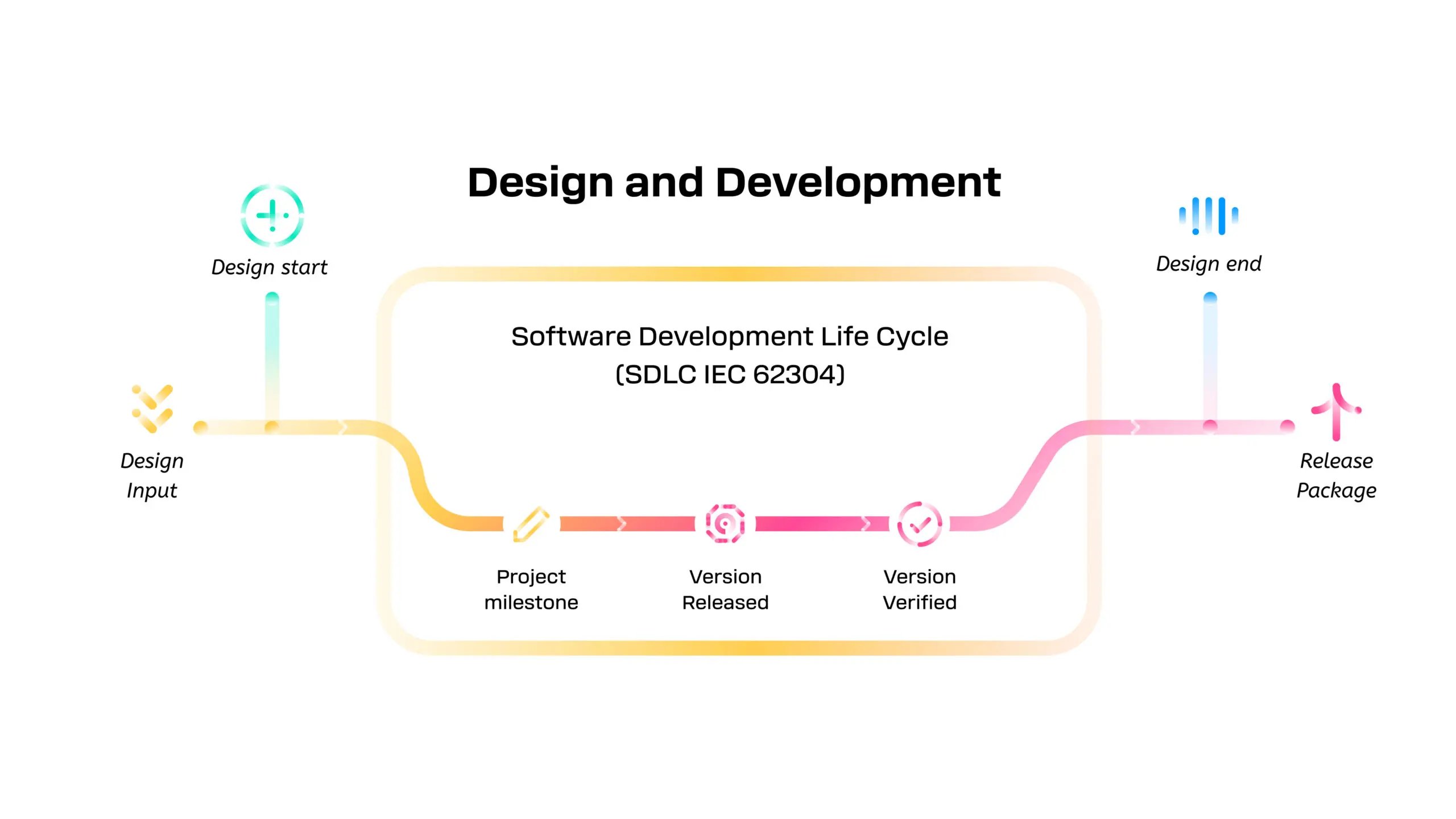
gMendel, a BioTech startup, set out to transform how genetic disorders are diagnosed and needed an in vitro diagnostic SaMD built to medical-device standards while it was still learning how to become a device manufacturer. Star supported the end-to-end MedTech product journey, applying IEC 62304 across the full software development lifecycle with dedicated project management, business analysis, QA, development, and DevOps so that the startup could ideate, build, and move toward a regulated market on a startup budget and timeline. Star's health portfolio also includes the digital therapeutic Constant Therapy and Clarify Health. Read the gMendel case study.
 Source: https://star.global/healthtech/
How much does Star cost?
Star does not publish rates and works on an enterprise engagement model, so treat it against the higher, consultancy end of the benchmarks below. It fits when a product needs strategy, design, engineering, and regulatory in a single team, and is is heavier than a small standalone MVP needs.
What do clients say about working with Star?
Star's health credibility rests on named, regulated work rather than a single testimonial: an in-vitro-diagnostic SaMD taken through the IEC 62304 lifecycle for gMendel, plus digital-therapeutic and analytics work for Constant Therapy and Clarify Health, and an in-house regulatory team led by a certified ISO 13485 lead auditor. As a large global consultancy, its trade-off is scale: the engagement model suits funded programs more than lean early-stage builds.
Why do businesses choose Star?
Strategy, product design, engineering, and regulatory consulting sit in one firm, so classification decisions and build decisions are made together.
Genuine SaMD and DTx track record, with named regulated clients and an acquired MedTech engineering team in Pro4People.
An in-house certified ISO 13485 and ISO 27001 lead auditor, useful when the regulatory strategy has to be right before code starts.
Global delivery footprint for multi-market products that need FDA and MDR/IVDR routes planned together.
WillowTree (TELUS Digital)
WillowTree, now part of TELUS Digital, was founded in 2008 in Charlottesville, Virginia, and grew from three people into a full-service product consultancy of 1,000+ employees before its acquisition by TELUS International, a deal valued at about $1.2 billion that closed in early 2023. It built its name on Fortune 500 consumer apps, then moved into regulated healthcare, and it has been named to the Inc. 5000 for seven straight years. For healthcare buyers, the draw is consumer-grade design polish backed by enterprise-scale engineering.
Example project by WillowTree
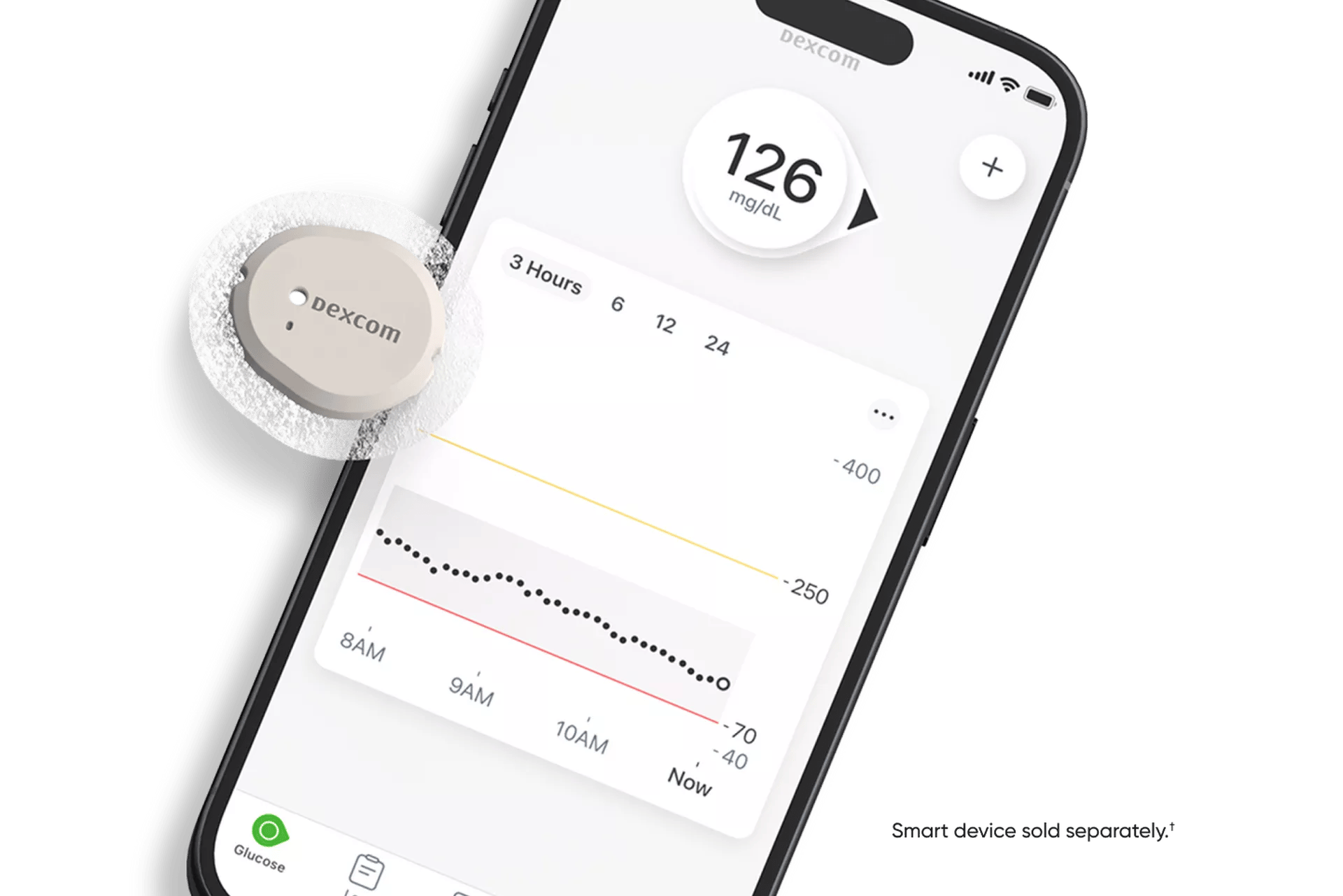
WillowTree built the FDA-approved Dexcom G7 companion app for continuous glucose monitoring, pairing real-time monitoring with alerts and, by its own account, using automation to cut FDA-approval testing time by a reported 77%. Its Vocable project, a free AAC communication app for non-verbal patients with conditions such as ALS and MS, was adapted for Apple Vision Pro and recognized at ViVE 2024. Together, they show a team that can meet device-companion requirements and still ship the kind of interface patients actually adopt.
 Source: www.dexcom.com
How much does WillowTree cost?
As a TELUS Digital business serving enterprise and Fortune 500 clients, WillowTree prices at the premium, enterprise end and does not publish standard rates. It is the right call when a healthcare app needs the design and engineering resources of a large consultancy, and more than a lean pre-seed MVP requires. Benchmark enterprise device work against the higher tiers in the cost guide below.
What do clients say about working with WillowTree?
"They're a leading electronic medical record provider in Canada."
Ivan Yao, Manager of Program Effectiveness, Workplace Safety and Insurance Board of Ontario
WillowTree holds a 4.9/5 average across its verified Clutch reviews. The WSIB engagement is a healthcare-billing platform serving roughly 30,000 institutions that cut payment turnaround from three months to under a month. Alongside the FDA-approved Dexcom G7 companion app and accessibility work honored at ViVE 2024, that is the track record large healthcare and device brands look for.
Why do businesses choose WillowTree?
A genuine FDA-approved device companion app in production, not just regulatory talk.
Consumer-grade UX craft that drives patient adoption, honed on Fortune 500 mobile products.
Enterprise scale and global engineering resources through TELUS Digital for large, multi-market programs.
A strong accessibility record, useful for products that have to serve vulnerable patient populations.
S3 Connected Health
S3 Connected Health is the digital-health division of Dublin-based S3 Group, founded in 1986 as Silicon & Software Systems, and it works as a specialist partner for pharma and MedTech companies building SaMD, digital therapeutics, and connected medical devices. The unit employs around 200 people and brings 20+ years of experience in medical devices and digital health, with a multidisciplinary team of software engineers, regulatory experts, UX specialists, clinicians, and business analysts. It holds ISO 27001 certification, builds to the regulated standards SaMD demands, and won Frost & Sullivan's 2025 Global Company of the Year award for medical-device connectivity. It is a member of the Digital Therapeutics Alliance.
Example project by S3 Connected Health
For NightBalance, a Dutch sleep-medicine company later acquired by Philips, S3 Connected Health turned the Lunoa positional-therapy device into a connected system. Lunoa is a palm-sized sensor worn across the chest that treats positional obstructive sleep apnea with gentle vibrations that prompt a change in sleeping position. S3 redesigned the device hardware to add a Bluetooth Low Energy module, adding secure wireless connectivity to a small, power-constrained medical device, then built a secure iOS and Android app (tuned to cover more than 87% of handsets) that automatically syncs therapy data to a cloud-based portal for patients and physicians. Lunoa later received FDA 510(k) clearance in the US, with equivalent authorizations in Europe and Australasia, and is now prescribed for positional OSA. Read the NightBalance Lunoa case study.
 Source: www.s3connectedhealth.com
How much does S3 Connected Health cost?
S3 does not publish rates and works on an enterprise engagement model built around pharma and MedTech programs, so treat it against the higher, consultancy end of the benchmarks below. It fits funded connected-device and DTx programs, and is heavier than a lean consumer MVP needs.
What do clients say about working with S3 Connected Health?
"S3 Connected Health focuses on best practices for consistency and quality of delivery."
Bhaskar Vittal, Research Manager, Frost & Sullivan
S3's pharma and MedTech clients typically work under NDA, so its proof points include regulated delivery for NightBalance, Salvia BioElectronics, Mirai Medical, and the Wyss Center, plus Frost & Sullivan's 2025 Global Company of the Year award for medical-device connectivity. The trade-off is orientation: S3 is built for funded pharma and MedTech programs, so it is heavier than a boutique for an early-stage app.
Why do businesses choose S3 Connected Health?
A genuine SaMD, DTx, and connected-medical-device specialist rather than a generalist with a healthcare page.
Regulatory experts, clinicians, and engineers on one team, so clinical validation and compliance are designed in.
The Affinial platform gives programs a validated digital-health foundation, which shortens the path to a compliant build.
End-to-end coverage from strategy through connected-device development to managed operation and lifecycle management.
HTD Health
HTD Health is a US healthcare software company that plans, designs, and develops Software as a Medical Device and digital-health products. It is the closest peer on this list to a full-service product partner like Monterail. It works exclusively in healthcare, holds ISO 13485 and ISO 27001 certifications, builds to IEC 62304 and ISO 14971, and runs its medical-device software lifecycle inside a Greenlight Guru eQMS. HTD reports 160+ healthcare projects for 100+ customers and supports the full SaMD path: strategy, risk management, human factors, compliant agile development, verification and validation, design control, and FDA guidance.
Example project by HTD Health
HTD's clearest named project is CIAS 3.0, the Computerized Intervention Authoring System that academic researchers use to build and run digital health-behavior interventions. HTD overhauled the platform's user experience and data design into a modern, highly customizable research tool, work its client called that of an irreplaceable partner. That consumer-grade craft sits on top of HTD's FDA-regulated SaMD practice, where the same team runs strategy, human factors, verification and validation, and design control inside a Greenlight Guru eQMS under its ISO 13485 system. Read HTD's case studies.
:quality(85)) Source: www.cias.app
Source: www.cias.app
How much does HTD Health cost?
Third-party trackers list HTD's hourly rate at $100 to $149 with a minimum project size of $100,000, placing it at the premium, US end of this list. That reflects a strategy-led consulting posture rather than a staff-augmentation model, so it fits funded programs more than a shoestring MVP.
What do clients say about working with HTD Health?
"The HTD team has been an irreplaceable partner in designing and building CIAS 3.0."
Steve Ondersma, Founder of CIAS, Clinical Psychologist, Professor Michigan State University
Clients describe the team as having "become trusted advisors on a range of critical issues" who deliver on time and on budget, the kind of relationship a regulated build needs over its multi-year life.
Why do businesses choose HTD Health?
A validated eQMS and full SaMD lifecycle, so the regulatory evidence a submission needs is generated as the software is built.
A strategy-and-design-led engagement model that suits founders making early architecture and classification calls.
ISO 13485 and ISO 27001 certification with a running eQMS and full SaMD lifecycle coverage.
A healthcare-exclusive focus and a high project count, so the team has met the FDA's questions before yours.
Revolve Healthcare
Revolve Healthcare is an ISO 13485-certified medical software company founded in 2015 in Katowice, Poland, with a team of around 50 specialists focused entirely on regulated healthcare software. Like Monterail, it is a European software house that builds end-to-end, from defining intended use through product design and software engineering to certification support, working to MDR, IVDR, FDA, IEC 62304, and IEC 62366. Its clients lean toward diagnostics and MedTech, including Centogene, Orikami, Smart4Diagnostics, Enpicom, and Innitius.
Example project by Revolve Healthcare
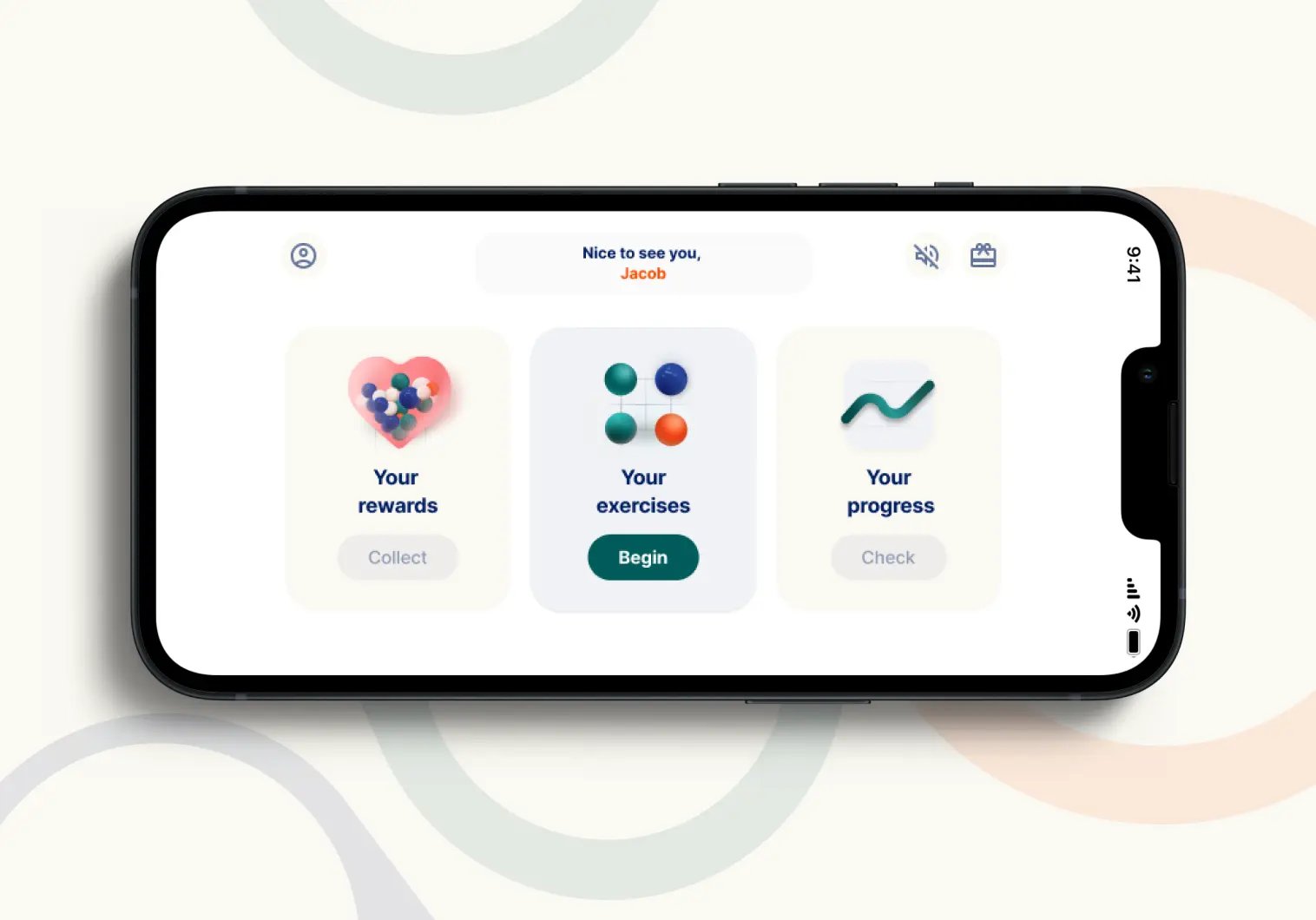
For ABAStroke, a Polish digital-therapeutics startup, Revolve built a DTx mobile app that delivers at-home cognitive rehabilitation for stroke survivors. The app uses Applied Behavior Analysis methodology and machine-learning algorithms to generate an individualized therapy path per patient, and Revolve built it for iOS and Android to MDR and ISO 13485 requirements. Revolve is steering the product through certification as a Class IIa medical device in Europe, where the technical-file audit came back with no nonconformities, and adapting it for Germany's DiGA reimbursement route. Read the ABAStroke case study.
 Source: www.revolve.healthcare
How much does Revolve Healthcare cost?
Revolve's Clutch profile lists an hourly rate of $50 to $99 and a minimum project size of $10,000+. As a roughly 50-person European specialist, it offers regulated-software rigor at rates below most US shops, with the trade-off that a team this size may not suit very large enterprise programs.
What do clients say about working with Revolve Healthcare?
"Revolve Healthcare supported the definition of the requirements based on their experience."
Rubén Molina, CEO, Innitius
Reviewers consistently score Revolve at or near 5/5 on Clutch and single out proactive problem-solving and clean, stable code. Its public case studies, though, lean toward EU CE and MDR work and diagnostics rather than a named US FDA clearance, so confirm the specific FDA-pathway experience your product needs.
Why do businesses choose Revolve Healthcare?
A regulatory-first European software house built around ISO 13485 processes, close in profile to Monterail itself.
End-to-end regulated delivery from intended use through certification support, to MDR, IVDR, and FDA.
A diagnostics and MedTech client base (Centogene, Orikami, Smart4Diagnostics) where medical-grade software is the norm.
European rates, with documentation written to carry much of the certification burden.
What makes a healthcare app developer genuinely FDA-experienced?
FDA experience is a set of engineering habits. The clearest marker is a quality management system built to ISO 13485 and a software lifecycle run to IEC 62304, because those are what an FDA reviewer expects to see behind a submission. Underneath that sit design controls and a design history file, risk management to ISO 14971, and, increasingly, cybersecurity documentation such as threat modeling, which FDA now expects in premarket submissions for connected software.
The practical test is whether a partner builds this evidence from the first sprint, including design history, traceability, and verification and validation as part of Agile delivery, so they can write a submission package without repeating work. A developer who understands the difference between a general-wellness app and SaMD, and who can identify a predicate device for a 510(k), has almost certainly done this before.
How much does an FDA-regulated healthcare app cost in 2026?
Healthcare app development in 2026 runs from about $30,000 for a basic wellness MVP to $2 million or more for a regulated, EHR-integrated platform. The spread is that wide because product type sets the compliance burden, and compliance drives most of the cost; the biggest variable is whether you are building a wellness tool or a medical device. These ranges track Monterail's own healthcare app cost guide.
Build cost by app type gives a rough starting point.
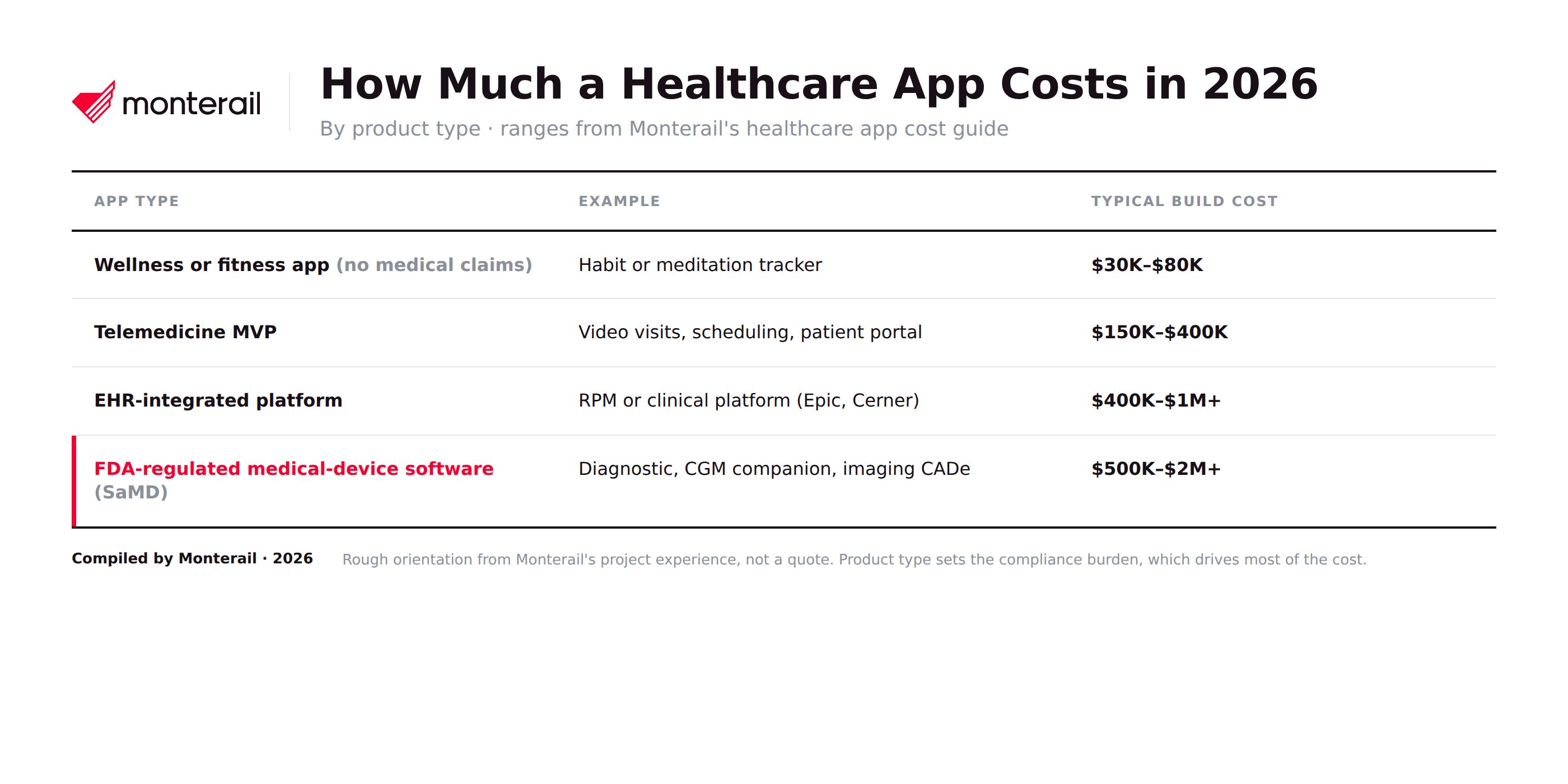 On top of the build, sit FDA user fees and the all-in cost of clearance itself, which depend on the pathway.
Pathway | Typical use | FDA user fee (FY 2026) | All-in regulatory cost | Review timeline |
|---|---|---|---|---|
General wellness (not a device) | No medical claim | None | Build only | Not applicable |
Class I SaMD | Low risk, often exempt | Establishment registration $11,423 | Minimal | Weeks |
510(k) (Class II) | Substantial equivalence to a predicate | $26,067 standard / $6,517 small business | $30,000 to $500,000+ | About 3 to 12 months from submission |
De Novo (Class II) | Novel, low-to-moderate risk, no predicate | Lower than PMA | $50,000 to $2 million | About 6 to 12 months |
PMA (Class III) | High risk, life-sustaining | $579,272 standard / $144,818 small business | $10 million to $100 million+ | 1 to 3+ years |
A few extra line items catch first-time teams off guard. Clinical validation studies run $50,000 to $500,000 each. IEC 62304 lifecycle documentation adds 200 to 600 engineering hours. The full path from finished development to a live app usually spans 12 to 18 months once you factor in App Store review and parallel HIPAA work. The FDA publishes current FY 2026 fees on its Medical Device User Fee Amendments page. Monterail's own breakdown of how software architecture becomes regulatory evidence sits in its SaMD FDA submissions guide.
510(k) vs. De Novo vs. PMA: which pathway fits your app?
SaMD reaches the US market through one of three routes, set by risk class and whether a comparable device already exists. Most software clears through a 510(k), which works when you can point to a legally marketed predicate device with the same intended use and show your software is substantially equivalent. This is the most common and fastest path, taking roughly 3 to 12 months from submission.
When your software is genuinely novel and low-to-moderate risk, there is no predicate to point at, and the De Novo pathway lets you establish a new classification; a successful De Novo then becomes a predicate for those who follow. High-risk software that supports or sustains life falls under PMA, the most demanding route, where clinical trials dominate the budget and timelines stretch across years. Make this decision at the start of a project because classification shapes the quality system, documentation load, and cost long before you write production code.
How to choose an FDA-ready partner, and the red flags to avoid
Ask for evidence, not adjectives. A partner with real FDA experience can name the clearances they contributed to, describe the 510(k) or De Novo pathway they worked on, and show live integrations shipped to production. Ask which named EHR vendors they have integrated with, and ask to see penetration-test reports and signed BAAs rather than a compliance claim. Prioritize a healthcare-specific portfolio over general mobile experience, and check Clutch or comparable reviews for what clients say after a project closes, not just during the pitch.
The red flags are the mirror image. Be wary of a team that cannot articulate the wellness-versus-SaMD boundary, that treats design history and risk files as paperwork to add at the end, or that has no answer on cybersecurity documentation. Ask how they handle post-market change management, because a partner who understands when a software change triggers a new 510(k) will save you from an expensive surprise after launch. If a developer promises FDA outcomes without ever mentioning a quality system, that absence is your answer.
Which FDA-experienced app developer fits your SaMD roadmap?
The right partner is the one whose FDA experience matches your risk class and stage, and hourly rate tracks that far more closely than it tracks quality. A pre-clearance consumer or FemTech app is served well by a cost-efficient studio with device-companion experience; an AI diagnostic heading for a 510(k) needs design and regulatory in one team; a connected device or digital therapeutic needs a team that has shipped regulated, connected software. The list above is built so each profile answers a different version of that question, and the guide so you can ask the right ones before you sign.
Learn more about the regulated products we've helped bring to market, from FDA-cleared devices to CE-marked SaMD. See more of our HealthTech case studies.
Key Takeaways
FDA experience, not HIPAA compliance, is the real filter for a healthcare app developer once your product may qualify as SaMD.
Classification drives cost: a wellness tool runs about $30,000 to $80,000, while an FDA-regulated, EHR-integrated build runs $500,000 to $2 million or more.
Expect 12 to 18 months from finished development to a live regulated app once FDA review and App Store review are counted.
The strongest partners build design controls, risk files, and cybersecurity documentation from the first sprint rather than before submission.
Vet on evidence: named clearances, the specific 510(k) or De Novo pathway worked, live EHR integrations, penetration-test reports, and signed BAAs.
Healthcare App Development FAQ
)
Piotr Zając
HealthTech Director

Piotr, Monterail’s Director of HealthTech brings over 15 years of entrepreneurial leadership and strategic innovation to the MedTech and HealthTech sectors. Piotr has demonstrated exceptional ability to build and scale healthcare solutions. Former President of EO Poland, part of the world's largest entrepreneur network. Combining his entrepreneurial background with Management 3.0 principles, Piotr specializes in helping organizations drive sustainable innovation in the rapidly evolving HealthTech landscape.