The New Default. Your hub for building smart, fast, and sustainable AI software
Table of Contents
and 5 more
A managed environment for enterprise agentic execution is the governed place where your AI agents actually do their work. Basically, it means giving an agent its own cloud computer, as described in the release of OpenAI’s Dots, as well as the rules that define what it should do.
An environment gives each agent an isolated workspace, an identity with limited permissions, a controlled set of tools and data, a record of everything it does, a budget, and clear points where a person has to approve what happens next. The model reasons, the environment decides what that reasoning is allowed to touch.
That distinction sounds technical, but it's really about operations and accountability. It's also a big reason for why so many promising agent pilots never reach the systems that matter.
Executive Summary
The limit on enterprise AI agents today is the environment the model runs in.
Most organizations have proven that agents can do useful work in a pilot. Far fewer have built the shared infrastructure that lets agents act on real systems with scoped permissions, full traceability, predictable costs and human sign-off where the stakes call for it.
Senior technology leaders rank governance and guardrails above model quality as the thing that most helps agentic AI scale. The managed environment is a platform decision with an owner, a budget and a roadmap, and it shouldn’t be an afterthought.
Why Do Enterprise AI Agent Pilots Stall Before Production?
Agent pilots usually stall because the work around the agent (permissions, review, integration, accountability) grows faster than the agent's output.
An agent in a demo can write code, draft a report or triage a ticket. In production it has to do all of that inside systems full of customer data, compliance obligations and people who'll be held responsible for the result.
Does Agentic AI Remove Enterprise Bottlenecks?
The bottleneck moves rather than disappears. Bain's survey found that "developers complete roughly 21% more tasks but review time rises approximately 91%, highlighting human review as the critical constraint."
In Bain's words, companies that speed up generation without redesigning the process around it "don't compound their gains; they redistribute their pain."
Most of the effort isn't the AI. In a clinical agent project covered by MIT Sloan, researchers found that "80% of the work was consumed by unglamourous tasks associated with data engineering, stakeholder alignment, governance, and workflow integration."
Scaled deployment is still rare. IBM describes the fully agentic enterprise as "a theoretical concept more than an operational reality". Many organizations still keep agents in narrow use cases or "confine agents to testing or staging environments, paired with strict guardrails and extensive human oversight."
Plus, accountability doesn't transfer, as noted by JetBrains: "while the work can be delegated, accountability cannot. An agent will not get the call at 3:00 am when something breaks."
None of this means the pilots failed. They usually did what pilots are for: they showed the capability is real.
What they rarely do is answer the questions a CISO, a compliance officer or a board member will ask before agents touch production.
JetBrains suggested some of those questions: "Which agents can access company code? Where can data go? Which output requires human review? What happened while an agent was working remotely? Who approved the resulting change, and how was it verified?"
A managed environment means you have a clear answer to those questions, and you don’t have to weigh different options every time you deploy a new agent.
What Does a Prototype Agent Setup Look Like, and Why Doesn't It Scale?
A typical prototype gives the agent broad permissions on one machine, runs on one person's credentials, and keeps its history in that person's session. That's the fastest way to learn what agents can do, and nearly every team starts there. It just isn't a shape that survives contact with an enterprise.
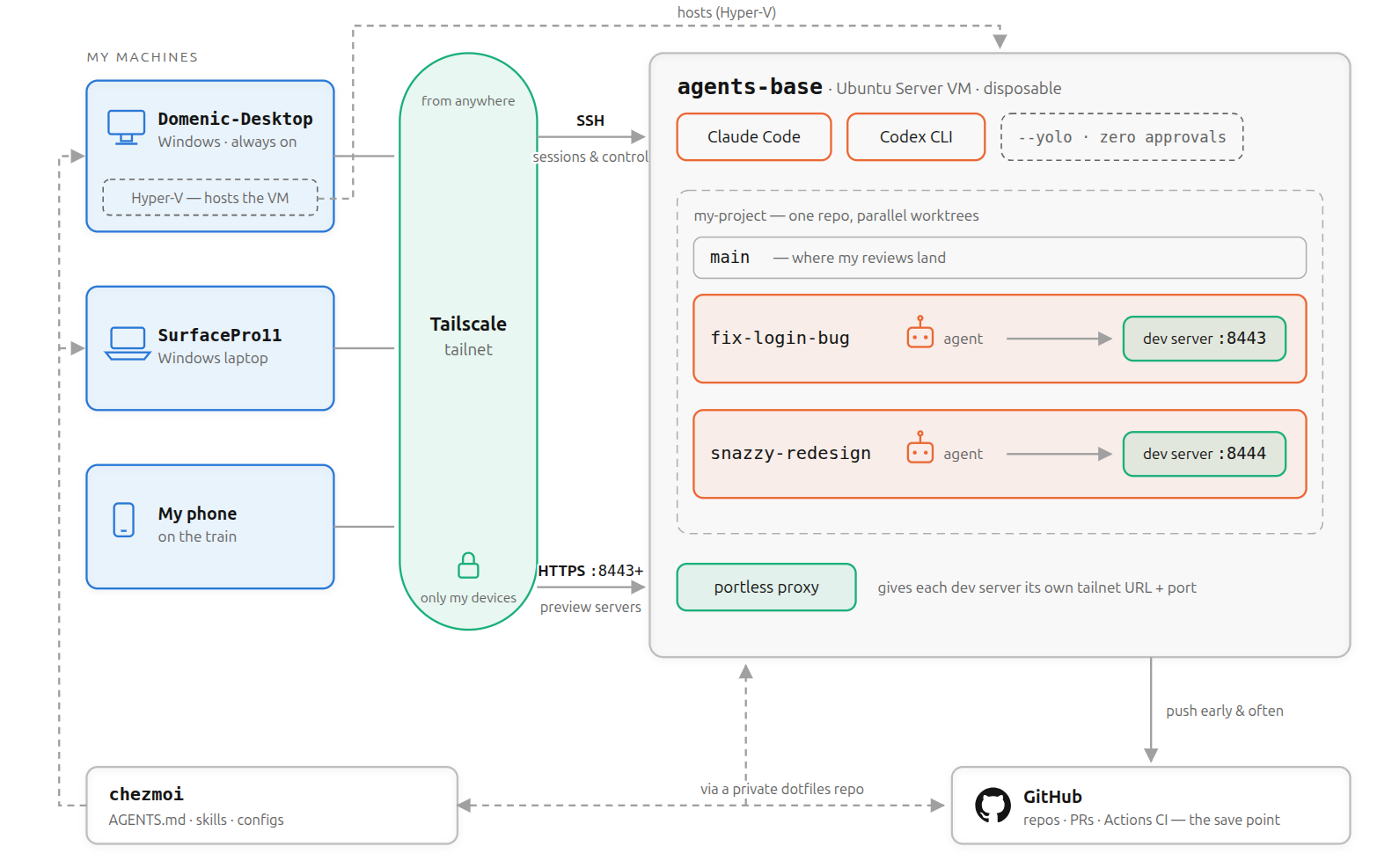
Engineer Domenic Denicola published a write-up of his own setup, My Agentic Coding Setup, July 2026. It's a good illustration because it's thoughtful, it works, and he's honest about its limits:
The agents run in a disposable virtual machine with approval prompts turned off, so they can work in parallel while he steps away.
They use his personal GitHub credentials and have administrator rights on the VM.
Session transcripts are, in his words, sometimes "the only record of certain design decisions."
 Source: domenic.me
He asks himself whether it's safe and answers, "No, not really." He also describes an agent that merged a pull request to the main branch "instead of doing what I meant and waiting for review." For one experienced engineer on personal projects, the disposable VM keeps the "blast radius" acceptable. Scale that pattern across hundreds of developers, shared credentials and regulated data, and every one of those trade-offs becomes a risk.
Practitioners in enterprises describe the predictable next step. As one engineer wrote in a r/devops discussion on deploying agents at work: "The autonomous usually starts off well-intentioned and then security concerns/governance rules etc. usually put a stop to the full autonomy pretty quick."
That pattern, where autonomy is granted and then withdrawn, is expensive in both directions. Teams lose momentum, and security teams spend their time saying no. The point of a managed environment isn't to take autonomy away from agents. It's to make the right amount of autonomy safe enough to keep.
What Are the Core Building Blocks of a Managed Agent Environment?
The core building blocks are isolation, agent identity, governed tool access, state, audit, cost control and human oversight. An environment counts as "managed" when these are provided as shared, centrally governed services instead of being rebuilt by each team.
Anthropic's own description of what production agents need is a useful baseline: "sandboxed code execution, checkpointing, credential management, scoped permissions, and end-to-end tracing". The company adds, "That's months of infrastructure work before you ship anything users see."
Here are the building blocks, each with the question a leader should be able to get a clear answer to.
Building block | What it does | The question to ask your team |
|---|---|---|
Isolated sandbox | Runs each agent task in its own contained compute environment, so mistakes stay local | "If an agent does something wrong, what's the most it can damage?" |
Agent identity and least privilege | Gives each agent its own identity with only the permissions its task needs, instead of borrowing a human's | "Whose credentials is this agent using, and what can they reach?" |
Governed tools and data access | Controls which tools, systems and data sources an agent can call, and which network destinations it can reach | "Which systems can an agent touch, and who approved that list?" |
State and long-running sessions | Keeps an agent's progress, memory and checkpoints so long tasks survive interruptions | "If a session dies halfway through, can we resume or cleanly roll back?" |
Tracing and audit | Records every prompt, tool call, decision and escalation in a form reviewers and auditors can use | "Can we reconstruct exactly what an agent did last Tuesday, and why?" |
Cost controls | Sets budgets and hard limits per team, agent or task, and attributes spend | "What stops a runaway agent from burning next month's budget tonight?" |
Risk-tiered human checkpoints | Routes high-impact or irreversible actions to an accountable person before they happen | "Which actions need a human signature, and who is that human?" |
Kill switch and rollback | Lets operators pause or stop agents immediately and undo their changes | "How fast can we stop every agent if something looks wrong?" |
A few of these deserve more explanation.
Why does an AI agent need its own identity?
Because an agent borrowing a human's credentials can do everything that human can, and the audit trail can't tell the two apart. A bounded-autonomy framework published in September 2026 by researchers at the University of Southern Denmark makes the point precisely: "Technical credentials enable execution, but they do not prove that the agent, initiating user or approving role is authorised for a particular action." The same paper notes that identity and access management built for human users "cannot express agents that shift personas, delegate recursively and operate across tenant boundaries." In practice that means one of two things: identity systems gain proper agent identities, or agents get narrowly scoped service identities that someone owns and reviews.
Security teams already treat this as a top risk. The OWASP GenAI Security Project's Top 10 for Agentic Applications, released in December 2025, lists "Identity & Privilege Abuse" and "Tool Misuse" among its ten categories. The major cloud platforms are moving the same way: Microsoft's Foundry Agent Service, for example, gives each hosted agent its own Microsoft Entra agent identity.
Why isn't connecting agents to tools through MCP enough on its own?
The Model Context Protocol (MCP) standardizes how an agent discovers and calls a tool, but not whether this particular agent should be allowed to call it for this particular person. MCP has quickly become the common way to plug agents into company systems, which is useful. The same research paper draws the line clearly: "The protocol standardises how a tool is discovered and invoked but not who may invoke it on whose behalf." The MCP specification says as much itself: "MCP itself cannot enforce these security principles at the protocol level," so implementers should "build robust consent and authorization flows" and "implement appropriate access controls." That decision still belongs to your environment's policy layer. This is why many teams keep a curated, approved list of tools and data sources and control network traffic in and out of agent sandboxes. The New Stack piece sponsored by Aviator calls these ingress and egress controls.
Why does AI agent observability matter to executives, not just engineers?
Because agent observability is where compliance, cost and quality evidence comes from. Bain describes the harness of a mature agentic setup as including audit trails that "capture every agent action, decision, and escalation for traceability." For a leader, that record is what turns "we think the agent did the right thing" into "here's what happened, who approved it, and what it cost." The paper also warns about a subtler risk: a well-written agent message isn't proof in itself. As the authors put it, "A fluent message to the customer is not evidence that the correct order, authority, refund recipient or product was verified."
How Much Autonomy Should an AI Agent Get?
Autonomy should depend on the risk of the action, not on the agent's capability: routine, reversible work runs freely, and consequential or irreversible actions go to an accountable person first.
This is the core idea of what the University of Southern Denmark researchers call bounded autonomy. In their framework the agent reasons and proposes freely inside a defined task, and independent controls decide what is actually allowed to change in enterprise systems.
The agent "may not silently broaden its purpose, grant itself permissions, redefine the process or convert generated text directly into enterprise state."
Crucially, the authors argue that "human oversight is therefore risk-proportionate rather than required for every action." Their triggers for escalating to a human are practical ones: consequence, irreversibility, uncertainty, data sensitivity, value and organizational policy.
Enterprise plans already lean this way. In Bain's survey, "41% of companies expect to deploy a risk-tiered model while only 6% envision fully autonomous development."
Risk tier | Typical examples | Default level of autonomy |
|---|---|---|
Low | Drafting documents, summarizing tickets, writing tests in a sandbox, research | Agent acts on its own; work is logged and sampled for review |
Medium | Opening pull requests, updating internal records, changing non-production configuration | Agent acts, and a person reviews before changes merge or go live |
High | Production deployments, customer-facing messages, payments or refunds, access to sensitive data | Agent proposes; a named person approves before anything executes |
Prohibited | Granting itself permissions, deleting audit records, acting outside its defined task | Blocked by the environment, whatever the agent "decides" |
Some limits should be enforced by the environment, not left to the agent's judgment or its instructions.
Tiering has a cost worth naming. The same paper cautions that "adding a human task does not guarantee effective oversight," because reviewers "may defer to a well-presented agent recommendation, lack time to inspect the evidence or become a routine approval bottleneck."
If every action lands in someone's approval queue, you've rebuilt the review bottleneck Bain measured. Good tiering keeps human attention for the decisions that actually need it.
Should You Build, Buy, or Layer a Managed Agent Environment?
Most enterprises will end up with a mix: a vendor-managed runtime for speed, their own cloud or platform controls where data and compliance demand it, and a governance layer across both. BCG, writing about regulated industries, says of the choice between reusing, configuring and building that "most enterprises will require a hybrid model that combines all three options."
The options broadly fall into five groups. The examples below were checked against each vendor's documentation in September 2026. This market changes quickly, so treat the list as a starting point for evaluation, not a ranking.
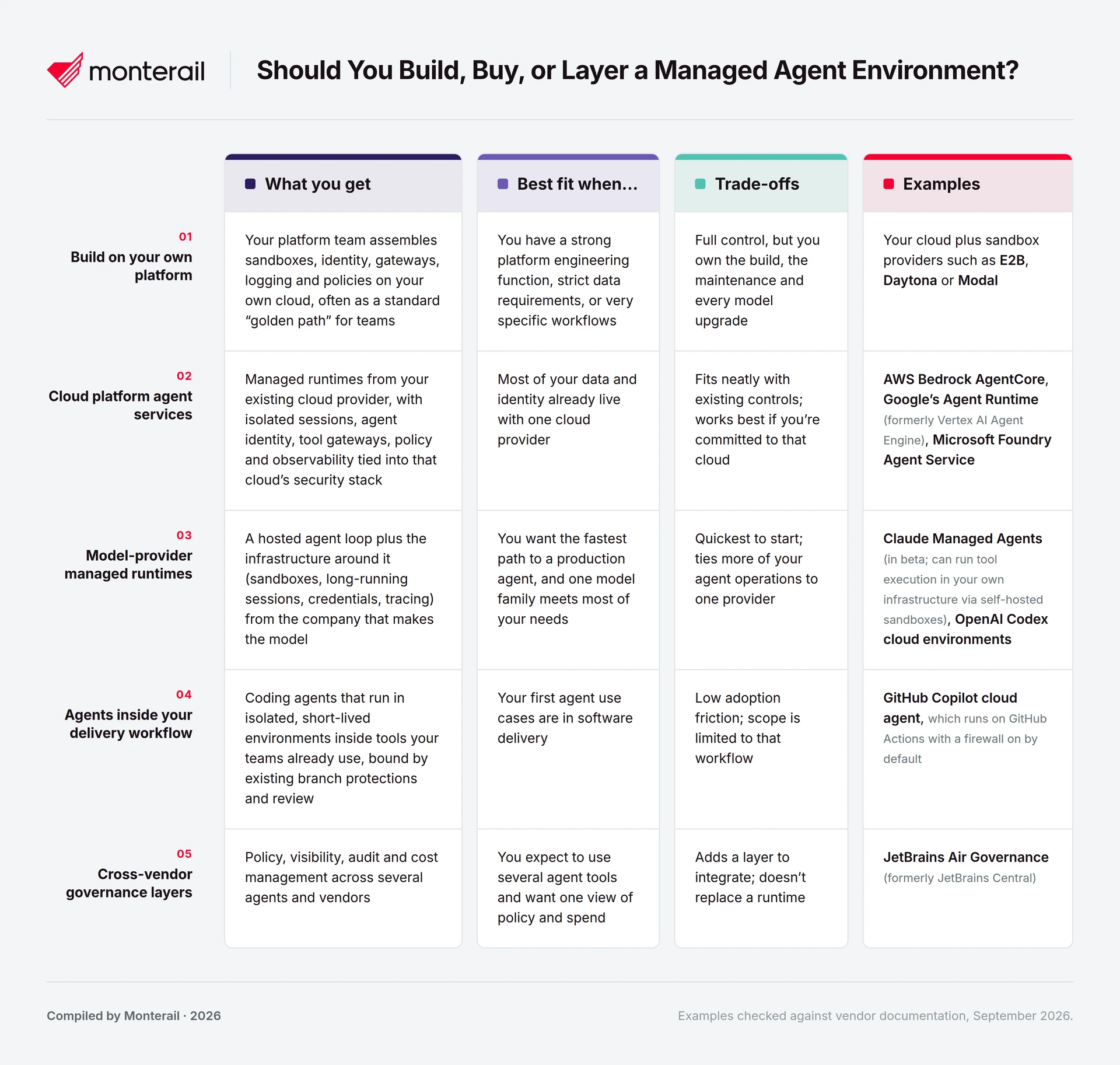
The boundary between "buy" and "build" is blurring. Anthropic, for example, now lets customers keep orchestration on its side while moving tool execution into their own infrastructure, "so the agent's code, filesystem, and network egress never leave your environment." That hybrid is exactly what many regulated organizations will want to evaluate.
A few considerations:
Lock-in versus speed. A vendor-managed runtime gets you to production fastest, but it ties part of your agent operations to one provider's roadmap. JetBrains, which has an obvious interest in a multi-vendor market, still makes a fair point: "Standardizing on one AI vendor today means making a multi-year commitment in a market that won't look the same next quarter."
Where governance lives. The bounded-autonomy paper recommends keeping your governance rules independent of any single product, because "independent governance artefacts can also outlive model providers and runtime platforms." In practice that means writing policies, risk tiers and approval rules down in a form you own, even if a vendor enforces them.
Data residency and perimeter. In regulated industries, BCG warns that "fragmented identity models, policy agents, and memory layers without data residency controls can quickly create compliance issues." Check whether the runtime can operate inside your own cloud or network, not just whether it's convenient.
When you compare options, a short set of questions cuts through most marketing:
Can agents run inside our cloud account or network, and where does our data go?
Does each agent get its own identity, and does it work with our identity provider?
Can we enforce policy on every tool call, not just on each agent as a whole?
Can we export complete traces into our own logging and security tools?
How is it priced, and can we set hard spending limits?
Is the service generally available, or still in beta or preview? What compliance coverage does it have, and which data-retention terms apply?
How hard would it be to move our agents, policies and history elsewhere?
Should You Build, Buy, or Layer a Managed Agent Environment?
Measure the whole system, not the model: task success, cost per task, time per task, throughput and latency, plus clear separation of human and agent contributions. Most agent metrics today evaluate the model. The environment needs its own scorecard.
Intel proposes six operational metrics drawn from its own agent workload experiments:
Task success rate: how often agents complete the job correctly.
Cost per task: tokens, compute and runtime together.
Time per task: end to end, including waiting for human approvals.
Task throughput: how much work the fleet completes per period.
Agent density: how many agents the infrastructure can support at once.
Latency: Intel suggests the slowest 5% of tasks (P95) as a better warning signal than average CPU use.
Bain adds two points that matter to leadership. Organizations need "metrics that distinguish human and agent contributions," and they should "elevate risk and control to first-class scorecard dimensions alongside speed and quality." MIT Sloan, drawing on MIT professor Kate Kellogg's research, adds a budgeting point: monitoring should be "a permanent operational expense, not a one-time project cost."
One caution on productivity claims: time saved isn't the same as money saved. Kellogg put it this way: "Just because an agentic AI model reclaims 20% of someone's time, that doesn't mean it's a 20% labor-cost savings." Tie your metrics to outcomes the business already tracks.
What Does a Well-governed Agent Environment Look Like in Practice?
The clearest public examples share one trait: agents work at volume inside the organization's existing controls, not around them. A few cases illustrate different sides of that:
Stripe: volume through the same front door. Bain reports that Stripe's task-specific agents, which it calls "minions", each work from a spec covering objective, scope, context, verification method and constraints. That produces "1,300 AI-authored pull requests merged per week across its engineering organization, all subject to the same human review process as any other change." Why it matters: scale came from clear specifications and standard review, not from skipping review.
Craft Docs: a shared platform for a small team. According to Bain, "a 20-person engineering team adopted a shared agentic platform with governance controls that helped reduce process friction, advancing from 15 to 20 issues per week to more than 100." Why it matters: a managed environment isn't only a big-enterprise concern. The shared platform is what lifted throughput.
Rakuten: faster deployment on managed infrastructure. In a customer testimonial published by Anthropic, Rakuten's general manager of AI for Business says the company can "deploy each specialist agent within a week" on Claude Managed Agents. Why it matters: this is a vendor-published quote, not an independent measurement. It still shows the time-to-production advantage buyers expect from a managed runtime.
A cautionary counterexample. In the same r/devops thread, an anonymous engineer at a large healthcare company says they "pulled a lot of" their agent orchestration after years of testing. They cite "metrics, reporting, and history" as the gaps. It's a single unverified account, but the gaps it names are exactly the ones a managed environment is meant to close.
GitHub Next's research prototype ACE points at a further direction. Staff research engineer Maggie Appleton demoed it at AI Engineer. In ACE, each shared team session is backed by a sandboxed cloud micro-VM on its own git branch, so agent work keeps running when a laptop closes and teammates can see and steer it.
Appleton's broader argument is one every manager will recognize: "Agreeing on what to build is the new bottleneck," and agents "have made the cost of not being aligned as a team much, much higher." Appleton herself describes ACE as a prototype that's not yet a finished product.
Managed environments are becoming shared team spaces, not only secure boxes.
What Does a Managed Environment for AI Agents Cost, and What Does It Require?
The costs sit in three places: consumption-based runtime and token spend, the platform and security work to integrate agents with your systems, and the ongoing people cost of oversight and operations. None of them is a reason to wait.
How much does it cost to run agents on a managed runtime?
Managed agent runtimes are usually priced on use. Anthropic, for example, bills Claude Managed Agents on standard token rates plus $0.08 per session-hour, counted only while a session is actively running. Token spend is the harder part to predict, especially for long-running or multi-agent tasks.
IBM warns that agents "can introduce unexpected or runaway costs, especially as organizations move from experimentation to full-scale deployments" and lists model routing, caching, batching and token capping as controls. Practitioners describe putting AI gateways in front of agents so that a connection is cut when a team or user hits a dollar or token limit.
Why do integration and identity work take so long?
BCG advises CIOs to address "identity, access, and entitlements" early in implementation, "not after agentic systems are already embedded in business workflows and rapidly scaling."
Connecting agents to legacy systems, setting up agent identities and deciding what data each agent may see often takes longer than configuring the agent itself. That's consistent with the MIT Sloan finding that most of the effort is integration and governance, not the model.
What operating model does a governed agent platform need?
Technology alone won't carry this. Several sources converge on a similar structure:
Central platform, distributed ownership. IBM describes a "hub and spoke approach," where a central team provides the platform and guidance while individual teams own their deployments.
A governance board with named responsibilities. MIT Sloan recommends an organization-level governance board for accountability, with specific duties such as monitoring and enforcing safety rules delegated to named people.
Clear accountability for errors. MIT Sloan again: organizations "need to clearly delineate who bears responsibility when agentic AI makes an error or causes harm."
Cross-functional coordination. BCG notes that scaling agentic AI "requires coordination across technology, risk, compliance, data, security, and business teams."
The bounded-autonomy paper notes a gap here too. Organizations currently govern agentic AI "mainly through steering committees, stakeholder management and model ownership," which allocate responsibility "but do not determine whether a particular agent action is admissible at a particular point in a workflow."
Committees set the rules. The managed environment is what enforces them at the moment an agent acts.
Who reviews all the work agents produce?
If agents produce more work, someone has to verify it.
JetBrains sums it up nicely: "Code becomes cheaper to generate but more expensive to verify." Budget for reviewers, automated checks and clear review ownership. Otherwise the bottleneck simply moves to your most senior people.
Where Should an Enterprise Start Building a Governed Agent Platform?
Start with one or two workflows that already have clear rules and measurable outcomes, run them in a properly isolated environment with scoped identities and logging from day one, and expand autonomy only as the evidence builds.
That order of operations reflects what the sources above agree on. Intel's piece observes that organizations getting production-grade results are "wrapping an automation layer around workflows that already have codified rules and measurable service levels."
BCG warns that controls "cannot be easily implemented by separate business units or added after agents are already operating at scale."
A pragmatic sequence looks like this:
Pick the first workflows deliberately. Choose work with codified rules, clear owners and existing metrics, such as test generation, ticket triage or internal reporting. An AI readiness assessment can help narrow the shortlist.
Decide the governance model before the tooling. Write down risk tiers, approval rules, data boundaries and who's accountable for each agent. Keep these in a form you own, independent of any vendor.
Stand up the minimum managed environment. That means isolated sandboxes, agent-specific identities, an approved tool list, full tracing and budget limits. Whether you build, buy or combine the two, these are the non-negotiables.
Measure the system, not just the model. Track task success, cost per task, review time and escalation rates, and separate agent from human contributions.
Widen autonomy tier by tier. Move a class of actions to a lower-oversight tier only when the evidence supports it, and keep the kill switch tested.
Turn it into a shared platform. Once the pattern works, offer it to other teams as the default path, so new agents inherit governance instead of reinventing it.
We've found that the organizations which move fastest with agents aren't the ones with the most permissive setups.
They're the ones where teams don't have to negotiate the basics every time.
When the environment answers the governance questions by default, people can spend their energy on the work the agents are meant to improve.
Key Takeaways
The model is rarely the constraint anymore; the environment around it is.
A managed environment provides isolation, agent identity, governed tools, state, audit, cost limits and human checkpoints as shared services.
Prototype setups trade safety for speed, which is fine for learning and unsustainable at enterprise scale.
Give agents their own scoped identities; borrowed human credentials break both security and the audit trail.
MCP connects tools but doesn't decide who may use them. That's your policy layer's job.
Match autonomy to risk: routine work runs freely, and irreversible actions need a named human.
Some limits belong in the environment, not in the agent's instructions.
Most enterprises will combine vendor-managed runtimes, their own cloud controls and a cross-vendor governance layer.
Keep governance rules in a form you own, so they outlive any vendor.
Measure task success, cost per task and review load, and budget for monitoring as a permanent cost.
Human review capacity is the hidden bottleneck; plan for it early.
Managed Environment for Enterprise Agentic AI: FAQ
)
Michał Nowakowski
Solution Architect and AI Expert at Monterail

Michał Nowakowski is a Solution Architect and AI Expert at Monterail. His strong data and automation foundation and background in operational business units give him a real-world understanding of company challenges. Michał leads feature discovery and business process design to surface hidden value and identify new verticals. He also advocates for AI-assisted development, skillfully integrating strict conditional logic with open-weight machine learning capabilities to build systems that reduce manual effort and unlock overlooked opportunities.