The New Default. Your hub for building smart, fast, and sustainable AI software

Table of Contents
Every mobile trends roundup promises to reshape your 2026 roadmap; most of them won't. What follows are the shifts already showing up in production release notes, developer-conference keynotes, and regulatory deadlines – which is what makes them worth a budget line instead of a bookmark.
Our mobile development team builds cross-platform and native apps across regulated healthcare and fast-growing consumer products, and the pattern holds across those engagements: the trends worth adopting match what your team can execute.
Executive Summary
The mobile trends that matter most in 2026 are existing categories hitting production maturity: cross-platform frameworks losing their old performance ceiling, generative AI moving on-device by default, and distribution multiplying beyond the app store.
React Native's asynchronous bridge is gone, and the number of top apps built with Kotlin Multiplatform has more than doubled in the past year. The EU AI Act and 24 US state privacy laws now make compliance a build-time decision, so businesses that get a return match each trend to their team's capability and regulatory exposure.

Should You Change Your Mobile Strategy Often?
Mobile is essentially the default interface for how customers transact and how employees work. Every extra week spent shipping a feature on two native codebases instead of one is a week a faster-moving competitor spends elsewhere.
The old argument for staying native has weakened too: React Native's 0.83 release in December 2025 was its first with zero user-facing breaking changes, and 0.86 repeated that in June 2026.
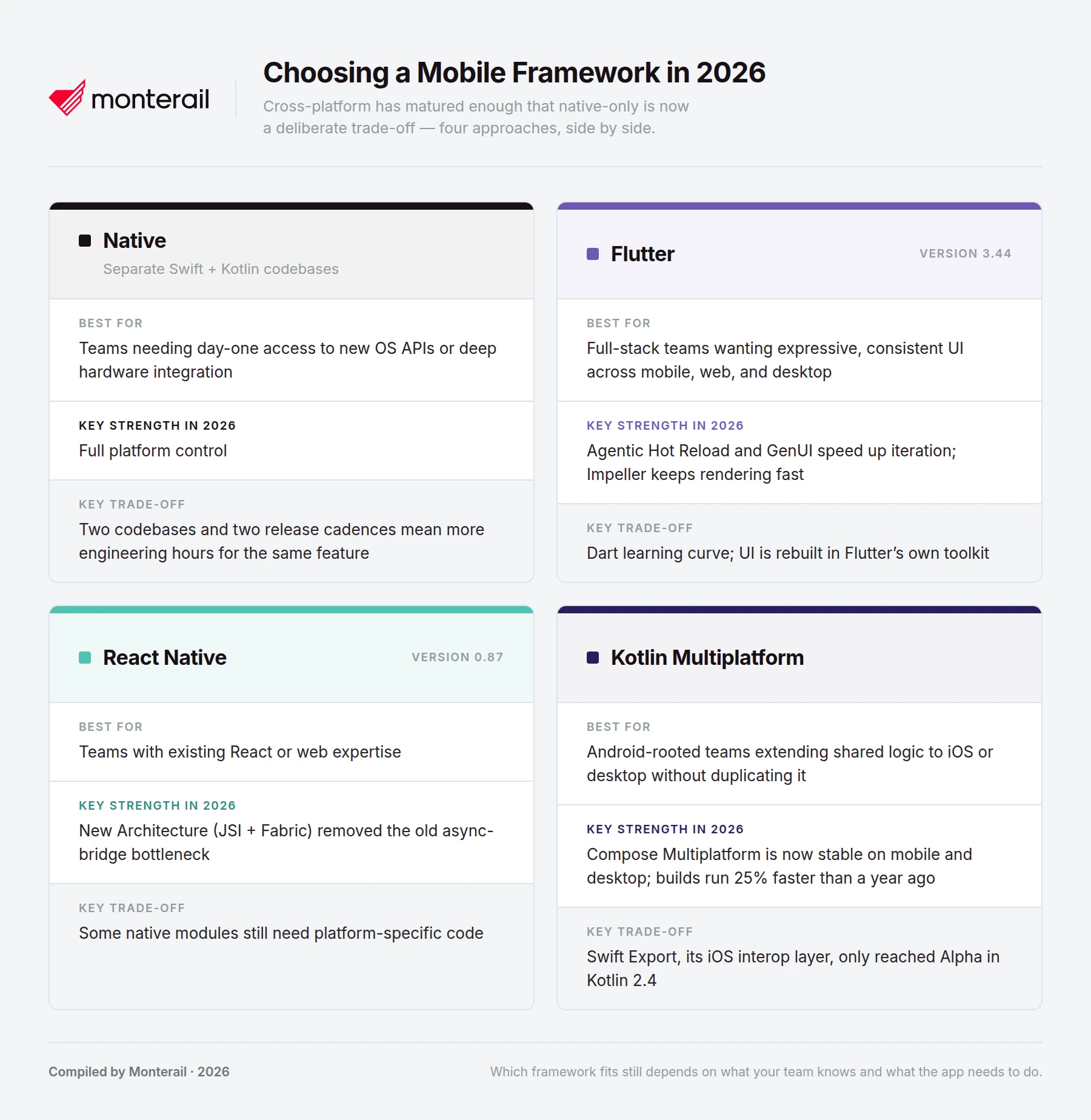
Cross-platform frameworks have matured enough in 2026 that "native-only" is now a deliberate trade-off, but which framework fits still depends on what your team knows and what the app needs to do.
How Are Mobile Development Frameworks Changing?
React Changes
For React Native, the change is architectural. The framework's old asynchronous bridge – the thing that made heavy animation or camera-processing work feel sluggish – is gone.
React Native's New Architecture replaces it with JSI, a direct JavaScript-to-native memory reference that skips serialization entirely, paired with the Fabric renderer for synchronous layout. It's been the default since version 0.76, and React Native 0.87, released in August 2026, ships Strict TypeScript by default plus experimental Swift Package Manager support.
In practice, that means camera- and video-processing features that used to need a native-module workaround can now run inside the shared codebase.
Flutter Changes
Flutter's shift is more about how UI gets built than how it runs.
Flutter 3.44 and Dart 3.12, announced at Google I/O 2026, introduced Agentic Hot Reload and Generative UI (GenUI) – interfaces the app assembles on demand instead of shipping pre-built – alongside continued rendering gains from Impeller. Flutter's widget-based toolkit still asks teams to learn Dart, but that cost buys UI consistency across mobile, web, and desktop from one codebase.
Kotlin Changes
Kotlin Multiplatform took the opposite bet: share the logic, keep native UI. That's changing too.
Compose Multiplatform, KMP's own UI layer, is now fully stable on mobile and desktop, so teams can share UI as well as business logic if they choose to.
Swift Export reached Alpha in Kotlin 2.4, making Kotlin-to-Swift calls read more like native Swift, and on JetBrains' own benchmark, builds now run 25% faster using under half the RAM they needed a year ago – a real cost line for teams paying per build minute in CI.
How On-Device and Agentic AI Are Changing What Apps Can Do
Apple and Google have both moved generative AI processing onto the device itself, and both frame it as much a trust argument as a speed one.
Apple's Siri AI, announced at WWDC26 and rolling out with iOS 27 this fall, can search a user's messages, email, and photos for personal context and answer questions about whatever's on screen.
It launches restricted on iPhone, iPad and Apple Watch in the EU and is unavailable entirely in China, though Mac and Vision Pro are unaffected.
Google's approach runs through Gemini Nano, a foundation model executing inside Android's AICore service, so tasks like summarization and proofreading happen locally instead of in the cloud.
The faster-moving shift is agentic, meaning AI that acts inside an app instead of answering inside a chat window. An agent that rebooks a flight, reconciles an expense line, or triages a support ticket without five manual taps is a different product decision than a chatbot bolted onto an existing flow, because AI logic now sits in the same layer as your core business rules.
That's why moving to an AI-native architecture is a structural decision. Monterail's own work on agentic workflow automation makes the same case for mobile: deployment pays off through strategic, focused integration.
Expanding Reach Beyond the App Store: PWAs, Super Apps, and Mini Apps
Progressive Web Apps
Progressive web apps remain the lowest-friction way to reach a mobile audience: no app-store review, no forced update cycle, only a single codebase reaching desktop, tablet, and phone alike – including on iOS, despite Apple's historically tighter PWA support. That makes PWAs a fit for teams validating demand or serving markets where app-store distribution adds real friction.
Super Apps
Super apps push the opposite direction: instead of minimizing footprint, they maximize it. WeChat, which Tencent's 2024 figures put at 1.371 billion users, hosts food ordering and payments inside one app through third-party mini-programs, and Grab's super app model runs a comparable approach across Southeast Asia.
Mini Apps
For most Western businesses, building a full super app isn't realistic – but shipping as a mini app inside an existing one is, and it buys access to a user base without the cost of acquiring it independently.
The trade-off is real: a mini-app lives inside someone else's platform rules and payment cut, which makes it a distribution bet.
How 5G, Edge Computing, and Spatial Computing Enable Real-Time Features
5G and edge computing solve a specific problem: processing data close enough to the user that latency stops being the ceiling on what a mobile feature can do.
That matters most where the round trip to a distant server carries a real cost – a wearable streaming vitals during a remote consultation, a fraud model scoring a payment before it clears, an AR overlay tracking a moving camera without lag.
Processing more of that closer to the device also keeps more sensitive data from leaving it, which feeds directly into the compliance picture below.
Spatial computing hardware has matured without fully arriving as a mass-market category. Apple's Vision Pro and Meta's Quest line remain the reference devices, both shipping developer SDKs and support for Unity and Unreal, but neither has replaced the phone as the primary mobile surface.
That makes AR/VR investment in 2026 a differentiator for specific use cases (3D product visualization, spatial training simulations) not a default line item on every mobile roadmap.
Implementation Constraints: Compliance, Delivery Model, and Partner Fit
Regulatory Exposure is no Longer Optional Homework
Most EU AI Act rules, including transparency and general-purpose-AI obligations, became enforceable on August 2, 2026, with deepfake and CSAM-generating-system prohibitions following in December.
The US has no federal equivalent – instead, 24 states have now enacted comprehensive privacy laws, up from 20 earlier this year; several of the newest (Alabama, Louisiana, Oklahoma, Vermont) aren't enforceable yet, which is exactly the kind of deadline a build needs ahead of time.
Delivery Model: When Low-code Earns its Place
Low-code and AI-native app builders are converging – Gartner's own market page now lists the segment in transition to "AI-Augmented Low-Code Application Platforms".
Still, the old boundary continues: these tools accelerate rapid MVPs where speed matters more than architectural control, and don't substitute for custom engineering once an app needs complex integrations or heavy scale.
Monetization Has to Be Built Into the Architecture
Spotify's four Premium tiers share one ad-free, offline-access entitlement (its separate Audiobooks Access plan deliberately doesn't); Calm gates its 300+ Sleep Stories and full music library behind one flag; Duolingo layers a free tier under paid Super Duolingo and a separate Max tier.
Each is a billing decision made before launch – retrofitting it afterward means rebuilding.
Partner Selection Still Decides Whether Any of This Ships
The criteria haven't changed: proven experience with the specific stack you're adopting, familiarity with your regulatory environment, and communication that surfaces risk before it becomes a missed deadline.
A partner that has already shipped in regulated sectors has built the compliance instincts above into their process – worth more at signing than a portfolio of demos.
How Do You Create a Mobile Strategy That Compounds Over Time?
The businesses getting the most out of 2026's mobile trends aren't the ones adopting the most trends. They're the ones treating each as a specific answer to a specific constraint: cross-platform frameworks for teams stretched across two codebases, on-device and agentic AI for products where latency or trust is the bottleneck, super apps and mini-apps for reach without a full rebuild, and compliance-by-design for anything touching EU or regulated US data.
Adopting every trend in this guide because it's in this guide is how a roadmap turns unfocused instead of ambitious – nine half-built bets rarely outperform three that were scoped properly and shipped well.
If you're weighing which of these fits your product and your team, Monterail's mobile development practice works through that trade-off with clients before a single line of code is written, the same way it does with Discovery Workshop scoping on any new engagement.
Key Takeaways
React Native's async bridge is gone; New Architecture (JSI + Fabric) has been the default since 0.76, removing the old graphics-heavy-app limitation.
Flutter 3.44 and a stable Compose Multiplatform mean "native-only" is now a deliberate trade-off in 2026.
On-device AI (Siri AI, Gemini Nano) and agentic AI that takes actions are separate strategic decisions worth planning independently.
EU AI Act rules are largely enforceable now, and 24 US states have their own privacy laws – design compliance in.
Low-code is converging with AI-native app builders, but it still fits MVPs and internal tools better than complex or heavily regulated products.
Mobile App Development Trends FAQ

Grzegorz Hajdukiewicz
Chief Delivery Officer

With over a decade of experience in the IT industry, Grzegorz has a proven track record of delivering complex projects on time and on budget. At Monterail, he leads a team of dozens of developers, designers, project managers, and business analysts, ensuring the successful delivery of software solutions for clients worldwide. Passionate about agile methodologies and continuous improvement, he constantly seeks new ways to optimize the delivery process.