Your product's claim sets the product model, and the sensor follows from that claim. Healthcare wearable app development means turning readings from an Apple Watch, an Oura ring, or a Garmin into coaching, clinical context, or a medical decision. A sleep coach and a contraceptive app can read the same overnight temperature. Only the contraceptive needs FDA authorization, because only it claims to prevent pregnancy.
Teams often add wearable data as one more feature, yet that choice picks the product model. Five models cover most of what founders build on consumer wearable data, and each comes with its own data setup, regulatory status, and ceiling. The data pipeline and consent screens follow from the model you pick, and so does the validation evidence you'll need. Choose it at the idea stage, or pay to build the product twice.
Executive Summary
Consumer wearables hand a health product raw signals, and regulators assess the software that interprets those signals by its intended use. Apple and Google keep phone-based health data on the device, while ring and band makers share data from their cloud services under their own approval rules. Both facts point the same way: fix the architecture before the first build. Founders who build consent and data records for their most ambitious target model can move up with far less rework.
What Data Can a Health Product Get From Consumer Wearables?
A health product can read activity, sleep, heart rate, and temperature, and where it reads them is the first technical choice. Wearable data sits in one of two places.
On the user's phone: On iPhone, HealthKit stores all data on the device. Android's Health Connect works the same way, behind Android permission screens. Your mobile app collects from that store and forwards data to your servers.
In the device maker's cloud: Oura, Whoop, Garmin, and Google let your server access a user's data through a wearable API after the user signs in and approves access. Oura recommends webhooks, automatic messages sent to your server when new data arrives.
Phone data requires an app that syncs in the background. HealthKit encrypts data while the phone is locked, which can block reads until it's unlocked. Cloud data can speed up a web-first launch, but vendors review apps; Oura and Whoop restrict access until approval. If users span iPhone, Android, and a ring, budget for both setups at launch.
Wearable Data Platforms Compared
Wearable API rules change often. The table reflects them as of October 2026.
Platform | Where the data lives | Access model | History limit | Key restriction |
|---|---|---|---|---|
Apple HealthKit (Apple Health API) | On the iPhone | Your iOS app requests each data type the user grants | None stated in Apple's docs | Data can't feed ads or go to data brokers |
On the Android phone | Android permission screens, per data type | 30 days back, more with the history permission | Background reads need extra permission | |
Google's cloud | User signs in with Google. Health data scopes are restricted | Not stated | Access requires a privacy and security review | |
Oura's cloud | User signs in with Oura. Your server gets change alerts | One history pull at first connection | Apps serve 10 users before approval. Gen3+ users need active membership | |
Whoop's cloud | User signs in with Whoop. Your server gets change alerts | Full history, fetched in batches | 10 members in sandbox. Each higher tier needs manual review | |
Garmin Connect cloud | Approval required. Garmin alerts you or pushes data | Backfill tool listed, no limit stated | Commercial use requires a license fee | |
Google's cloud | Fitbit Web API off from October 30, 2026 | Follows the Google Health API | Existing integrations must migrate | |
Aggregators, e.g. Terra | Vendor cloud, plus phone SDKs | One API that pushes data to your backend | One more processor holding user data |
Model 1: Personalization and Coaching Apps on Wearable Data
In Model 1, wearable data tailors recommendations, plans, or reminders to the person wearing the device. A sleep coach might move a wind-down reminder earlier after several short nights. Consumer-sensor accuracy is enough here, because nobody makes a medical decision from the output.
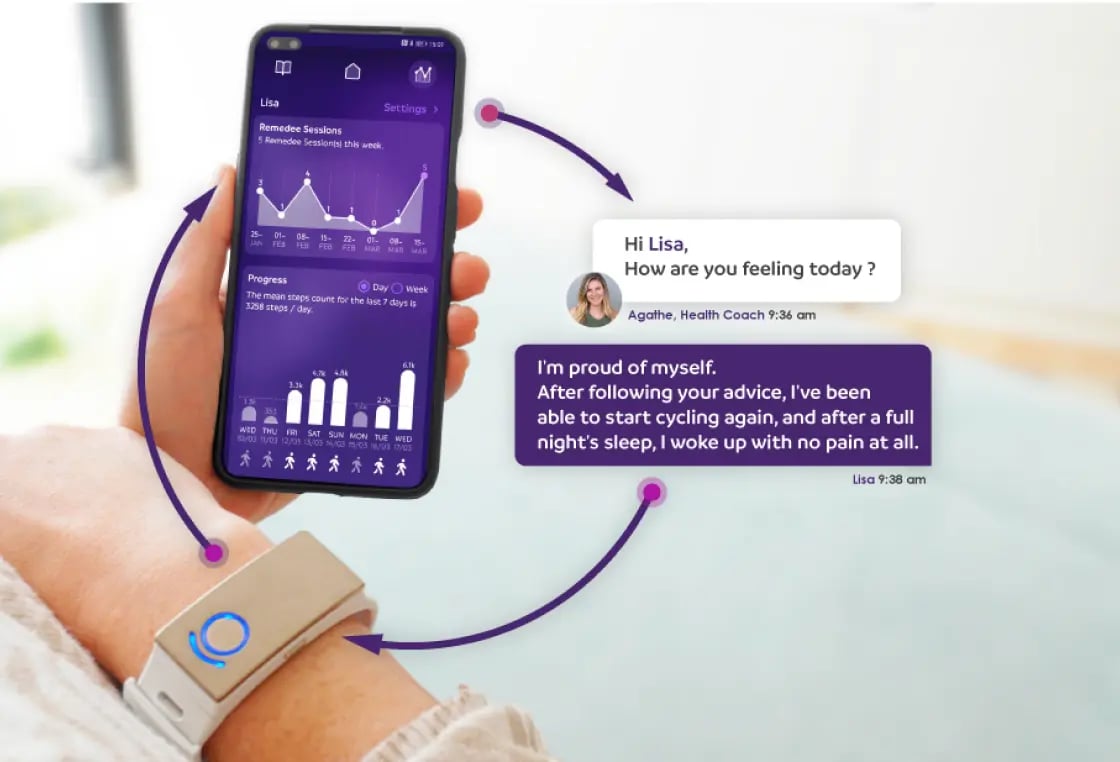
Personalization can also sit inside a regulated product. We built Remedee Labs' native iPhone and Android apps for a CE-marked Class IIa wristband for chronic pain. The wristband carries the medical claim, while data synced from Apple Health and Google Fit, such as sleep, activity, and sun exposure, feeds machine learning that tailors stimulation sessions. Every software change had to leave Remedee's ongoing clinical trials intact. Remedee Labs later received FDA Breakthrough Device designation.
 Source: Remedee Lab case study
Your claims decide if Model 1 remains in wellness territory. Under the FDA's guidance for low-risk wellness devices, revised January 6, 2026, non-invasive products that estimate values such as heart rate variability may qualify as wellness devices. To fit the policy, steer clear of disease claims, prompts for specific clinical action, and unvalidated clinical values. Regulatory attorneys Steven Gonzalez and Jennifer Newberger of Hyman, Phelps & McNamara explain what the update changed.
Claims about sleep, fitness, stress, or daily habits keep a product in this model, while a named condition moves it toward Model 3. Collect all claims in one list before writing onboarding copy, then screen notifications and store listings for condition names.
Model 2: Wearable Data as Context for Clinical Care
Wearable data can also reach a clinician as background, with diagnosis left to the clinician. The model ends where software starts flagging patients as abnormal.
Our team built Lifeness, a patient app for obesity treatment that integrates data from Apple Health and Google Fit. Over about six years, more than 1,000 patients across multiple clinics used it. Role-based access controls what admins, health professionals, and patients can see.
Once data enters care, privacy law follows the business relationship. HHS guidance for health app developers treats a developer hired by a provider to manage patients as a HIPAA business associate. A consumer-chosen app under the user's control generally falls outside HIPAA, and the FTC's Health Breach Notification Rule covers most such apps.
Under EU law, health data is a special category under Article 9 of the GDPR, so processing it requires explicit consent or another listed condition. Before a first clinic pilot contract, map which HIPAA and FDA rules apply to your app. Plan encryption, access logs, and data residency to meet healthcare data privacy requirements.
Model 3: A Medical Algorithm on Wearable Data (Software as a Medical Device)
In Model 3, software interprets wearable data to support a medical claim, making it a regulated medical device known as Software as a Medical Device (SaMD). The watch or ring stays a data source. Your algorithm carries the FDA submission, the evidence, and a quality management system.
Natural Cycles is the public reference case for regulated use of wearables in healthcare. The FDA granted it a De Novo authorization as birth control in 2018. De Novo is the FDA pathway for a novel device with no existing equivalent. Its own announcement recounts a 510(k) clearance in 2021 for Oura Ring data; a 510(k) clears a device by showing it is equivalent to one already on the market. In August 2023, a further 510(k) clearance let the app use Apple Watch temperature. The FDA summary cites a 272-user study comparing Apple Watch and oral thermometer temperatures.
Each new data source needed its own validation and clearance. Lock the device list in your labeling, and budget clinical validation per sensor.
Check whether your digital health app falls under device regulation before you commit to a sensor. Building your own hardware changes the picture, since connected health device software follows a different architecture and regulatory path.
Model 4: Collecting Wearable Data for a Future Model or Trial
Some products launch to collect data under clear consent and earn their clinical use in a later version.
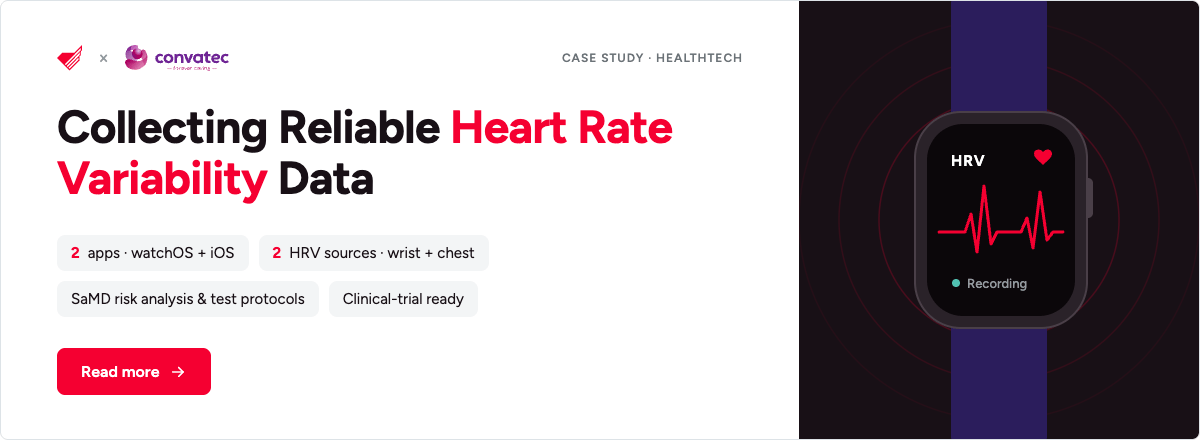
Convatec, a medical technology company, commissioned us to build an Apple Watch app for continuous heart rate variability monitoring, plus an iOS companion app.Convatec wanted real-world data for clinical trials and a way to explore how HRV correlates with catheter usage patterns.
Data quality was the hard part: we built the system to diagnostic-grade accuracy from both wrist and chest monitoring, and the scope included risk analysis and test-protocol preparation for SaMD certification. The finished system was ready for clinical trials, and the research helped Convatec start them with a different product configuration than first planned.
 Source: Convatec Case Study
For Infinant Health, the company behind a clinically studied infant gut microbiome probiotic, we ran a discovery engagement for a companion app for parents. The roadmap scoped version 1.0 as a data collection tool feeding future ML models, with cry, stool-photo, and breastfeeding analysis, and planned version 2.0 toward SaMD certification.
Our technical prototype validated an Apple Watch-to-iPhone pipeline with on-device audio capture for cry and breastfeeding analysis. Until that certification, the app was deliberately scoped to avoid giving medical advice.
Collected data remains reusable when consent covers research use, and Apple allows sharing HealthKit data for medical research once the user agrees. Include the device model, app version, and timestamps with every raw reading, plus a log of every change. Request research consent at sign-up, since asking existing users later is slower.
Expect due diligence questions about how reliable the data is and who owns its quality. Once your product makes a claim, your company owns that quality, as Natural Cycles demonstrated by running its own Apple Watch study.
Model 5: Wearable Integration as a Feature of a Health App
Model 5 covers products that do something else and connect to wearables because people expect their steps or sleep to show up. Booking, medication reminder, and rehab exercise apps fit here. Wearable sync is a core feature of modern health apps and rarely determines why people pay.
This model is the cheapest to start and the easiest to underestimate, because platform rules shift beneath it. As of October 2026, Fitbit shuts down its Web API on October 30, and Google keeps the Google Fit APIs running until the end of 2026.
Even this lightest form of wearable device app development needs a named owner for the integration and an annual review of each platform's rules. An aggregator like Terra helps when you need many brands quickly, but it means one more vendor holds your users' health data. Model 5 is sufficient when removing the wearable connection would leave your core value intact.
Can You Bill Remote Patient Monitoring With Consumer Wearables?
Usually not, because Medicare requires the monitoring device to meet the FDA's definition of a medical device. The CMS remote patient monitoring page adds that the device must upload data digitally. Most consumer wearables target wellness. Oura's terms of use state that its services are not a medical device, apart from features released as regulated. A ring or watch that a patient already owns rarely qualifies on its own.
If RPM payments sit at the center of your business model, get a reimbursement review from specialists before you scope the app. Consumer wearables can still add sleep or activity context next to qualifying devices. Teams planning a remote patient monitoring application should settle devices and billing partners before features.
Which Wearable Health Product Model Are You Building?
Your model is the one that matches the strongest claim you plan to make within two years. Find it in the table, then read the last column first.
Model | What the wearable data does | Public example | Regulatory status | Technical requirement | Where the model stops |
|---|---|---|---|---|---|
1. Personalization and coaching | Tailors plans, sessions, reminders | Remedee Labs app personalization | General wellness if claims avoid disease | Phone-side sync from HealthKit and Health Connect | Any diagnostic or treatment claim |
2. Context for clinical care | Gives clinicians background trends | Lifeness | HIPAA once a provider hires you. GDPR Article 9 in the EU | Role-based access, audit logs, clinician views | Software that flags or diagnoses |
3. Medical algorithm (SaMD) | Drives a medical output | Natural Cycles | Regulated device. Each data source authorized | Validated algorithm, fixed device list, quality system | Any sensor outside the authorized list |
4. Data for a future model or trial | Builds a reusable dataset | ConvaTec HRV app | Set by the trial and the later claim | Research consent, raw data with device metadata | The moment data drives a clinical decision |
5. Integration as a feature | Shows users their own numbers | Sleep Cycle, a phone sleep tracker importing steps | Follows the host product | Sync layer with a named owner | When users start relying on the numbers clinically |
Moving up a model makes wearable app development a second build. A jump from Model 1 to Model 3 usually brings new consent and a validated algorithm. Development records typically follow IEC 62304, the standard for how device makers build and document software. The data setup should also show where every reading came from. Code written for coaching seldom maintains those records.
Founders who already run a wellness MVP and now receive clinic requests should first check three things:
What your consent text allows.
Whether you kept raw data with device metadata.
Whether code changes trace back to requirements.
Those answers tell you whether to extend the current build or lay a new foundation for the clinical version.
To run that check more thoroughly, use our free SaMD: Building It Right the First Time self-assessment, curated with MAE Group for founders and teams preparing their first regulated product. It scores your product on architecture, regulatory groundwork, and team setup, with an optional block for AI features, and shows where the gaps are before a submission exposes them.
How Monterail Approaches Wearable-Data Products
Our portfolio includes 75+ health products, 15+ of them regulated devices—several involved wearables, from standalone Apple Watch apps to Apple Health integrations. We built Lifeness, which brought Apple Health and Google Fit data into obesity care for 1,000+ patients, and Remedee Labs' apps, which use the same sources to personalize therapy sessions. We helped Convatec build Apple Watch HRV monitoring for real-world data collection.
We build to IEC 62304, ISO 13485, HIPAA, and GDPR and prepare audit-ready documentation, so evidence for a regulated product grows with every release.
If you’re not sure which model you’re building, or which product decisions will shape your regulatory path, start with our webinar When You Design the Software, You Design the Regulation. Our HealthTech Director Piotr Zając and Janet Kwiatkowski of MAE Group, our regulatory and commercialization partner, show how early architecture and data decisions turn into the evidence a submission needs. Then bring your questions to us. We cover the software side and bring in MAE Group for the regulatory pathway and commercialization.
Key Takeaways
Healthcare wearable app development starts with the claim, because the claim picks the model and the sensors follow.
HealthKit and Health Connect keep data on the phone, while Oura, Whoop, Garmin, and Google share it from their clouds after approval.
Model 1 can rely on the FDA's wellness guidance as long as its claims avoid disease. Model 3 makes your software the medical device.
Natural Cycles needed a separate clearance for each new wearable data source.
Consent, raw data records, and traceability planned at launch decide whether moving up a model means an extension or a rebuild.
Strategic Takeaway: Let the Claim Shape the Build
A wearable health product's data foundation outlasts its first feature set. Design version one around the records your two-year target model will need, even if that version is a coaching app. A product built that way can take on new devices and clinic partners, and later a regulatory submission, without a rewrite.
Talk to our HealthTech team and bring your claim list and the wearables your users own. Together, we map which of the five models fits and what your first build has to record. To start, send us your project details.