The New Default. Your hub for building smart, fast, and sustainable AI software

Table of Contents
Vue.js development services help companies ship web products faster and maintain them more cheaply, because Vue's component model, official tooling and gentle learning curve cut the time between an idea and a working, maintainable feature. The framework is easy to like for developers, but the decision to use it usually sits with a founder, CTO or product owner who cares about launch dates, hosting bills and hiring. This article translates Vue's technical features into those business consequences, shows where they paid off in real projects, and names the cases where Vue isn't the right call.
Executive Summary
Vue.js is a mature, actively maintained JavaScript framework that lets teams build fast, maintainable web applications with less custom code and a shorter onboarding curve than heavier alternatives. Its business value comes from four places: faster time-to-market, faster pages that convert better, lower long-term maintenance costs, and the ability to modernize a legacy app piece by piece instead of rewriting it. The trade-offs are real, though: React still has a much larger hiring pool, and teams on Vue 2 are running unsupported code. Vue fits best when you want a lean team to ship and iterate quickly on a web product.
Why Do Companies Choose Vue.js Development Services in 2026?
Companies choose Vue.js because the framework stays out of the way of delivery. Teams that adopt it rarely leave: in Monterail's State of Vue.js Report 2025, which surveyed 1,428 developers and CTOs, 93% said they were likely or very likely to use Vue for their next project.
The business chain behind that loyalty is short. A framework with official, well-documented answers to routing, state management and builds means fewer architecture debates and fewer homemade workarounds. That shows up as shorter release cycles and a codebase new hires can read in their first week, which in turn means lower cost per feature and less dependence on one or two senior people who "know how it works."
Vue is also a safe long-term bet. It's been in production use for over a decade, Vue 3 is the current stable line (Vue 3.5 at the time of writing), and the core team is working on Vapor Mode, a compilation strategy aimed at even faster rendering that's still in release-candidate stage in Vue 3.6.

What Are the Business Benefits of Vue.js Development Services?
1. How Does Vue.js Make Web Pages Faster and Convert Better?
Vue.js renders pages efficiently out of the box, so a well-built Vue app loads and responds quickly without months of performance tuning. Its compiler analyzes templates at build time and its reactivity system updates only the parts of the page whose data changed, rather than re-rendering whole screens. Vue also supports async components and route-level code splitting, so users download the code for the screen they're on, not the entire application.
Speed matters because it moves revenue. In Google's Core Web Vitals case studies, Vodafone Italy improved its Largest Contentful Paint by 31% and saw 8% more sales. Faster loading pays off most in e-commerce, SaaS onboarding flows and content-heavy sites, where every extra second costs sign-ups or orders.
Framework choice alone won't guarantee a fast app; heavy third-party scripts and unoptimized images can slow down any stack. For the practical side, see our guide on how to maximize Vue.js performance.
2. How Does Vue.js Shorten Time-to-Market?
Vue.js shortens time-to-market by removing setup and boilerplate work. Single-File Components keep a component's template, logic and styles in one file, so developers spend less time jumping between files. The v-model directive keeps form inputs and application data in sync without hand-written event handling. Vite, the build tool created by Vue's author, starts a dev server in seconds and reloads changes almost instantly, and first-class TypeScript support catches whole classes of bugs before they reach testers.
Sprii, a live-shopping platform, needed to find product-market fit for its proof of concept as fast as possible. The Vue.js PoC Monterail built grew into a full web application that is now used by more than 700 retailers and handles 2 million orders a year, according to the Sprii case study.

3. How Does Vue.js Lower Long-Term Maintenance Costs?
Vue.js lowers maintenance costs by pushing teams toward small, reusable components with clear boundaries. Each component owns a piece of the interface and its logic, so a bug fix or redesign touches one place instead of ten. Pinia, Vue's official state management library, keeps shared data in predictable, typed stores that are easy to debug.
The financial effect is less technical debt. A tidy component structure means new features don't get slower and riskier to build as the product grows, which is what usually drives up maintenance budgets in year two and three of a product's life.
4. Can Vue.js Modernize a Legacy App Without a Full Rewrite?
Yes. Vue.js was designed to be incrementally adoptable: you can mount a Vue app on a single part of an existing server-rendered page and leave the rest of the system as it is. That lets you upgrade an outdated codebase screen by screen, ship improvements to users along the way, and avoid the cost and risk of a big-bang rewrite.
GitLab is a well-known example: its frontend guide describes mounting Vue apps into its Rails and HAML pages. The same guide also carries a lesson from experience, as GitLab now discourages scattering many small Vue apps across one page. Incremental adoption works best with a plan for where the boundaries between the old and the new code sit.
5. Will Vue.js Scale From an MVP to an Enterprise Product?
Vue.js scales from a quick MVP to a large product without forcing a framework switch. You can start with a few components and add routing, state management, server-side rendering and a design system as the product grows, all with official or widely adopted tools.
What usually limits scale isn't the framework but the architecture around it: module boundaries, shared component libraries and test coverage. If you're weighing Vue for a large organization, our analysis of whether Vue.js is enterprise-ready covers the questions an enterprise buyer should ask.
6. How Does Vue.js Improve Developer Productivity and Onboarding?
Vue.js makes developers productive quickly because its templates look like plain HTML and its official documentation is thorough and kept up to date. A developer who already knows JavaScript can usually contribute to a Vue codebase within days. Vue DevTools lets them inspect components, state and performance in the browser, which shortens debugging.
For the business, faster onboarding means lower ramp-up cost for each new hire or contractor, and less risk when team members change.
7. What Does the Vue.js Ecosystem Save You?
The Vue.js ecosystem saves you from building and maintaining common infrastructure yourself. Routing (Vue Router), state management (Pinia), builds (Vite) and full-stack rendering (Nuxt) are official or closely aligned projects, so they're designed to work together and are updated in step with the framework. That's an advantage over stacks where every team assembles its own mix of third-party libraries and then owns the upgrade pain.
The project is no longer the one-person effort it was in its early days. It has a full core team, a large community, and VoidZero, a venture-funded company founded by Vue's creator Evan You to develop Vite and the tooling around it.
8. Is Vue.js Good for SEO?
Vue.js is good for SEO when paired with server-side rendering. A purely client-side single-page app sends search engines an almost empty page that has to be filled in by JavaScript, which can delay or weaken indexing. Nuxt, the full-stack framework built on Vue, renders pages on the server or at build time and lets you choose a rendering strategy per route, so marketing pages are fully crawlable while logged-in screens stay dynamic.
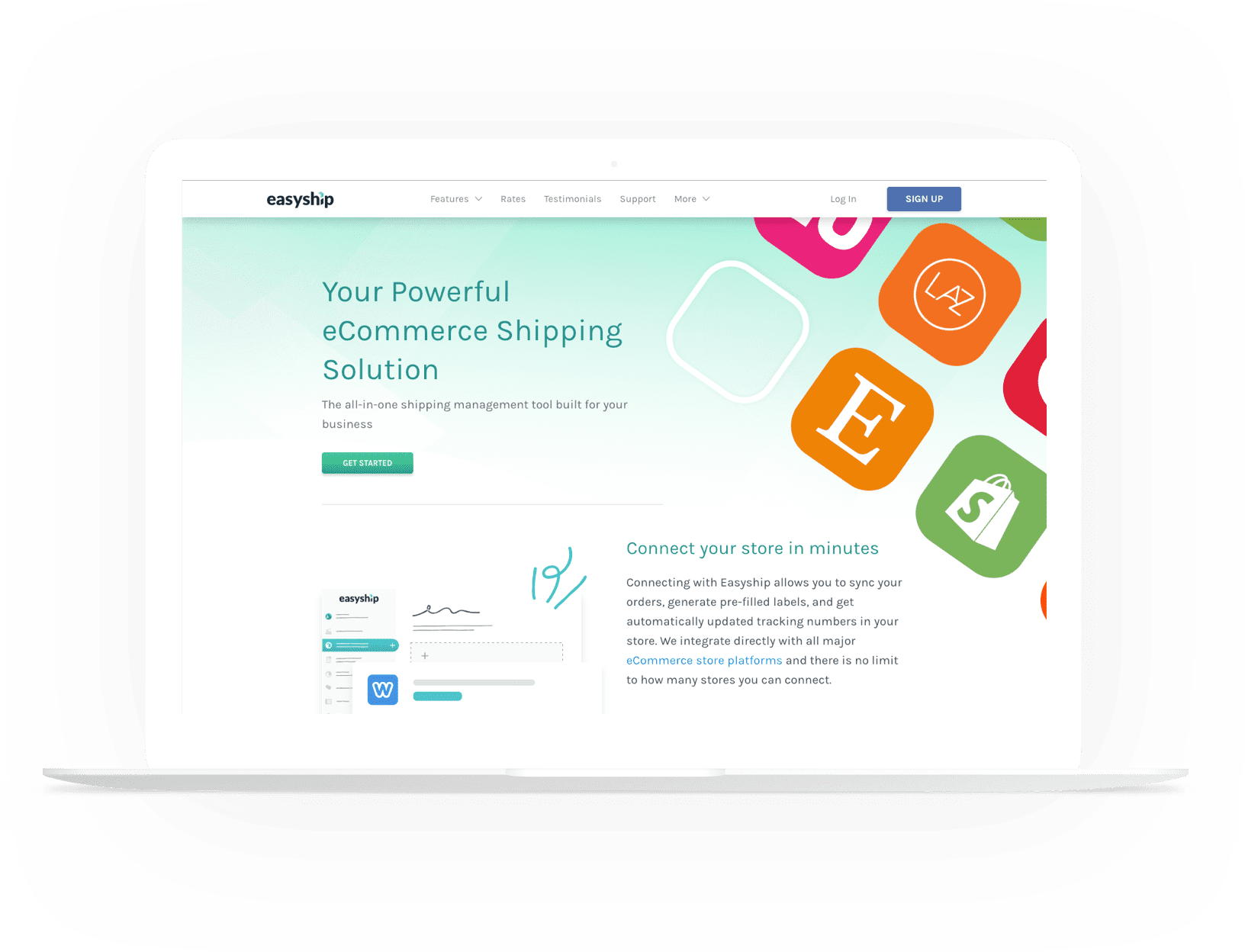
Easyship, a shipping platform, had Monterail rewrite its website in Vue.js with Nuxt. The new site improved conversion rates by 36% and loading performance by 37%, and brought in 14% more organic traffic, as described in the Easyship case study.
9. Does Vue.js Make Web Applications More Secure?
Vue.js protects against a common class of front-end attack, cross-site scripting (XSS), by default: according to Vue's security guide, content in templates and dynamic attribute bindings is automatically escaped, so user-supplied text can't run as code.
That protection has limits your team needs to know. Rendering raw HTML with v-html, binding user-provided URLs, or building templates from user input all bypass it. Cross-site request forgery (CSRF) and SQL injection are backend concerns that no front-end framework solves. Vue gives you safe defaults, but applications that handle financial or health data still need secure backend design, authentication and regular security reviews.
Which Companies Benefit Most From Vue.js Development Services?
Vue.js fits a wide range of products, but the reasons differ by company type:
Company type | Why Vue.js fits | What to watch |
|---|---|---|
Startups building an MVP | Fast setup with Vite, quick onboarding, small team can cover the whole front end | Plan the component structure early so the MVP code can grow into the product |
SaaS companies | Reusable components and Pinia keep large, data-heavy dashboards maintainable | Agree on a shared component library before several teams build in parallel |
E-commerce and content sites | Nuxt delivers server rendering for SEO and fast page loads | Third-party scripts (analytics, ads, chat) can erase speed gains |
Enterprises with legacy web apps | Incremental adoption lets you modernize screen by screen | Define clear boundaries between old and new code |
FinTech and other regulated products | TypeScript support and safe-by-default templates | Security and compliance depend on backend and process, not the framework |
When Is Vue.js Not the Right Choice?
Vue.js isn't the best choice for every company, and a good development partner should tell you when that's the case.
The biggest trade-off is the talent pool. In the Stack Overflow Developer Survey 2025, 46.9% of professional developers reported working with React, against 18.4% for Vue.js. If you plan to hire a large in-house front-end team quickly in your local market, React gives you more candidates to choose from.
Native mobile is another limit. If a mobile app is central to your product and you want to share code between web and mobile, React with React Native is the more established path; Vue's options for native mobile are less mature.
Finally, if your product still runs on Vue 2, you carry a risk that's easy to overlook: Vue 2 reached end of life on December 31, 2023, and no longer receives official security fixes. Over 35% of respondents to the State of Vue.js Report 2025 had still worked with Vue 2 in the previous 12 months. Budget for a migration to Vue 3, or for paid extended support, rather than treating it as a someday task.
Key Takeaways
Vue.js speeds up delivery mainly through official, integrated tooling: Vite, Pinia, Vue Router and Nuxt.
Faster pages translate into revenue, but only if third-party scripts and images are kept in check too.
Incremental adoption lets you modernize a legacy app screen by screen instead of funding a risky rewrite.
For SEO-critical pages, use server-side rendering with Nuxt rather than a client-only single-page app.
React offers a far bigger hiring pool, so weigh how you'll staff the team, not just the framework.
Vue 2 has been unsupported since the end of 2023; any Vue 2 code is a security and maintenance liability.
How Do You Get the Most Out of Vue.js Development Services?
Vue.js pays off when it's used for what it's best at: shipping and evolving web products quickly with a lean team, on a codebase that stays maintainable as it grows. Getting there takes a deliberate component architecture, server rendering where SEO matters, a migration plan for any Vue 2 code, and honest security practices around the framework.
Monterail is an Official Vue.js Partner and has built Vue products for companies like Sprii and Easyship. If you're deciding whether Vue fits your product, or need a team to build or modernize a Vue app, talk to our Vue.js team.
Vue.js Development Services FAQ

Joanna Staromiejska-Drwięga
Marketing Strategy Specialist

Joanna Staromiejska-Drwięga is a T-shaped marketer with over 10 years of experience in B2B tech marketing. As a Marketing Strategy Specialist at Monterail, she drives growth through multi-platform campaigns and cross-functional collaboration. Joanna holds a degree in International Business and Management. Her work spans landing pages, ebooks, and in-depth guides, including the well-known State of Vue reports.